 SwitchMyTool

My verdict
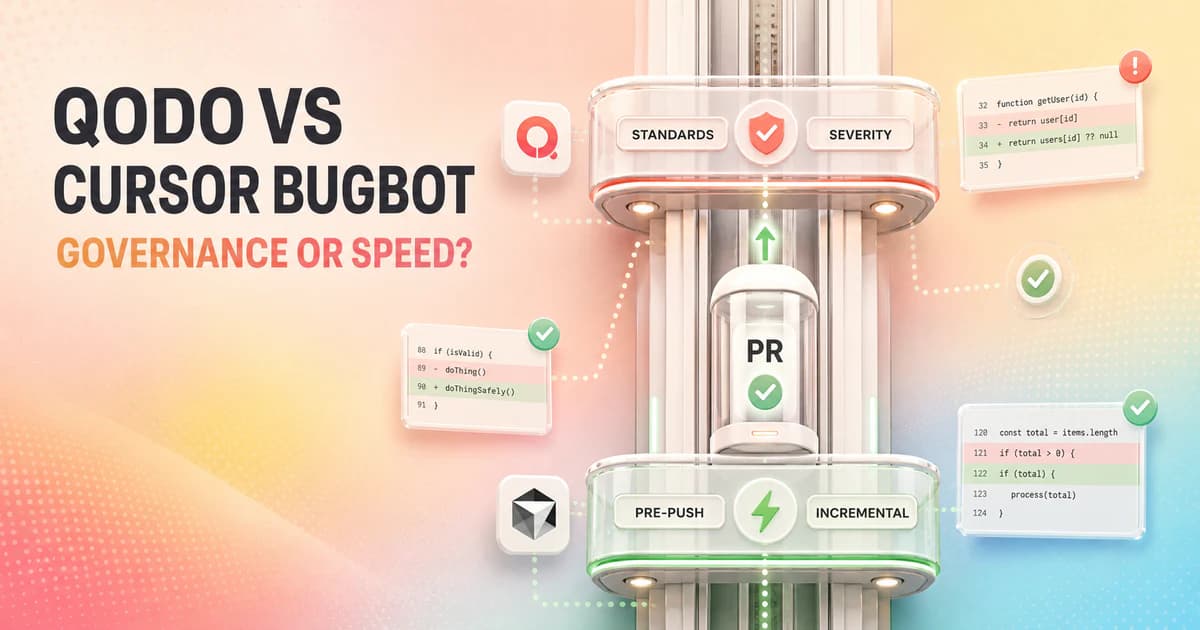
Qodo governs review. Bugbot compresses the Cursor loop.
I choose Qodo when review has become an organization problem. Its useful controls are severity, review effort, comment visibility, specialized agents, repository standards, and cross-repository context. The product helps a platform or quality lead make the same expectations visible across teams.
I choose Cursor Bugbot when the team already builds in Cursor and wants feedback before a pull request reaches the queue. The pre-push commands, automatic PR review, incremental checks, and route from a finding to an agent-assisted fix make the loop shorter. That convenience is real.
The tradeoff is separation. Qodo can act as an independent reviewer alongside whichever editor generated the code. Bugbot lives in the same product family that may have written a large share of the diff. I am comfortable with that for ordinary changes when a human still approves the merge. For security-sensitive work, I prefer more independent evidence.
My Qodo vs Cursor Bugbot verdict is therefore conditional. Qodo is the stronger governance choice. Bugbot is the faster Cursor-native choice. Neither earns merge authority, and neither excuses weak tests.
If neither workflow sounds right, my guide to Qodo alternatives compares seven review approaches, from repository-context specialists to deterministic quality gates.
The real difference
One product standardizes judgment. The other moves judgment closer to the edit.
Qodo starts from the pull request as a team artifact. Several specialist agents can inspect different risks, after which findings are combined, ranked, and presented with controls for depth and visibility. I can shape what reaches the developer and what the organization considers severe.
Bugbot starts from the developer's loop. Cursor now supports /review, /review-bugbot, and /review-security before code is pushed. When that same diff later becomes a GitHub or GitLab pull request, Bugbot can recognize the prior review and avoid repeating it. The feature is small on a comparison sheet and important in practice.
Both products support rules, repository context, automatic review, and remediation. This is not a tidy list where one has context and the other does not. Product emphasis is the difference. Qodo makes review policy legible. Bugbot makes review timing and remediation feel like part of coding.
I choose based on the bottleneck. If postmortems say teams knew the standard but enforced it inconsistently, I lean Qodo. If developers wait until the pull request to discover an obvious logic mistake, I lean Bugbot.
At a glance
Qodo vs Cursor Bugbot feature comparison
| Decision | Qodo | Cursor Bugbot |
|---|---|---|
| Core job | Runs a multi-agent review process, ranks findings by severity, and gives teams controls for standards, effort, visibility, and governance. | Reviews pull requests inside the Cursor workflow, catches logic and security issues, and can hand findings to an agent for a fix. |
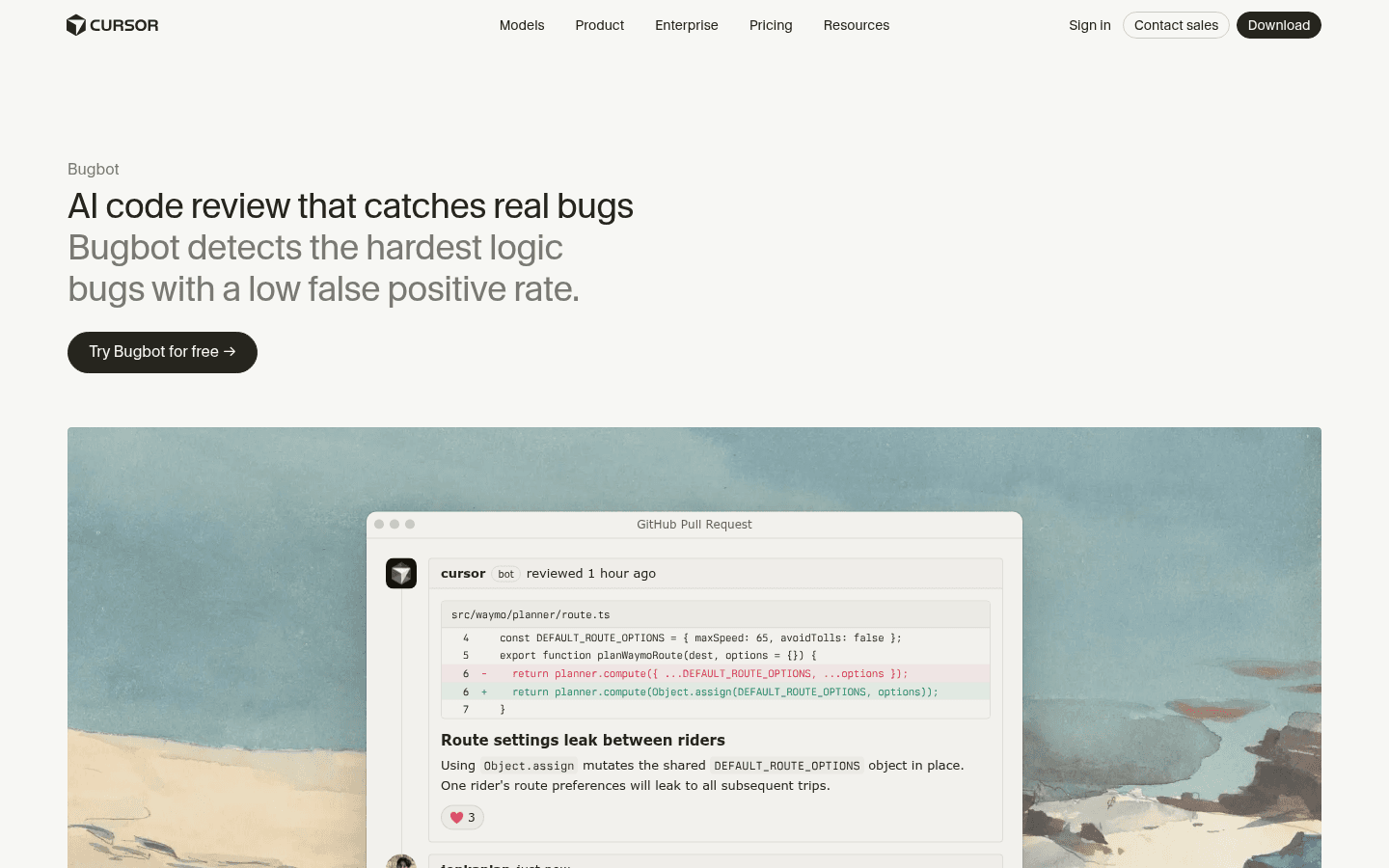
| Earliest review point | Usually starts when a pull request is opened, published, or updated. | Can run before a push with /review, /review-bugbot, and /review-security, then sync the same diff with GitHub or GitLab. |
| Context | Uses the full repository, history, standards, architecture, and optional cross-repository context. | Uses repository rules, team rules, BUGBOT.md, the pull-request diff, and Cursor's surrounding coding context. |
| Tuning | Review effort, verbosity, finding location, ignored content, severity thresholds, and repository guidelines. | Effort levels, automatic or manual triggers, only-review-what-is-new behavior, rules, block lists, and feedback. |
| Remediation | Discuss, dismiss, commit suggested fixes, or apply remediation from a finding. | Fix findings in Cursor or hand them to a Cloud Agent through Bugbot Autofix, which Cursor labels beta. |
| Price shape | Pro Team starts at $30 with pooled credits at $0.012 each, no repository or review rate limits, and a customer-set overage cap. | Usage based. Cursor says an average run costs about $1 to $1.50, depending on pull-request size and complexity. |
| Best fit | Teams that need one review policy across repositories, visible severity, and a reviewer that stands apart from the coding editor. | Cursor-first teams that value pre-push checks, fast incremental review, and a short path from finding to agent-assisted fix. |
A longer feature list does not settle this decision. Every automated comment has a review cost because somebody must read it, verify it, dismiss it, or change code. The reviewer that produces fewer but better-supported findings can beat the one that appears more active.
I score an accepted finding only when it changes code, adds a useful test, prevents a known regression, or records a decision the team needed. Summaries and compliments are pleasant. They are not the unit I use to justify procurement.
Review workflow
Bugbot can enter earlier. Qodo gives the review queue more structure.
Qodo can run when a pull request is published or updated. Findings explain what needs attention, why it matters, and how to fix it, then the developer can discuss, dismiss, commit a suggestion, or ask Qodo to remediate the issue. Severity and review effort help me keep the queue proportional to risk.
Bugbot can review automatically on pull requests or run on demand. The newer pre-push flow catches a problem while the code and intent are still in the developer's head. Cursor also offers an only-review-what-is-new option, which matters when a large pull request receives several small updates.
Bugbot Autofix can pass a finding to a Cloud Agent, but Cursor currently labels that path beta. I treat the result as another proposed change, not as proof the original issue is solved. The fix needs tests, a diff review, and human approval, especially when the same vendor produced the diagnosis and the patch.
I do not run the deepest AI review after every save. Formatting, types, known security rules, dependencies, and tests belong in deterministic CI. I reserve AI effort for logic, missing cases, architectural mismatches, and changes whose impact crosses files.
Context and rules
Context only helps when the repository contains the truth.
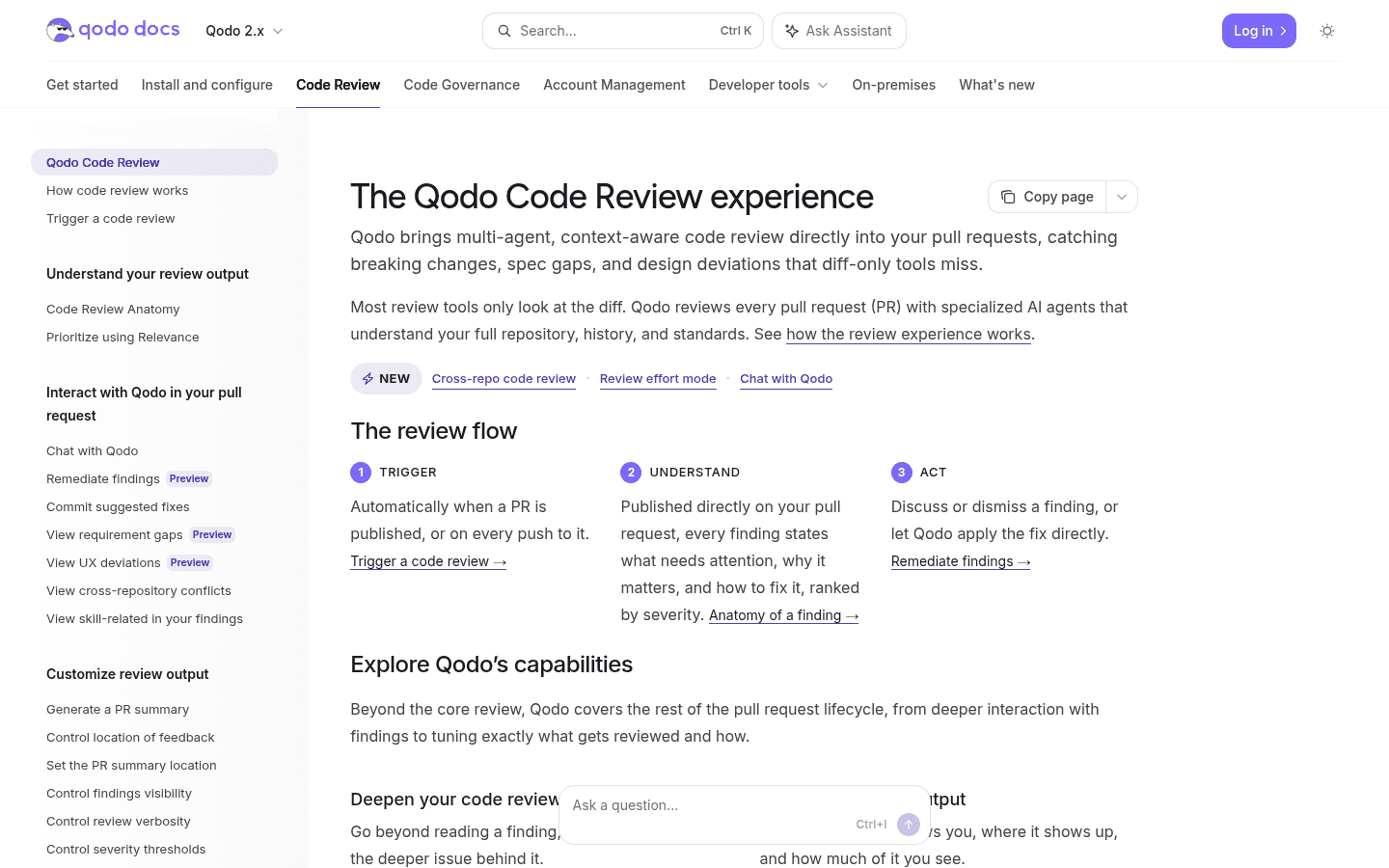
Qodo says its review agents use the full repository, history, standards, architecture, and optional cross-repository context. That is attractive in a service-heavy system where a schema or SDK change crosses repository boundaries. I also value the ability to rank findings by severity rather than presenting every observation as equally urgent.
Bugbot supports repository rules, team rules, and BUGBOT.md. That gives a Cursor team several places to encode conventions. I keep the rules short and testable: name the files they apply to, describe the invariant, and give one useful example. I do not ask an AI reviewer to enforce spacing or import order.
The hardest context still lives outside code: customer exceptions, operational history, regulations, and architecture that exists only in someone's memory. No reviewer can retrieve a rule the team never wrote down. I move important invariants into tests, short architecture notes, rule files, or comments beside deliberately strange code.
I also watch for stale rules. A rule that once protected a migration can become a source of confident nonsense six months later. One person must own cleanup, otherwise the reviewer gradually becomes a museum of old decisions.
- Write rules as observable constraints, not broad style preferences.
- Exclude generated files, vendor code, snapshots, and lockfiles unless they are the purpose of the change.
- Ask findings to cite impact and evidence from the repository.
- Test one cross-file regression and one cross-repository contract change.
- Keep authentication, billing, and data-handling changes under independent human review.
Pricing and limits
Qodo sells a shared credit pool. Bugbot charges for each review run.
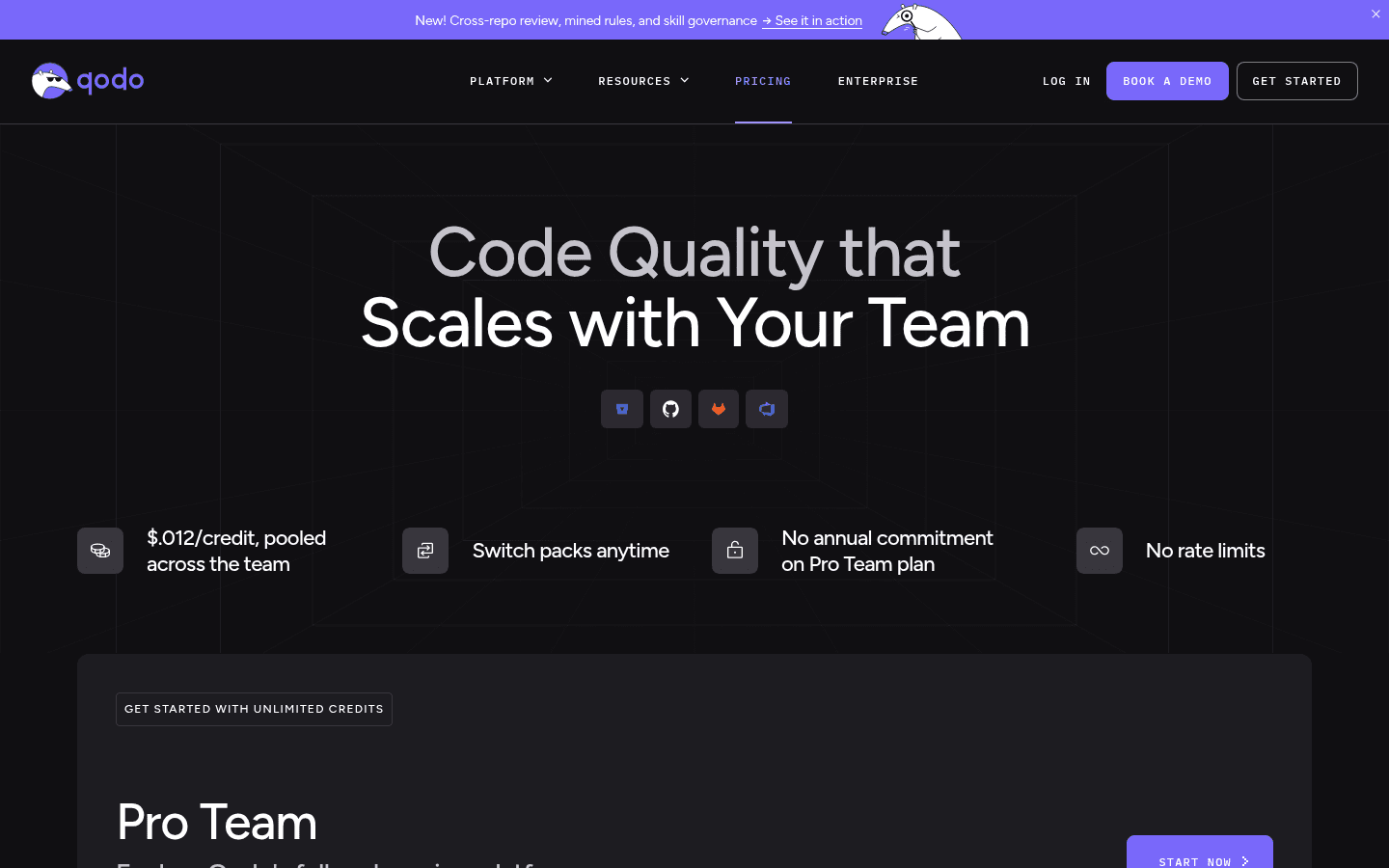
Qodo Pro Team currently starts at $30. The pricing page lists pooled credits at $0.012 each, lets teams change packs, and says there are no repository or review rate limits. Credits expire at the end of the monthly cycle, and the Pro Team plan is designed for up to 30 users. Teams can set an overage cap.
The pool works well when review activity is uneven because a busy developer can use more capacity without wasting a quiet seat. Forecasting still takes work. Review effort, repeated updates, large diffs, and cross-repository checks can turn a tidy starting price into a less tidy operating budget.
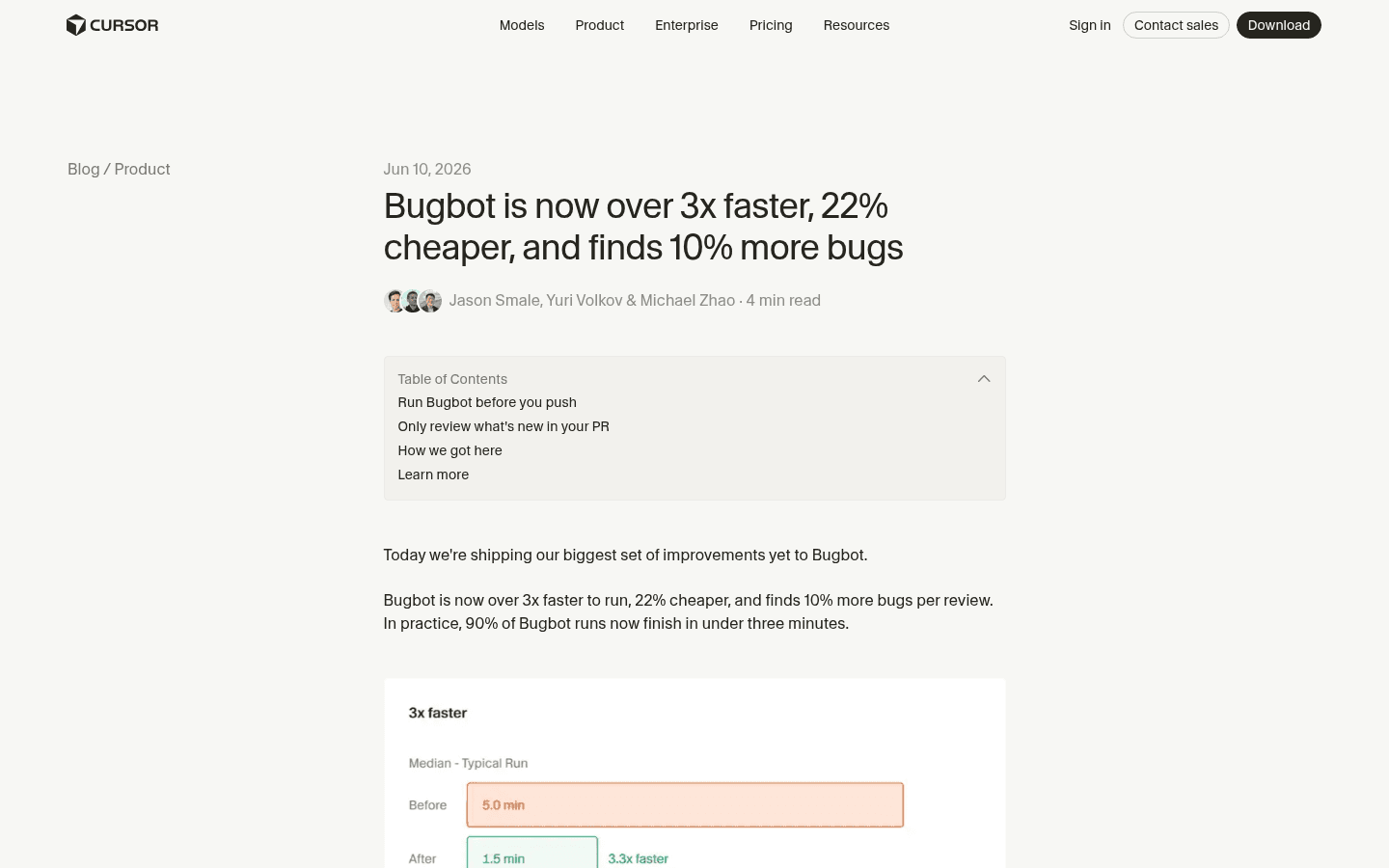
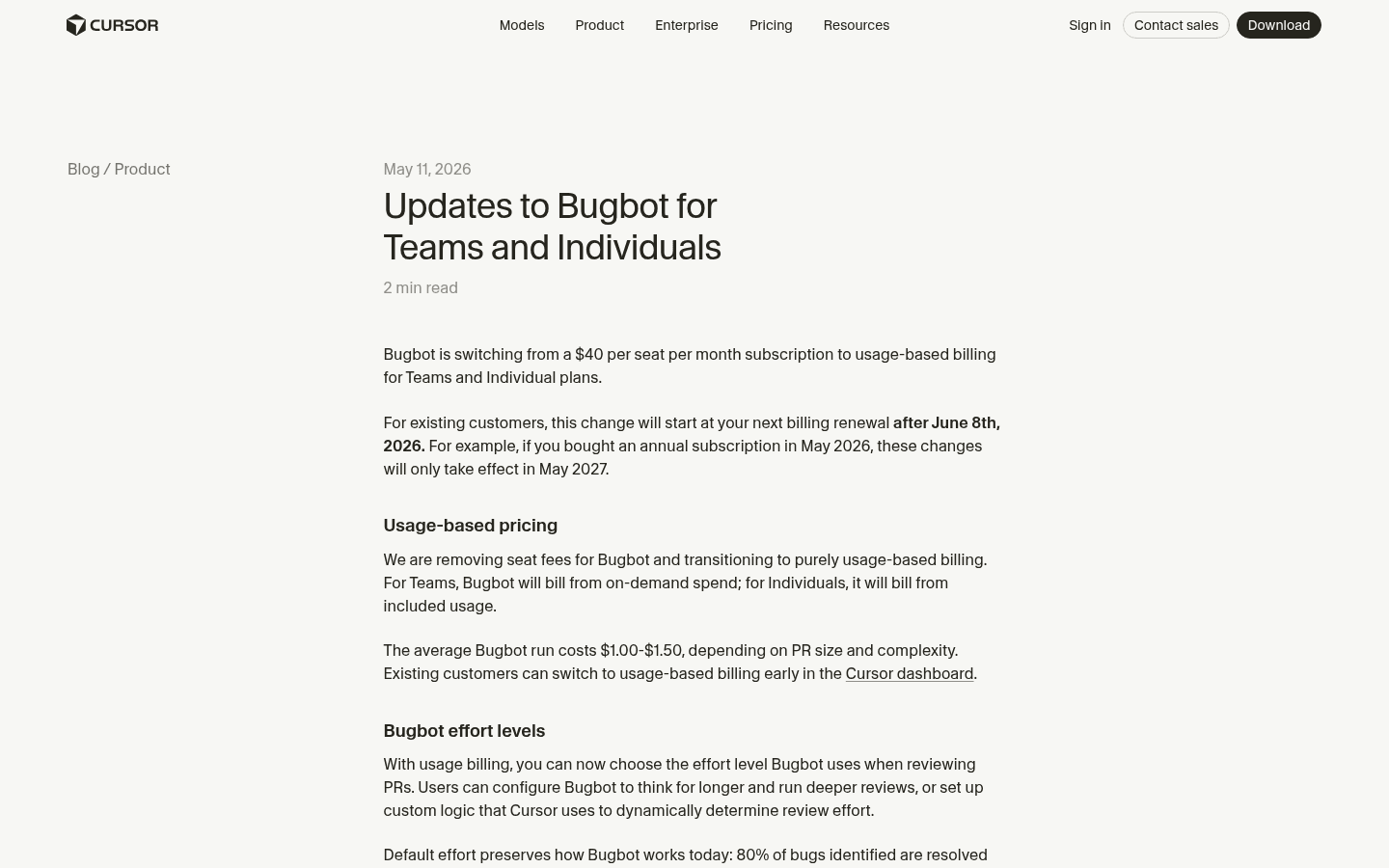
Cursor moved Bugbot from a $40 per-seat subscription to usage-based billing for renewals after June 8, 2026. Cursor says an average run costs about $1 to $1.50 depending on pull-request size and complexity. Teams draw from on-demand spend, while individuals use included usage. Effort levels trade cost for review depth.
The average is not a cap. A team that pushes seven times, automatically reviews every update, and requests deep effort can pay for several passes over one piece of work. The recent Reddit report of almost $300 in 14 days is not a benchmark, but it is a useful warning to configure triggers and spend limits before inviting the entire organization.
I model three months: normal volume, release-week volume, and one large migration. Then I divide total spend by accepted findings rather than by runs. Cheap comments that nobody trusts are expensive.
Fit before features
Choose the reviewer that matches who owns quality.
- Choose Qodo
- I need consistent review policy across several teams, explicit severity, configurable review depth, cross-repository context, and a reviewer that is not tied to one editor.
- Skip Qodo
- I want a permanent free team tier, dislike forecasting pooled credits, or have a small repository where tests and deterministic checks catch most regressions.
- Choose Bugbot
- My team already works in Cursor and wants review before push, automatic pull-request checks, incremental review, and a direct route from a finding to a proposed fix.
- Skip Bugbot
- My developers do not use Cursor, I need a flat review budget, or I want stronger separation between the tool generating code and the system judging it.
- Keep human review
- The change touches authorization, payments, personal data, concurrency, migrations, compliance, or a business rule that is not fully encoded in the repository.
A five-person Cursor team can adopt Bugbot with relatively little ceremony. The team already understands the editor, agents, repository configuration, and billing account. A platform organization with many repositories may get more leverage from Qodo because standards and severity need an owner above any single editor.
I also ask whether independence matters. If Cursor writes code, reviews it, and proposes the fix, one tool family controls the whole loop. That can be efficient. For critical code, I want a human and deterministic checks from outside that loop. Qodo is not automatically unbiased, but it creates more operational separation.
Customer research
Reddit complaints become my pilot checklist.
The recurring complaint is context depth. Developers like that Bugbot can find real issues, then notice it misses a contradiction spread across another service or a private local pattern. Qodo users report the same class of problem when an in-house library or legacy convention is poorly documented.
The second complaint is review noise. A plausible edge case is not automatically useful. I measure whether comments cite evidence, whether duplicates disappear after new commits, and whether developers still read the reviewer after four weeks.
The third complaint is cost visibility. Usage-based review feels harmless one run at a time. It becomes material when automatic triggers meet frequent pushes and large pull requests. Pooled credits have a different forecasting problem, but they still need an owner and an alert.
I discount threads that read like launch copy, affiliate promotion, or a benchmark without reproducible details. Specific failure stories help me design tests. Popularity does not tell me which reviewer understands my repository.
Switching cost
Installation is easy. Rebuilding trust is the migration.
| Work | What I migrate | Cost |
|---|---|---|
| Permissions and identity | Install the challenger on two lower-risk repositories. Review GitHub or GitLab permissions, Cursor team identity, data handling, retention, and model controls. | Medium |
| Rules | Translate Qodo guidelines into repository rules, team rules, or BUGBOT.md, or move Bugbot rules into Qodo guidelines. Delete preferences that belong in a formatter. | Medium |
| Trigger policy | Decide whether review runs before push, on every pull-request update, only on new commits, or manually for high-risk changes. | Medium |
| Budget model | Replay a normal month against Qodo credit packs or Bugbot runs and effort levels. Include repeated pushes and unusually large pull requests. | Medium to high |
| Comment baseline | Record accepted findings, false positives, duplicates, missed seeded regressions, cleanup time, and cost before changing the default reviewer. | High |
| Team habit | Set who owns rules, who dismisses weak findings, when a human enters, and whether an agent-generated fix needs a second reviewer. | High |
Moving from Qodo to Bugbot is easiest for an already standardized Cursor team. The harder work is translating severity, review effort, cross-repository expectations, and comment policy into Cursor rules and trigger settings without losing the useful separation Qodo provided.
Moving from Bugbot to Qodo means giving up some editor-native speed. The team must decide when Qodo runs, how findings are ranked, which agents matter, and how developers move from a finding to a fix. I keep the old reviewer active until the challenger proves itself on the same pull requests.
I preserve branch protection, human approvals, tests, static analysis, dependency checks, and secret scanning throughout the migration. An AI reviewer adds evidence. It does not become the control plane.
A practical pilot
Thirty pull requests expose the difference quickly.
I select ten historical pull requests with known defects, ten normal completed pull requests, and ten live pull requests. The set includes a small logic bug, a dependency update, a data migration, a configuration change, generated code, a cross-file contract change, a security-sensitive edit, and one large refactor.
For historical work, I hide the final fix and run both reviewers against the original change. For live work, I keep one tool's comments from influencing the other. A maintainer labels each finding useful, duplicate, weak, wrong, or outside scope.
- Accepted findings that changed code or added a useful test.
- Known regressions found and known regressions missed.
- False positives and duplicate comments per pull request.
- Time to first useful finding and total review latency.
- Developer minutes spent verifying and dismissing findings.
- Cost per accepted finding during normal and busy weeks.
- Trust after week one and again after week four.
I choose Qodo if severity, specialist agents, and standards produce a cleaner queue across teams. I choose Bugbot if pre-push checks and incremental review catch the same meaningful bugs with less waiting and lower cleanup. If neither beats the current human-plus-CI baseline, I do not buy a reviewer because the demo looked industrious.
FAQ
Qodo vs Cursor Bugbot questions I would answer before buying
Which is better in Qodo vs Cursor Bugbot?
I choose Qodo for review governance across teams and repositories. I choose Cursor Bugbot for a Cursor-first team that wants pre-push checks, incremental pull-request review, and a shorter route from finding to fix.
What is the main difference between Qodo and Cursor Bugbot?
Qodo treats AI review as an organization-wide quality process with specialized agents, severity, standards, and cross-repository controls. Bugbot treats review as part of the Cursor development loop, including checks before push and agent-assisted remediation.
How much does Cursor Bugbot cost?
Bugbot uses usage-based billing. Cursor says an average run costs roughly $1 to $1.50, depending on pull-request size and complexity. Teams pay from on-demand spend, while individuals use included usage.
How much does Qodo code review cost?
Qodo Pro Team currently starts at $30 and uses pooled credits priced at $0.012 each. Its pricing page says there are no repository or review rate limits, and teams can set an overage cap.
Can Bugbot review code before I push?
Yes. Cursor documents /review, /review-bugbot, and /review-security commands for checking local work before push. When the same diff becomes a pull request, Bugbot can recognize the prior review and avoid duplicating it.
Can Qodo or Bugbot replace human code review?
No. I use either as a first reviewer for regressions, missing tests, risky patterns, and cross-file impact. Humans still own architecture, product behavior, security, policy, and final merge approval.
Official references
Product and pricing pages checked for this comparison
Qodo code review documentation
Cursor Bugbot usage-based pricing announcement
Read related articles
Keep reading practical SwitchMyTool guides after this one.

Qodo vs Codacy in 2026: Better AI Review or Stronger Merge Gates?
I compare Qodo and Codacy by AI review, static analysis, security gates, pricing, migration cost, team fit, and common Reddit complaints.
Read more
Qodo vs Graphite Agent in 2026: Better Review Governance or a Better PR Workflow?
I compare Qodo and Graphite Agent by review quality, stacked pull-request workflow, pricing, team fit, migration cost, and common Reddit complaints.
Read more
Qodo vs Bito in 2026: Better Review Governance or Broader Developer Coverage?
I compare Qodo and Bito by review governance, Git and IDE coverage, repository rules, pricing, team fit, migration cost, and Reddit complaints.
Read more