SwitchMyTool

My verdict
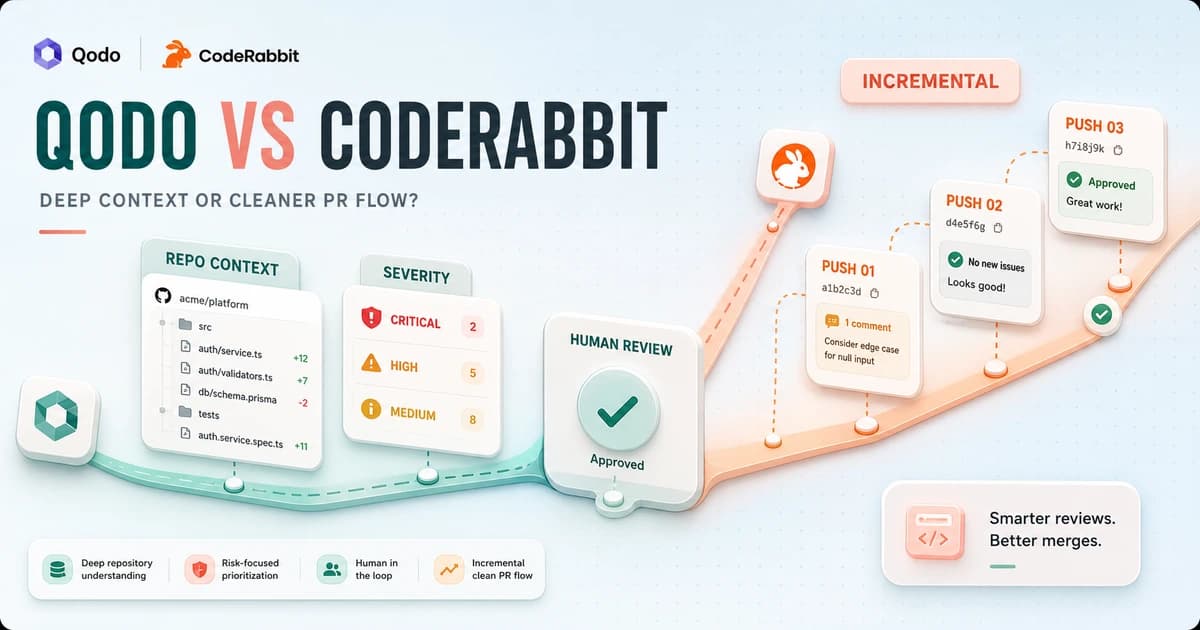
I choose Qodo for deeper context. I choose CodeRabbit for the cleaner rollout.
Qodo is my pick when the difficult part of review lives outside the visible diff. Its current product is built around specialized review agents, repository history, coding standards, architecture, severity, and organization-level context. That extra reach is valuable in a mature monorepo, a service platform, or any system where a ten-line change can violate a rule three directories away.
CodeRabbit is my pick when the difficult part is getting a team to use the reviewer consistently. It installs into the pull-request workflow, produces summaries, reviews new pushes, accepts manual commands, and exposes practical controls for drafts, branches, labels, users, paths, and incremental runs. The product is easier to explain to a team that wants useful automation without adopting a wider code-quality platform.
Neither wins by posting more comments. The winning tool is the one that finds consequential defects without turning every pull request into a support queue for the bot. I keep human review responsible for architecture, domain behavior, permissions, security, and the final merge.
If both products feel too opinionated, my guide to Qodo alternatives compares seven different review workflows, including repository specialists, GitHub-native options, and deterministic quality platforms.
The real difference
Qodo organizes review intelligence. CodeRabbit organizes the PR conversation.
The products overlap enough to make a feature checklist misleading. Both review pull requests, use repository context, generate summaries, suggest fixes, and let teams add instructions. The difference appears after the first review.
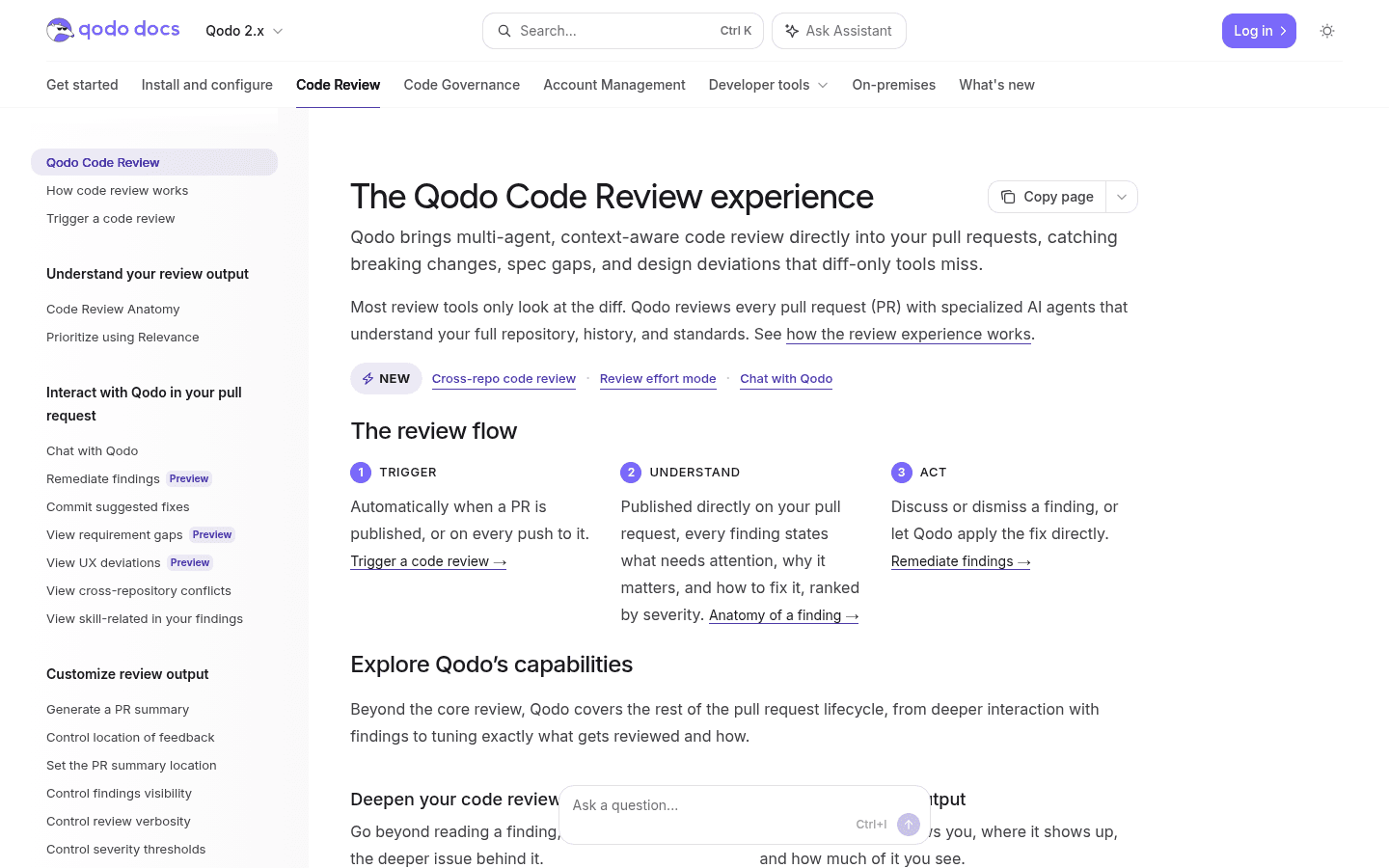
Qodo treats a pull request as one view into a wider quality system. Its agents look at correctness, risk, standards, architecture, history, and related context, then a judge agent combines the results, removes duplicates, filters lower-confidence findings, and ranks what remains. The product wants to make review more consistent across a codebase and eventually across an organization.
CodeRabbit treats the pull request as the operating surface. It decides which PR qualifies, reviews the first version, reacts to new commits, accepts commands in comments, and lets the team pause or narrow automation. That focus makes the daily behavior easier to observe. It also means poor defaults become visible quickly because every unnecessary comment lands where developers already work.
At a glance
Qodo vs CodeRabbit feature comparison
| Decision | Qodo | CodeRabbit |
|---|---|---|
| Primary strength | Context-aware, multi-agent review that ranks findings and can apply repository standards across a wider codebase. | Fast PR automation with summaries, incremental review on new pushes, chat, and explicit controls for when the bot runs. |
| Review loop | Reviews the pull request, merges findings from specialized agents, and can keep one persistent review updated across commits. | Runs on eligible pull requests and reviews each new push by default, with controls for drafts, labels, branches, and pause behavior. |
| Context | Uses repository history, standards, architecture, and cross-repository context where configured. | Uses repository context and configurable instructions, with a workflow centered on the current pull request and its updates. |
| Noise control | Ranks findings by severity, filters lower-confidence output, and can update one persistent review comment. | Lets teams narrow automatic reviews, exclude paths and users, pause incremental runs, and trigger full or incremental reviews manually. |
| Price shape | Pro Team starts at $30 per month with pooled credits, a 14-day trial, and overage controlled by a spending cap. | Free plan covers summaries, while Pro starts at $24 per developer monthly on annual billing and $30 on monthly billing. |
| Best fit | Larger or more connected codebases where context, standards, severity, and governance justify setup work. | Teams that want a quick Git-based rollout, visible PR automation, predictable seat pricing, and a useful free entry point. |
I would not choose from this table alone. Context is useful only when it changes the quality of a finding. Incremental automation is useful only when it reduces waiting without repeating stale advice. Pricing is predictable only after I know how often developers push and how much time they spend resolving bot output.
That is why I score both tools on the same real pull requests. A polished demo with a planted bug proves that the product can recognize a familiar pattern. It does not prove that the reviewer understands my codebase, respects my conventions, or stays quiet when the change is already correct.
PR review workflow
CodeRabbit makes each push explicit. Qodo tries to keep the review coherent as the PR changes.
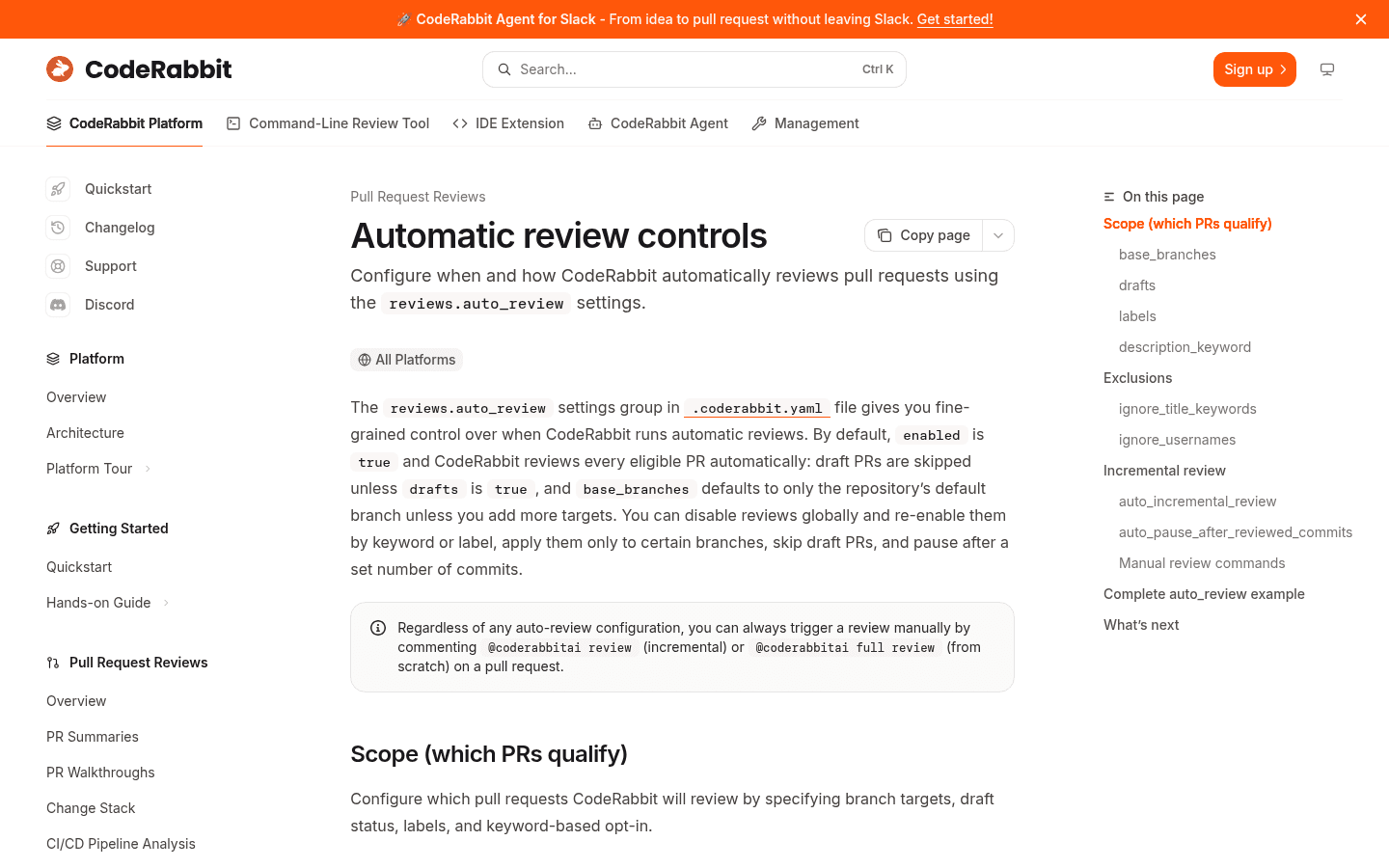
CodeRabbit automatically reviews an eligible pull request and, by default, runs an incremental review when new commits arrive. I can pause that behavior after a chosen number of reviewed commits, exclude drafts, narrow target branches, use labels, ignore users or title keywords, and call either an incremental or full review from a comment.
Those controls matter on active pull requests. A developer may push six small fixes while responding to a human reviewer. Running a complete AI review after each push can burn attention and rate limits. Incremental review is faster, but it still needs sensible pause behavior and path exclusions or the bot becomes another notification source.
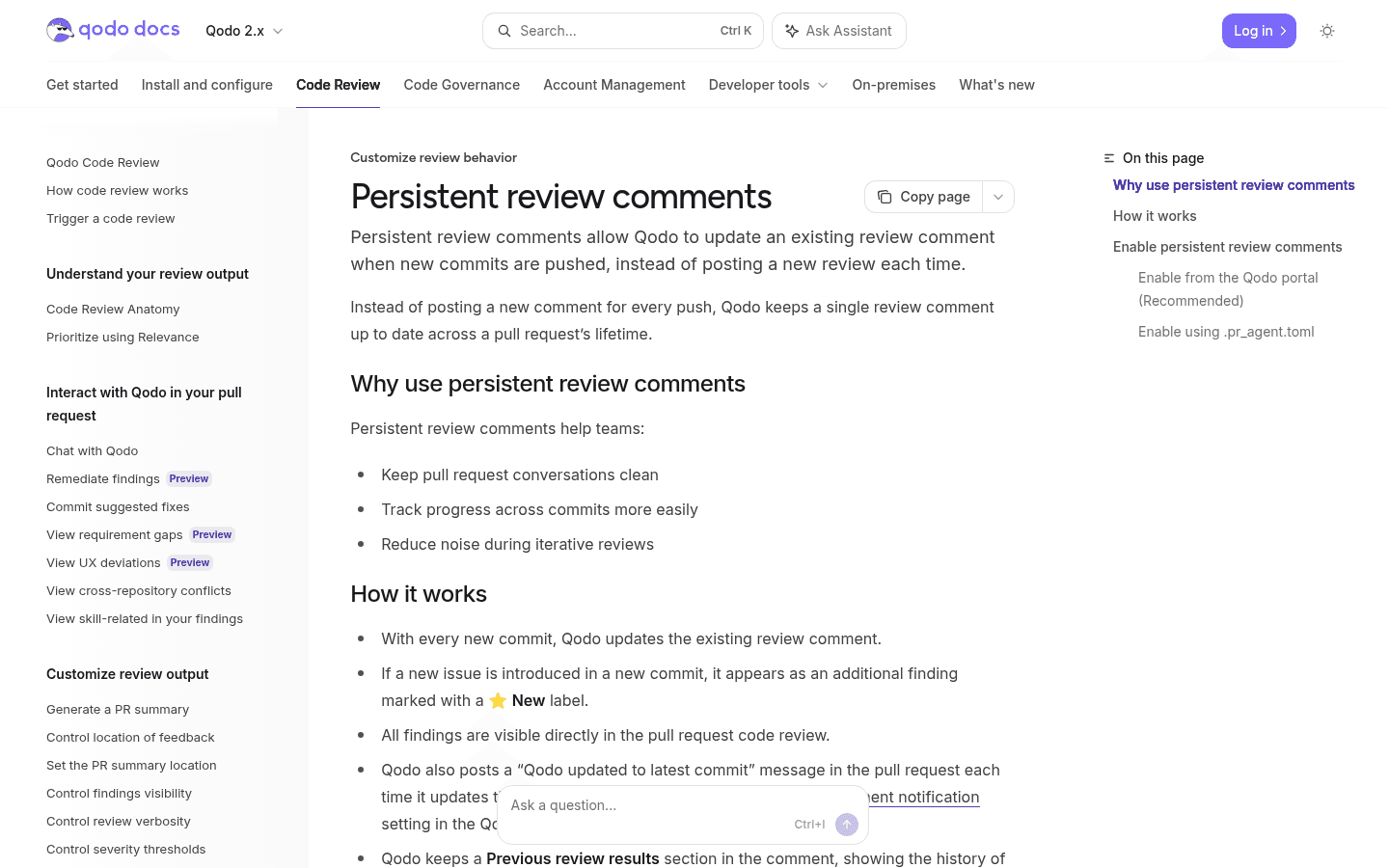
Qodo can also review every push, but its persistent-comment option changes the social shape of the PR. Instead of adding a fresh review trail each time, Qodo updates one existing review comment and marks new findings. I prefer that behavior on long-running pull requests because the conversation stays readable and old findings do not masquerade as current work.
Repository context
Qodo has the stronger context story, but the repository still has to explain itself.
Qodo's documentation is unusually direct about reviewing more than a diff. The product uses repository history, standards, architecture, specialized agents, and cross-repository context. That is the right direction for service boundaries, shared schemas, migration contracts, generated clients, and code where the dangerous consequence appears far from the edited line.
I still do not assume that indexing a repository gives an AI the missing business rule. A model can see that two functions disagree. It may not know that a regulator, customer contract, or old vendor integration requires the strange behavior. I put those rules in short repository instructions, tests, architecture notes, or comments near the code that depends on them.
CodeRabbit also uses codebase context and supports repository configuration. In my experience, its advantage is less about claiming infinite context and more about making the PR loop easy to tune. If the change is usually local and the team has strong tests, linters, and ownership, that practical workflow can matter more than a broader context graph.
- Write rules as testable constraints, not broad style preferences.
- Keep business invariants close to the code and cover them with tests.
- Exclude generated files, lockfiles, snapshots, and vendor code unless they are the point of the review.
- Send formatting and simple style enforcement to deterministic tools.
- Ask the AI reviewer to explain impact, evidence, and the smallest safe fix.
Comment quality
Review noise is not a cosmetic problem. It changes developer behavior.
A reviewer can be technically correct and still make the team slower. If it comments on naming, repeats a linter, proposes a wider refactor, and raises low-confidence edge cases on every PR, developers learn to scan past it. The rare critical finding then arrives through a channel the team has trained itself to ignore.
Qodo's severity ranking and confidence filtering are the features I care about most. I want a small number of findings ordered by consequence. Its judge-agent design is intended to merge overlapping output from specialized reviewers instead of publishing every thought. I still verify whether that promise survives my codebase.
CodeRabbit gives me more visible levers around when the review runs. I can reduce noise by skipping drafts, limiting branches, excluding paths and authors, pausing incremental reviews, and reserving full reviews for meaningful milestones. I also keep its instructions narrow. Asking a general-purpose model to review everything is a reliable way to receive everything-shaped noise.
My operating rule is simple: if a comment does not lead to a code change, a documented decision, or a useful test, I count it as review cost. After thirty pull requests, that cost is measurable.
Pricing and limits
Qodo sells pooled review capacity. CodeRabbit sells developer seats with usage guardrails.
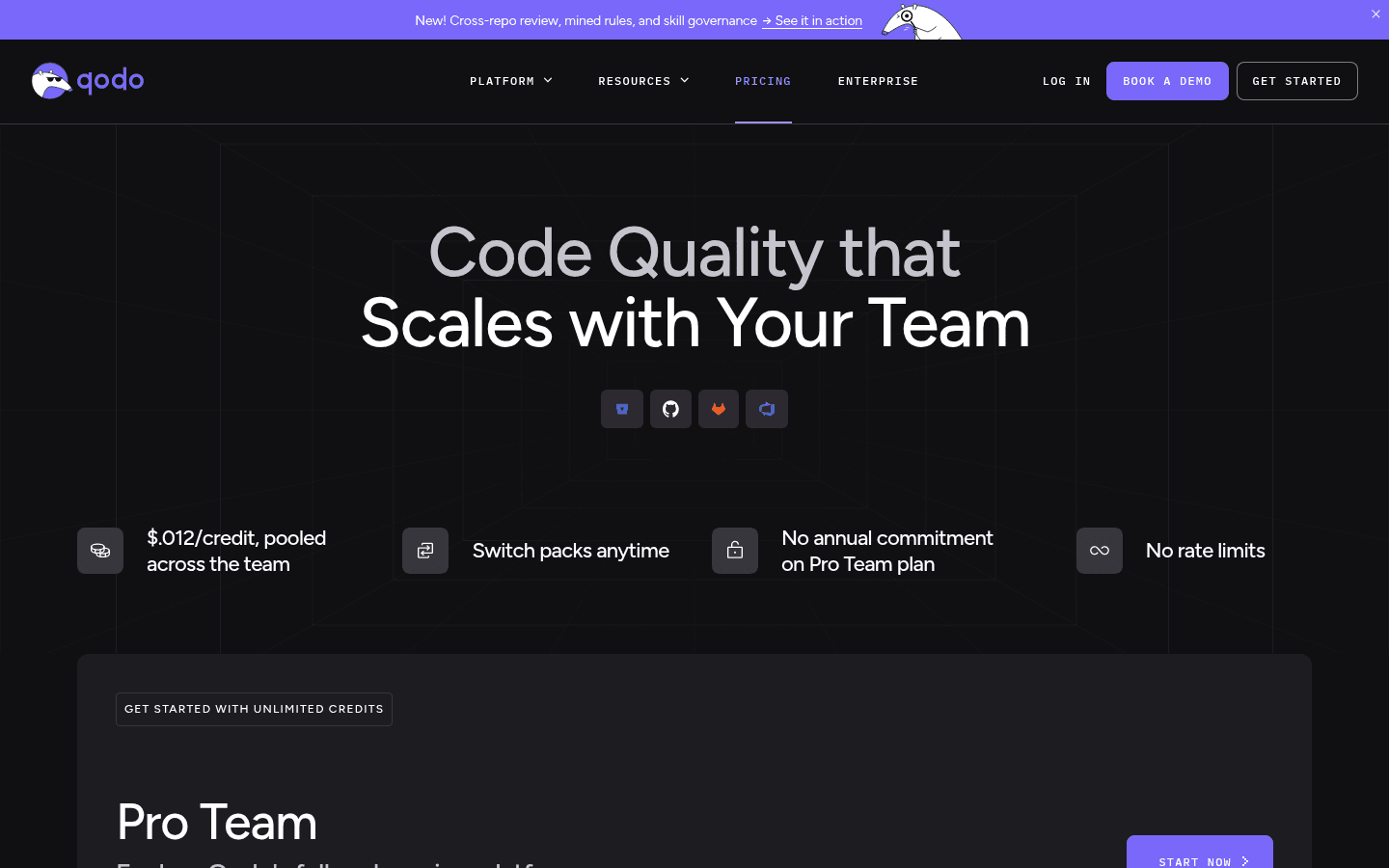
Qodo's current Pro Team plan starts at $30 per month and includes 2,500 pooled credits. The company offers a 14-day trial without a credit card and says there is no permanent free tier. When the base allocation is exhausted, teams can use overage at the same credit rate with a monthly spending cap.
The credit model can work well when review demand is uneven across a team. It is less comfortable when nobody knows how a large pull request, repeated push, or deeper agent workflow translates into monthly spend. I run a representative month before procurement, record credits by repository, and include failed or repeated runs in the estimate.
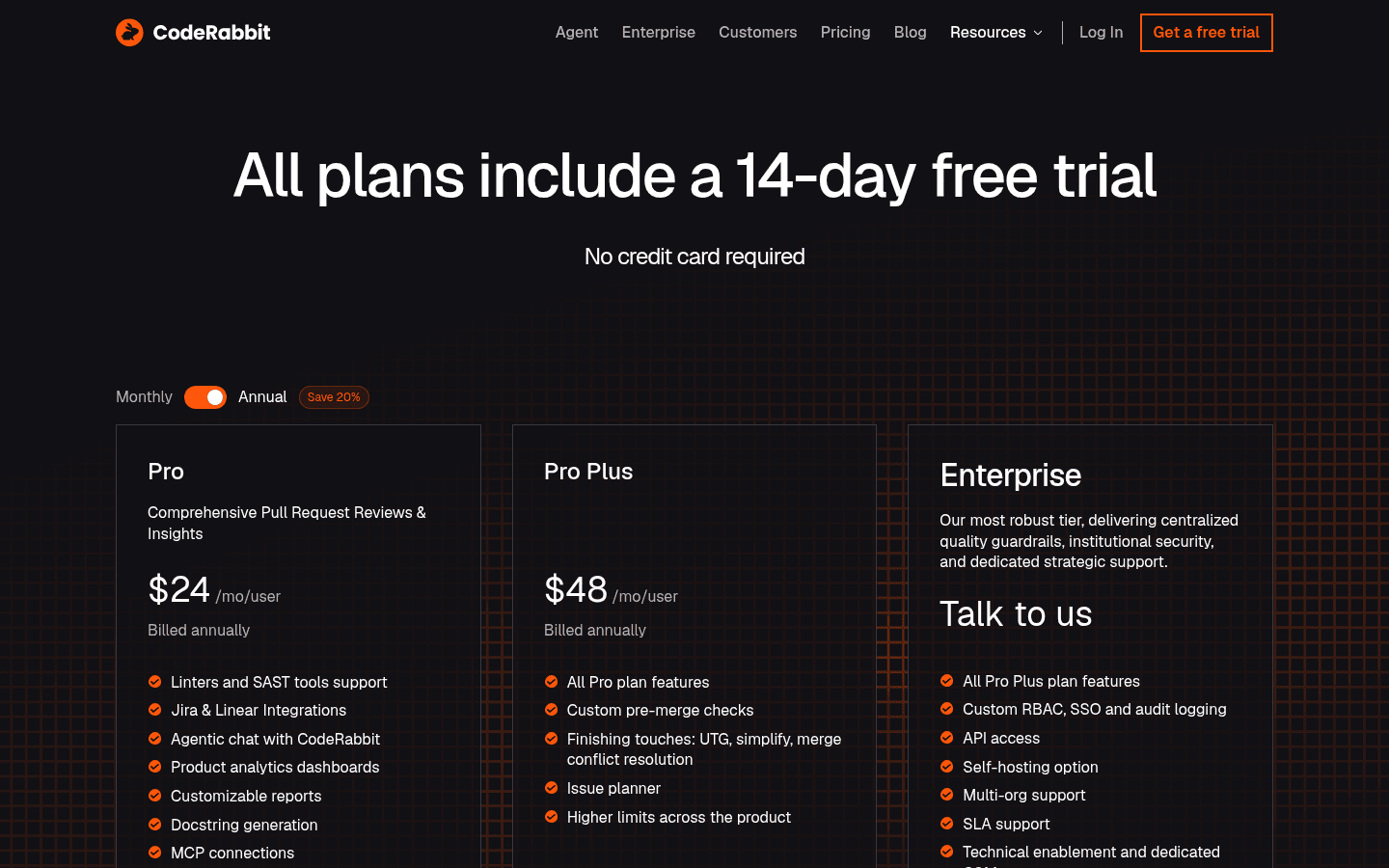
CodeRabbit's free plan includes pull-request summaries across public and private repositories, while full reviews are available through its IDE extension and CLI. Pro costs $24 per developer each month on annual billing or $30 on monthly billing. Pro Plus costs $48 annually or $60 monthly. Paid plans include rate limits that vary by recent activity, and eligible teams can add usage-based capacity.
Seat pricing is easier to explain, but it is not automatically cheaper. Count active developers, not company headcount, then add the cost of Pro Plus features, rate-limit pressure, and review cleanup. The invoice is only one part of the budget.
Fit before features
Who should use Qodo, and who should use CodeRabbit?
- Choose Qodo
- I need repository history, architecture, coding standards, risk ranking, or cross-repository context to make a review useful.
- Skip Qodo
- I want a permanent free PR reviewer, dislike credit forecasting, or do not have enough repeated review volume to justify governance work.
- Choose CodeRabbit
- I want automated PR summaries and comments across common Git hosts, plus clear controls for incremental reviews and a simple pilot.
- Skip CodeRabbit
- My team treats every low-value bot comment as review debt, or I cannot spend time tuning paths, labels, instructions, and severity.
- Keep human review
- The change involves business rules, permissions, data loss, concurrency, compliance, or a design decision that only the team can explain.
I lean toward Qodo for platform groups, regulated teams, large codebases, several repositories with shared contracts, and organizations that want review standards to survive beyond one strong senior engineer. The setup earns its keep when the code has enough context to manage.
I lean toward CodeRabbit for product teams that want a useful reviewer inside the existing Git workflow this week. It is especially attractive for open-source maintainers, teams evaluating privately before procurement, and organizations that value explicit controls over when the bot appears.
I skip both when the team lacks tests, code ownership, review discipline, or a clear definition of a consequential defect. An AI reviewer does not repair a review culture. It gives that culture a faster way to produce more output.
Community signal
Reddit complaints point to one problem: the bot has to earn its place in the PR.
The most credible positive reports describe AI review as a first pass. It catches routine mistakes, missing tests, null handling, inconsistent comments, SQL errors, forgotten headers, and patterns a tired reviewer may overlook. Developers still inspect the finding and still perform the real review.
The most credible complaints are not that every finding is wrong. They are that the useful finding sits beside enough low-value output to slow the team down. Several experienced developers describe business logic and unusual system behavior as the weak point. That matches how I use these products: mechanical and cross-file checks first, domain judgment last.
I would not use Reddit sentiment to choose Qodo or CodeRabbit. I use it to build the failure checklist for a pilot. Noise, missed context, false confidence, comment spam, vendor promotion, and price sensitivity all belong in the test plan.
Switching cost
Installing another app takes minutes. Rebuilding trust takes a month of real pull requests.
| Area | What I move or rebuild | Effort |
|---|---|---|
| Repository access | Install the new app on a small repository set, review requested permissions, and keep sensitive repositories out of the first pilot. | Low technically, high for security review |
| Rules and instructions | Translate Qodo rules or CodeRabbit YAML into short, testable instructions. Move style checks back to linters where possible. | Medium |
| Review triggers | Rebuild draft, branch, label, path, username, and incremental-review behavior so the bot appears only where the team expects it. | Medium |
| Comment baseline | Measure useful findings, false positives, duplicate findings, dismissed comments, and developer cleanup time before changing defaults. | High |
| Team habits | Decide whether the bot runs before human review, who resolves its comments, and whether an unresolved AI finding can block a merge. | High |
| Billing model | Convert pooled credits or seat pricing into a real monthly estimate using active authors, push frequency, retries, and overage. | Medium |
| Historical trust | Preserve examples of useful and harmful comments so the new reviewer can be judged against the old one rather than against memory. | Medium to high |
The smallest migration is parallel. I keep the current reviewer running, add the challenger to two repositories, and prevent either bot from blocking a merge. That produces comparable evidence without turning the evaluation into an emergency process change.
The expensive work is rule translation. Qodo and CodeRabbit organize configuration differently, and a literal copy can preserve old mistakes. I rewrite each rule as a short constraint, identify the files it applies to, and add one example of the failure I want caught.
I also decide what happens to AI comments. If developers can dismiss everything without a reason, the pilot cannot teach me anything. If every comment must be resolved, noise can freeze the PR queue. I use a small set of labels such as useful, false positive, duplicate, needs context, and not actionable, then review the totals weekly.
30-PR pilot
I compare accepted findings, not marketing feature counts.
- Scope
- Use two representative repositories and thirty pull requests across small fixes, features, refactors, tests, configuration, and one intentionally difficult cross-file change.
- Same inputs
- Give both tools the same repository rules, exclude the same generated paths, and run them at equivalent pull-request milestones.
- Quality
- Count findings that expose a real defect, improve a test, prevent a regression, or document a decision the team accepts.
- Noise
- Count false positives, duplicates, stale comments, style-only suggestions, and findings that lack enough evidence to act.
- Speed
- Record time to first useful feedback, time spent reading bot output, and whether repeated pushes create a queue or rate-limit problem.
- Cost
- Project Qodo credits and overage or CodeRabbit seats and limits using the pilot's real push frequency and active authors.
- Decision
- Choose the reviewer with the highest accepted-finding rate and the lowest cleanup time. Keep human merge approval unchanged.
Qodo wins my pilot when its broader context and ranking consistently produce fewer, more consequential findings. CodeRabbit wins when developers understand its behavior faster, its incremental loop keeps pace with active PRs, and configuration removes noise without constant babysitting.
A tie is useful. It usually means the team should choose on workflow and price, not pretend one model is uniquely intelligent. The boring tool that developers trust often produces better code than the clever tool they mute.
FAQ
Qodo vs CodeRabbit questions I settle before rollout
Which is better, Qodo or CodeRabbit?
I choose Qodo when repository context, standards, severity ranking, and governance are the hard parts of review. I choose CodeRabbit when the team needs a faster rollout, incremental pull-request automation, explicit trigger controls, and clearer seat pricing.
What is the main difference in Qodo vs CodeRabbit?
Qodo leads with context-aware, multi-agent review and organization-level code quality. CodeRabbit leads with an automated Git pull-request loop that is easy to start, configure, and observe on every new push.
Does CodeRabbit have a free plan?
Yes. CodeRabbit documents a free plan with pull-request summaries for public and private repositories, while full reviews remain available in its IDE extension and CLI. Paid PR review starts with Pro.
Does Qodo have a free plan?
Qodo currently offers a 14-day Pro Team trial without a credit card, but its pricing FAQ says there is no permanent free tier. The paid team plan uses pooled credits and supports controlled overage.
Can Qodo or CodeRabbit replace human code review?
No. Both can catch routine defects, missing tests, risky patterns, and inconsistencies, but neither reliably knows why a business rule exists. I use an AI reviewer as a first pass and keep humans responsible for architecture, domain logic, security, and merge approval.
How should I test Qodo against CodeRabbit?
Run both on the same 30 representative pull requests. Track useful findings, false positives, repeated comments, missed defects, time to first feedback, cleanup time, and the percentage of comments that lead to a code change.
Sources
Official pages used for current product facts
Plans, limits, and review behavior can change. These are the reference points I used on July 28, 2026.