SwitchMyTool

My verdict
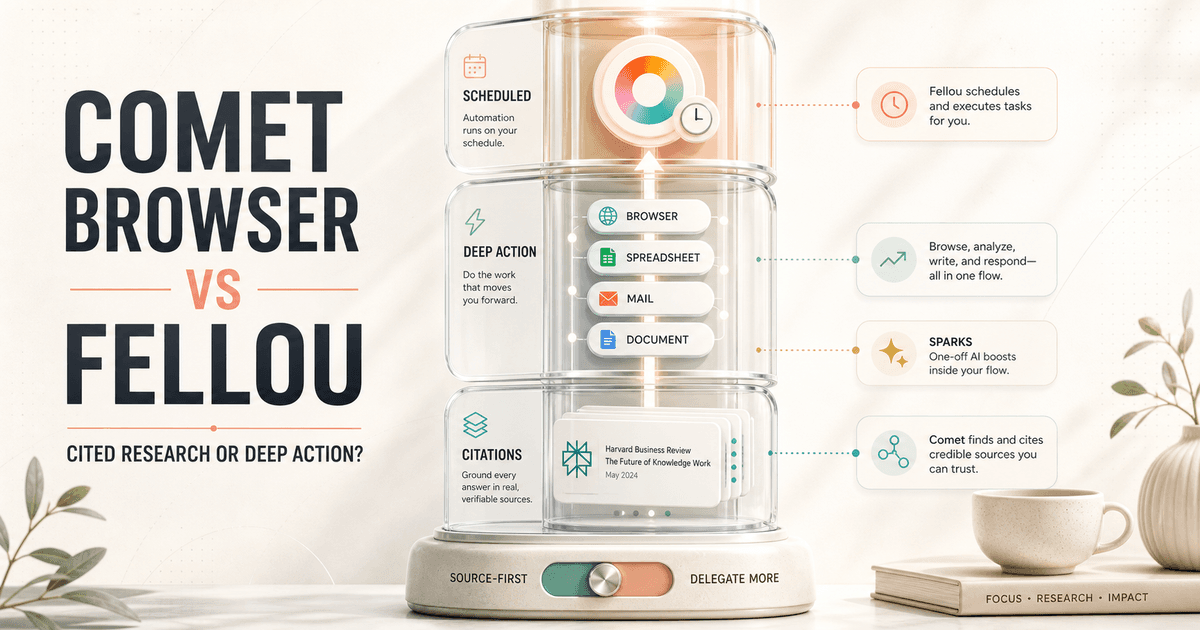
Comet is the better research browser. Fellou is the bolder automation experiment.
I choose Comet when the quality of the answer depends on knowing where it came from. Its useful loop is simple: search, inspect sources, ask a follow-up, open the relevant pages, and let Assistant help with a bounded action. That rhythm works for vendor research, policy checks, market scans, and any assignment where I expect somebody to ask, "What supports this?"
I choose Fellou when the assignment is less about reading and more about delegation. It wants to search across services, use logged-in context, continue through several steps, schedule work, and produce a result while I do something else. That is more ambitious than Comet. It also creates more ways for a task to spend credits, hit a website barrier, misunderstand a finish line, or touch an account I did not intend to expose.
For most people, Comet is the safer first choice because its best feature is easier to evaluate. I can inspect citations and decide whether the answer is good. Fellou makes more sense for experienced automation users who already know how to break a workflow into recoverable steps and monitor the first several runs.
If neither choice feels right, my broader list of Comet Browser alternatives compares the other research-first, privacy-first, and action-first options.
The real difference
Comet keeps me close to evidence. Fellou asks me to trust a longer chain of work.
The phrase agentic browser makes these products sound like close substitutes. They are not. Comet begins with Perplexity. Research, citations, follow-up questions, page context, and Spaces shape the product. Assistant adds action to that research environment.
Fellou begins with Deep Action. Research is one stage in a larger job that may involve several sites, a connected account, a report, an exported file, a schedule, or another application. Its value appears when the workflow continues after the answer.
That difference changes how I test them. With Comet, I judge source quality, missed context, browser usefulness, and whether an action saves clicks. With Fellou, I also judge permission scope, recovery after failure, task cost, background behavior, and whether the final state matches what I meant.
At a glance
Comet Browser vs Fellou feature comparison
| Decision | Comet Browser | Fellou |
|---|---|---|
| Primary job | Turn browsing and questions into source-backed research with supervised browser help. | Delegate broader research and cross-site execution to an agent that can continue through a workflow. |
| Research style | Search, citations, follow-up questions, page context, and Perplexity Spaces keep evidence close to the answer. | Deep search gathers from public and logged-in services, then organizes findings into a report or an action plan. |
| Browser action | Assistant works in the current browser context and can navigate, click, fill, organize tabs, and perform bounded tasks. | Deep Action is built around multi-step work across sites, files, and apps, with scheduled and background execution. |
| Trust model | I can keep the task close to the page I am viewing and ask for sources before acting. | I gain more delegation, but I must review a wider permission surface, more account access, and longer chains of action. |
| Cost model | Access and usage depend on the current Perplexity product and plan limits. | Plans include Sparks and approximate task counts, so the cost of a long workflow is less obvious before I run it. |
| Best fit | Researchers, analysts, consultants, and careful operators who want evidence before action. | Automation experimenters and operators who want one agent to research, schedule, and carry out recoverable work. |
The table is not a feature-count contest. Fellou can look stronger because it promises more categories of action. Comet can look narrower because its product story is built around research. The useful question is which failure would cost me more: an answer I cannot verify, or an automated workflow I have to unwind.
For client research, purchasing decisions, fact checks, and unfamiliar subjects, I would rather have Comet's evidence loop. For a recurring workflow that gathers public information, organizes it, and sends a recoverable output to another tool, Fellou is the more interesting test.
Daily workflow
Comet feels like a browser with a strong research desk. Fellou feels like an agent wearing a browser.
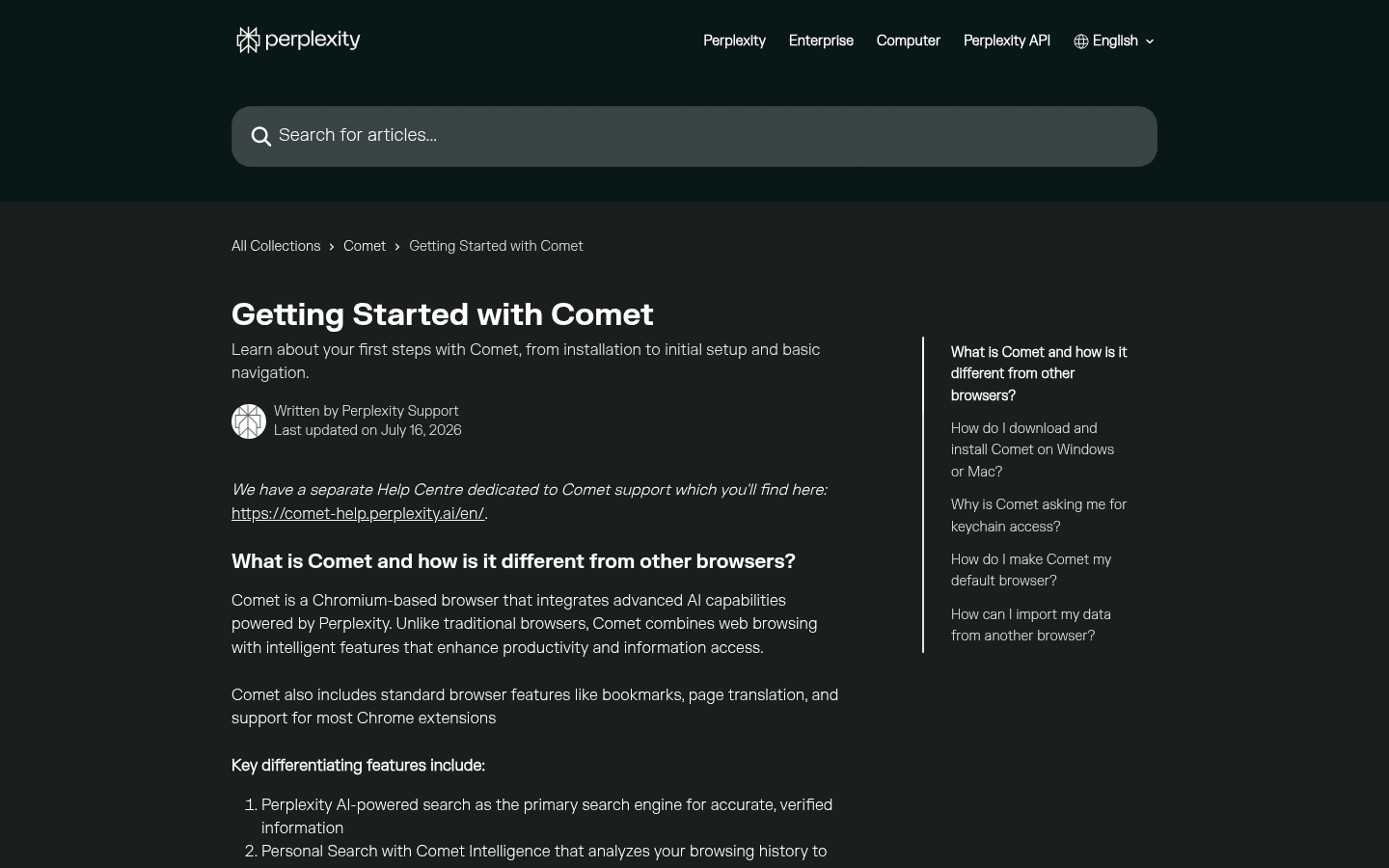
Comet has the easier daily transition for me. It is Chromium-based, supports most Chrome extensions, and includes familiar browser machinery such as bookmarks and translation. I can use it conventionally, then bring Assistant into the page when I need help.
That matters because most browsing is boring. I open a dashboard, check a document, read a support page, and move on. A browser should not force every small action through an agent. Comet lets the AI remain close without making it the only way to work.
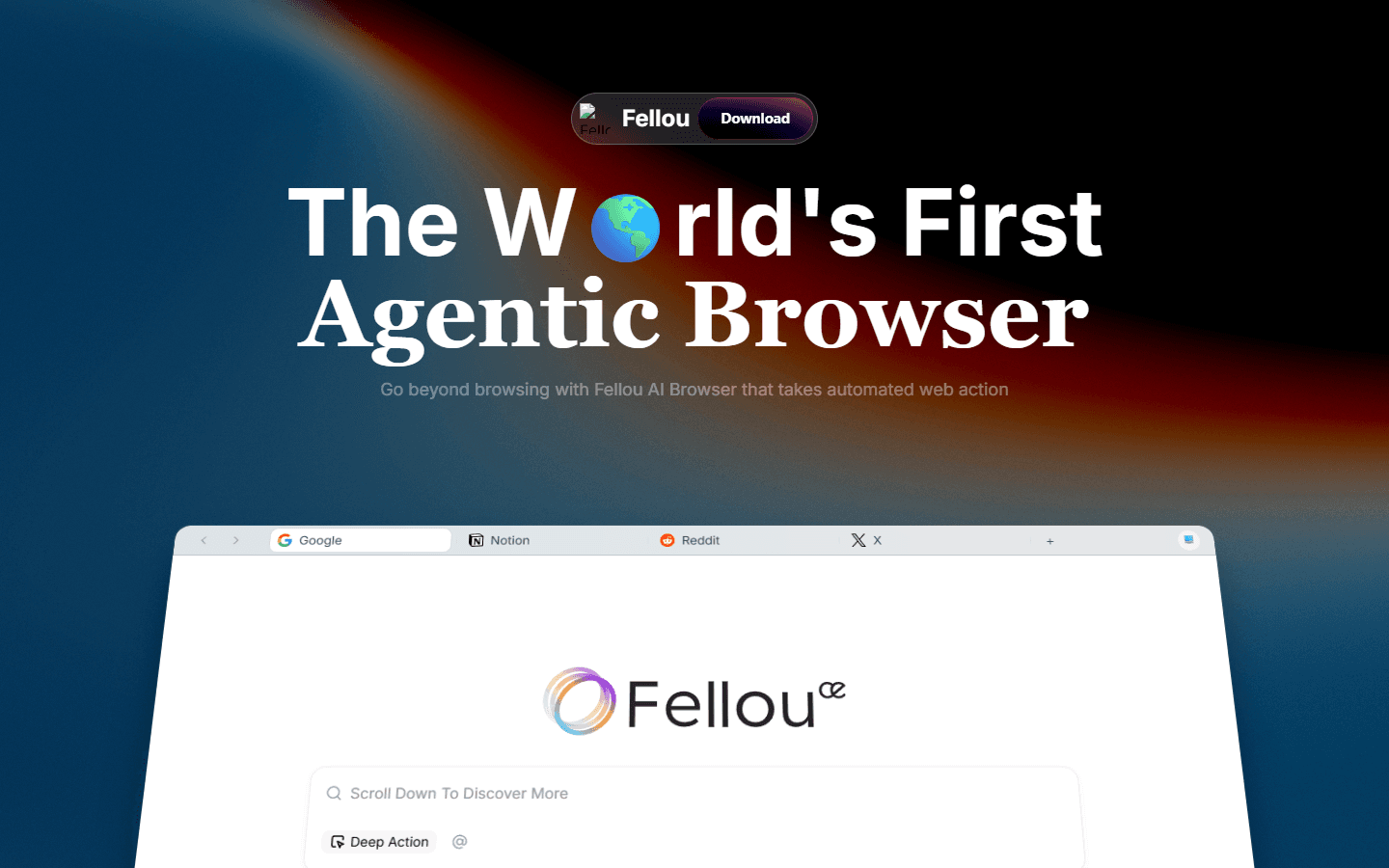
Fellou is more compelling when I arrive with a job description rather than a destination. Instead of asking me to open five sites and stitch the result together, it wants the task, the services, and enough permission to continue. The product page emphasizes automated web action, deep search, real-time intervention, and workflows that can cross public and logged-in sources.
I would not make Fellou my default browser on day one. I would make it a dedicated workbench. A separate profile, a small set of accounts, and tasks with an obvious finish line give me a way to learn what it can do without handing it my entire online life.
Research and citations
Comet wins when the answer has to survive a skeptical reader.
My research workflow is rarely just a search box. I need to understand a question, discover the vocabulary experts use, open primary sources, compare dates, and preserve enough evidence to explain the result later. Comet fits that sequence because Perplexity search and citations are not an extra panel. They are the starting point.
Current-page context is another practical advantage. When I am already reading a pricing page, help article, or dense report, I can ask a focused question about that material instead of reconstructing the subject in a separate agent. Spaces also give repeated research a home, which matters when a project lasts longer than one afternoon.
Fellou's deep search is broader in ambition. Its official material describes multi-source research that can include logged-in services such as Reddit and can turn findings into a traceable report. That is attractive when discovery spans places a conventional search engine cannot see.
Still, breadth does not replace source judgment. I want to know whether the report distinguishes a vendor claim from independent evidence, whether it preserves dates, and whether it shows enough context for me to spot a bad inference. I would use Fellou to gather and organize. I would still verify the claims that drive money, policy, or client advice.
Actions and scheduling
Fellou has the higher ceiling, but long tasks need stronger guardrails.
Comet Assistant can work with the page and browser context in front of me. That makes it useful for tasks such as collecting details from several tabs, filling a low-risk form, organizing research, or moving through a known sequence. I like that the work remains visible and close to the source.
Fellou is designed for a longer chain. It advertises browser use, computer use, scheduled tasks, concurrent work, and agents for images, music, and code. The product is trying to become a general execution layer rather than a clever helper inside one page.
The extra reach is useful only when I define the job well. "Research competitors" is a bad task. "Find the current pricing pages for these eight vendors, record the annual entry price and plan date in this sheet, flag missing prices, and stop before sending anything" is much better.
I also add approval points before irreversible actions. Sending mail, publishing content, changing a subscription, deleting a record, or submitting personal data stays manual. A background agent can draft and prepare. It does not get to surprise me.
- Give the task one measurable finish line and one output location.
- List the sites and accounts it may use instead of granting a vague browsing mandate.
- Require a stop before sending, buying, publishing, deleting, or changing permissions.
- Keep a manual fallback for sites that block automation or change their interface.
- Review the first three scheduled runs before trusting the fourth.
Privacy and control
The more useful the agent becomes, the more deliberate I have to be about access.
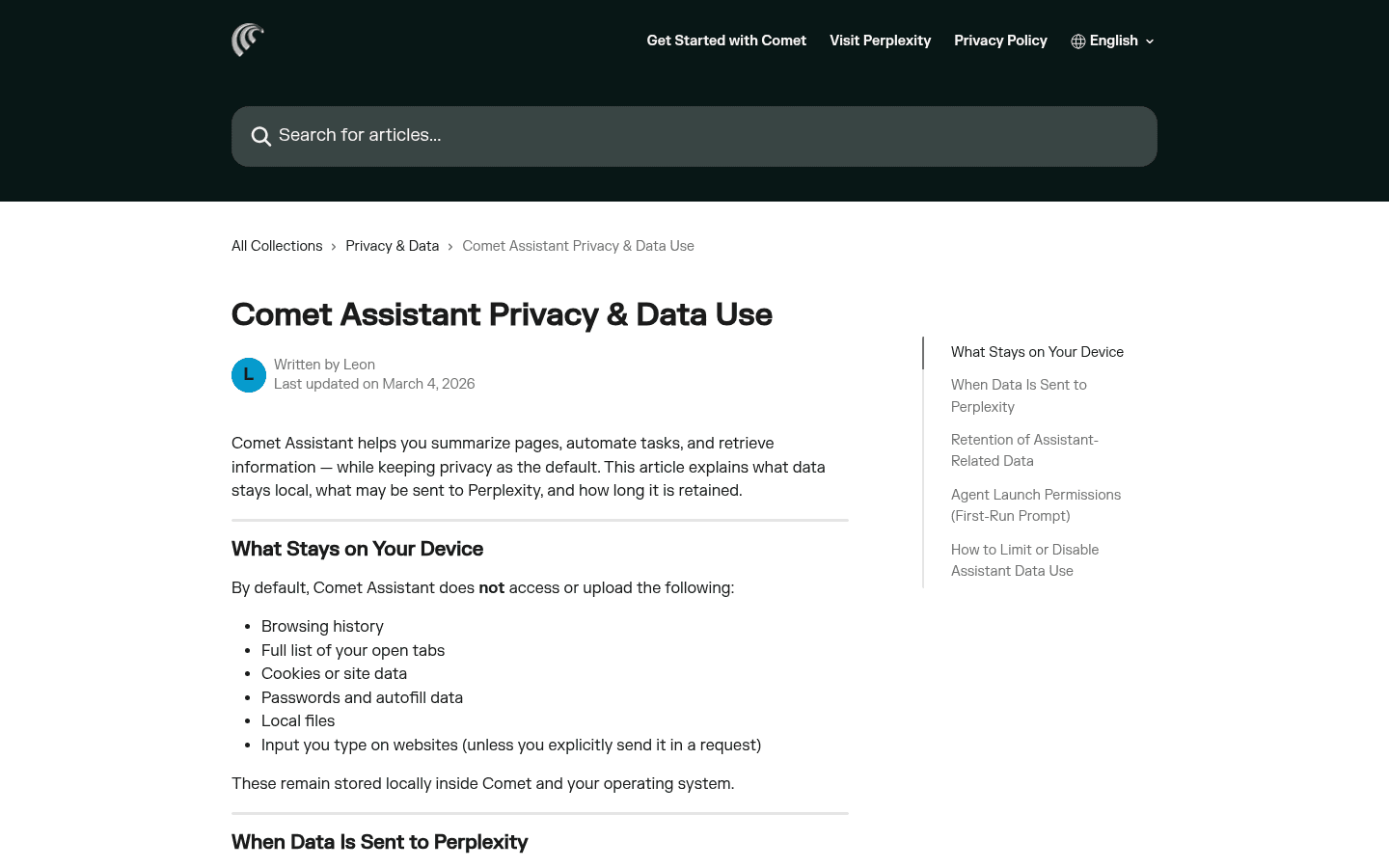
Comet's privacy documentation gives me a concrete baseline. It says browsing history, the full list of open tabs, cookies, passwords, autofill data, local files, and text typed on websites are not accessed or uploaded by default. Relevant context may be sent when an Assistant request needs it.
That is not the same as saying every agent request is private. If I ask an assistant to read a page, use a tab, or complete a task, the request needs some context. My job is to understand which context I am deliberately providing and whether the account behind the page is appropriate for automation.
Fellou's promise naturally asks for more. Logged-in research, cross-platform work, memory, schedules, and background execution become more useful as I connect more services. They also increase the blast radius of a bad instruction, a compromised session, or a simple misunderstanding.
My rule is boring and effective: no primary password vault, no banking, no government identity, no production administration, and no client account whose mistakes cannot be reversed. I use separate browser profiles and low-risk credentials. Convenience is not a reason to remove every boundary.
Price and Sparks
Fellou's plan price is clear. The cost of a real workflow takes testing.
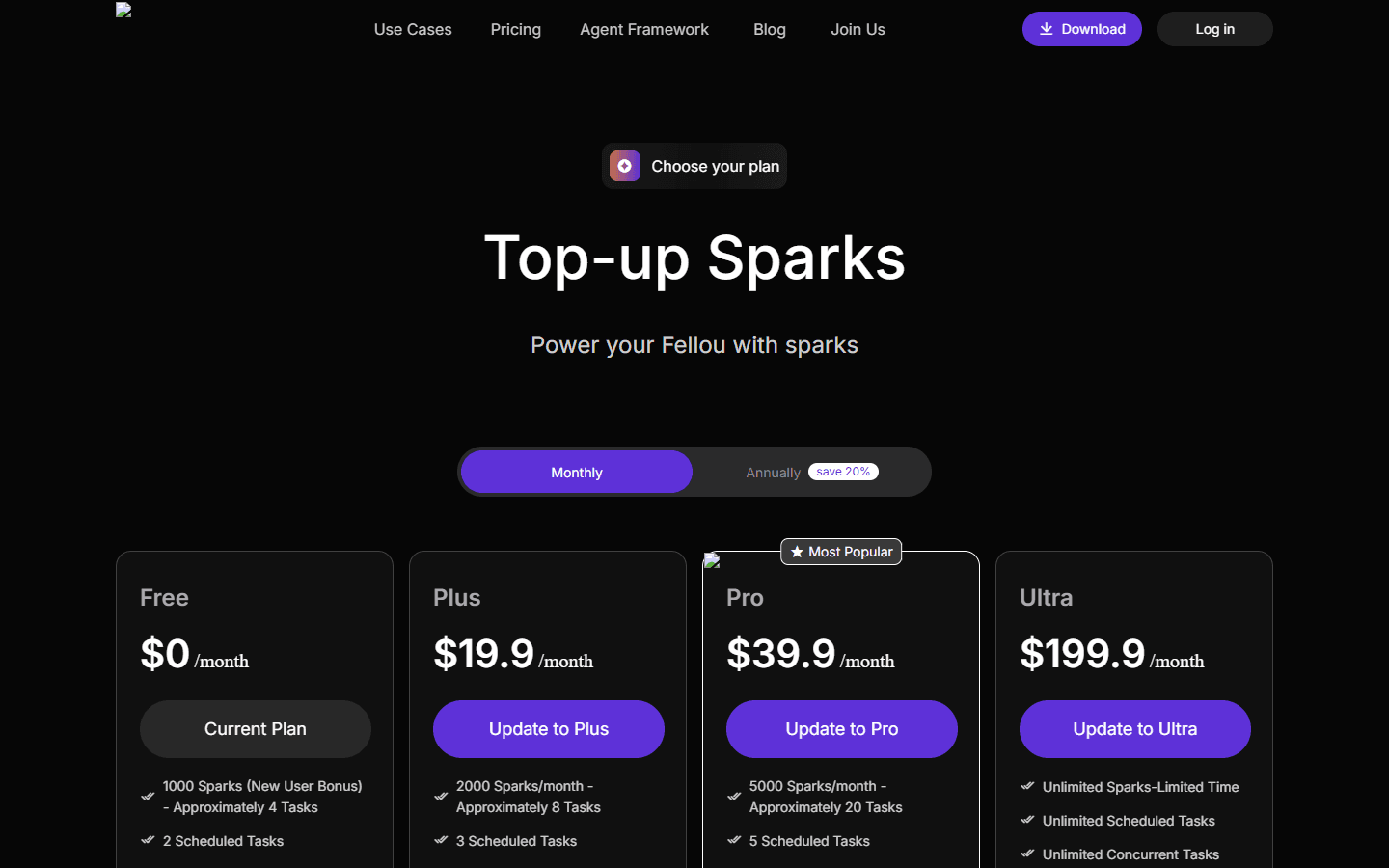
On July 27, 2026, Fellou listed Free at $0 with a 1,000-Spark new-user bonus and about four tasks. Plus was $19.90 per month with 2,000 Sparks and about eight tasks. Pro was $39.90 with 5,000 Sparks and about twenty tasks. Ultra was $199.90 with limited-time unlimited Sparks and unlimited scheduled tasks. Annual billing showed a 20% saving.
Those approximate task counts are the part I pay attention to. A task is not a stable unit of work. One clean lookup and one multi-site workflow with retries may both be called tasks while consuming very different time and value. I do not estimate Fellou from the headline plan alone.
I run one repeatable job five times. I record Sparks used, duration, failed steps, manual corrections, and whether the output was actually usable. Then I compare the cost with the minutes saved. If the workflow needs constant rescue, cheap Sparks are still expensive.
Comet's economics are tied to the current Perplexity plan and usage rules, which can also change. The decision is easier for me when Comet replaces research time I already spend. Fellou needs a clearer automation payoff because its value depends on both execution and a credit budget.
Fit before features
Who should choose Comet, who should choose Fellou, and who should use both
- Choose Comet
- I spend more time verifying claims, comparing products, reading unfamiliar subjects, and collecting evidence than moving data between apps.
- Skip Comet
- I want long unattended workflows, broad cross-app automation, and scheduled execution more than citations or a polished daily browser.
- Choose Fellou
- I have repeatable web work that spans several sites, can define a clear finish line, and am willing to supervise an ambitious agent.
- Skip Fellou
- I dislike credit-style usage, cannot expose logged-in accounts to an early product, or need mature administrative controls and predictable support.
- Use both
- I keep Comet for source-backed daily research and test Fellou in a separate profile for bounded, recoverable automation.
Comet is the easier recommendation for a consultant, analyst, researcher, student, product manager, buyer, or journalist who needs to move quickly without losing the trail of evidence.
Fellou is the more interesting choice for an operations-minded founder, automation builder, recruiter, growth researcher, or independent operator who repeats the same cross-site work and can tolerate an early product.
Neither is a good fit for a team that needs mature audit controls, deterministic execution, formal support guarantees, and zero ambiguity about where sensitive information travels. In that environment, I would test narrowly and keep important actions inside approved enterprise systems.
Community signal
Reddit likes Fellou's ambition and distrusts the same things that make it ambitious.
The discussion volume is still too small for a popularity verdict. I use it to identify what deserves a test. Comet needs a direct agency test: can it complete the task without repeated nudging? Fellou needs a trust and budget test: can it complete the task without surprising permissions, unstable site behavior, or unclear Spark consumption?
A repeated complaint about credit-based AI is not just price sensitivity. Credits make experimentation feel risky because users do not know whether a failed run was their fault, the site's fault, or the agent's fault. A product can reduce that anxiety with transparent task logs, predictable retries, and clear cost estimates. Until then, I budget for learning waste.
Switching cost
Moving bookmarks is easy. Moving trust, schedules, and memory is the real migration.
| Area | What I have to move or rebuild | Effort |
|---|---|---|
| Bookmarks and extensions | Import the Chromium profile, then verify folders, search engines, shortcuts, and the extensions that actually moved. | Low |
| Research archive | Decide where saved threads, citations, reports, Spaces, and reading lists will live after the move. | Medium |
| Prompts and task recipes | Rewrite browser commands as explicit steps with a finish line, approval points, and a manual fallback. | Medium |
| Scheduled work | Rebuild recurring tasks, confirm time zones and triggers, and monitor the first several runs. | High |
| Connected accounts | Review every login, calendar, mail, social, file, and work account the agent can reach. | High |
| Cost forecasting | Run the same real task several times and record Sparks, retries, failures, and cleanup before estimating a monthly budget. | Medium to high |
| Trust boundaries | Create a separate profile, restrict sensitive accounts, and decide which actions always require human confirmation. | High |
A Chromium import can make the first hour look successful. That is only the surface. The valuable parts of an AI browser are saved research, prompt habits, approval rules, connected accounts, task recipes, and the judgment I have built about when the assistant can be trusted.
The migration from Comet to Fellou is therefore not mainly technical. I have to translate a research habit into executable steps. The migration in the other direction means deciding where scheduled actions will go and whether I am willing to do more of the workflow manually in exchange for a tighter evidence loop.
I keep the old browser available for at least two weeks. I do not delete the profile, cancel the plan, or move every recurring task on the first successful run. A reversible switch costs less than an enthusiastic one.
Seven-day pilot
I test the same work, not two polished demos.
- Day 1
- Import a clean profile, install only essential extensions, and document which accounts each browser may access.
- Day 2
- Run one source-heavy research question. Score citation quality, missing context, time to a defensible answer, and cleanup.
- Day 3
- Run one bounded browser task with five to eight steps and an output I can verify.
- Day 4
- Repeat the task after changing one website or instruction. Watch recovery, retries, and whether the browser asks for help.
- Day 5
- Schedule a low-risk task, inspect the log and final state, then calculate the real cost of the run.
- Day 6
- Review privacy settings, account permissions, saved memory, local data, and every action that should require approval.
- Day 7
- Choose the browser that produced more usable work with fewer surprises, not the one with the more dramatic demo.
My winner is Comet when the score is dominated by source quality, research speed, browser polish, and control. My winner is Fellou when it completes the full workflow reliably enough to justify the extra permissions and Spark budget.
The hybrid setup often wins. Comet becomes my daily evidence engine. Fellou becomes a contained automation lab. That is not paying twice for the same tool. It is separating a research job from an execution job.
FAQ
Comet Browser vs Fellou questions I settle before switching
Is Fellou better than Comet Browser?
Fellou is better when I want to test broad, multi-step automation and scheduled work. Comet is better when my first priority is reliable web research, citations, page context, and a more polished browser experience.
What is the main difference in Comet Browser vs Fellou?
Comet begins with source-backed research and adds supervised browser action. Fellou begins with delegated execution and uses deep search, connected accounts, schedules, and background tasks to complete a wider workflow.
Does Fellou use a credit system?
Yes. Fellou calls its usage units Sparks. Its pricing page lists monthly Spark allowances and approximate task counts. I test a real workflow before budgeting because a task with retries and several sites can consume more than a short research request.
Which browser is safer for sensitive accounts?
I would not give either browser agent unrestricted access to sensitive financial, administrative, or identity accounts. Comet gives me a narrower research-first workflow, while Fellou invites broader cross-site execution. I use a separate profile and keep high-risk accounts outside both agent workflows.
Can Comet and Fellou run scheduled tasks?
Both products describe scheduled work, but Fellou makes scheduled and background execution a more central part of its product and pricing. I still verify the trigger, account state, approval behavior, and final output before relying on any recurring browser task.
Can I use Comet Browser and Fellou together?
Yes. My practical setup is Comet for daily research and cited answers, with Fellou in a separate low-risk profile for recoverable automation. That division keeps experimentation away from the accounts and browsing history I use every day.
Sources
Official pages used for current product facts
Features, plans, limits, and policies can change. These are the reference points I used on July 27, 2026.