 SwitchMyTool

My verdict
Contentful is excellent infrastructure when content deserves architecture
I reach for Contentful when a team needs the same structured content to feed a website, app, campaign system, product surface, and several locales. I do not reach for it because somebody said 'headless' in a roadmap meeting. The platform earns its place when reuse, APIs, governance, and delivery scale matter enough to justify a separate frontend and a carefully designed content model.
The awkward truth is that a Contentful CMS project can feel cheap and simple during a prototype. The Free plan is generous enough to build something real. The harder costs appear later: content modeling, frontend components, preview, migrations, editor training, additional spaces, governance, and the jump to a paid plan when the product outgrows a limit.
My rule is simple. If the buyer wants to edit a conventional marketing site without developers, I start elsewhere. If the organization treats content as reusable product data and already has engineering capacity, Contentful becomes much more interesting.
The plain-English definition
What is Contentful?
Contentful is an API-first content platform commonly used as a headless CMS. Editors create and manage structured entries in Contentful's web interface. Developers fetch published or preview content through REST or GraphQL APIs and decide how it appears in a website, mobile app, digital display, commerce frontend, or another channel.
That is different from WordPress, Squarespace, or another page-oriented system that bundles content management with templates and presentation. Contentful deliberately separates the content backend from the frontend. It stores the ingredients; your code decides how dinner looks.
A space contains a project's entries, assets, locales, permissions, and content model. The model defines content types such as Product, Article, Author, Store, Campaign, or Legal Notice. Each type has fields and references. Once published, those entries become structured JSON that a frontend can query.
Contentful now markets a broader platform around content management, personalization, Studio, AI Actions, analytics, apps, and services. For this guide, I keep the buying decision anchored on the core Platform because that is what most people mean when they search for what is Contentful or Contentful CMS.
The operating model
Content goes in as structure and comes out through APIs
I explain the architecture with four layers. First, a content strategist and developers agree on the model. Second, editors create entries and assets inside that model. Third, Contentful exposes published and preview content through delivery APIs. Fourth, one or more frontends render the result.
The Content Delivery API serves published content. The Preview API exposes drafts for preview experiences. The Content Management API can create and change content programmatically. The Images API transforms stored assets, and the GraphQL API generates a schema from the content model. Those capabilities save me from building and operating a custom content backend.
They do not remove frontend work. I still need routes, components, rendering, accessibility, SEO fields, metadata, search, forms, analytics, consent, error handling, caching, deployment, and monitoring. That missing 'head' is freedom for a product team and a nasty surprise for a buyer expecting a theme marketplace.
I also plan for failure. API content should not make a production page blank because an optional reference disappeared. I define required fields carefully, handle absent assets, cache sensible responses, watch rate limits, and decide what the site serves if Contentful or a downstream build step is unavailable.
Current public plans
Contentful pricing starts friendly, then asks a serious question
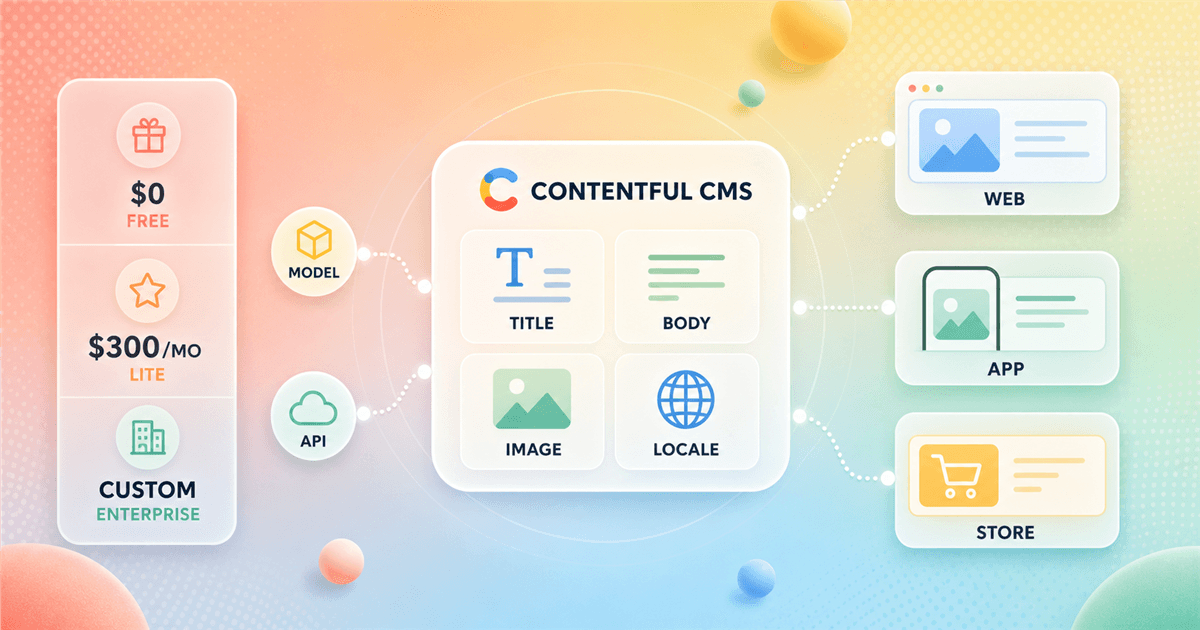
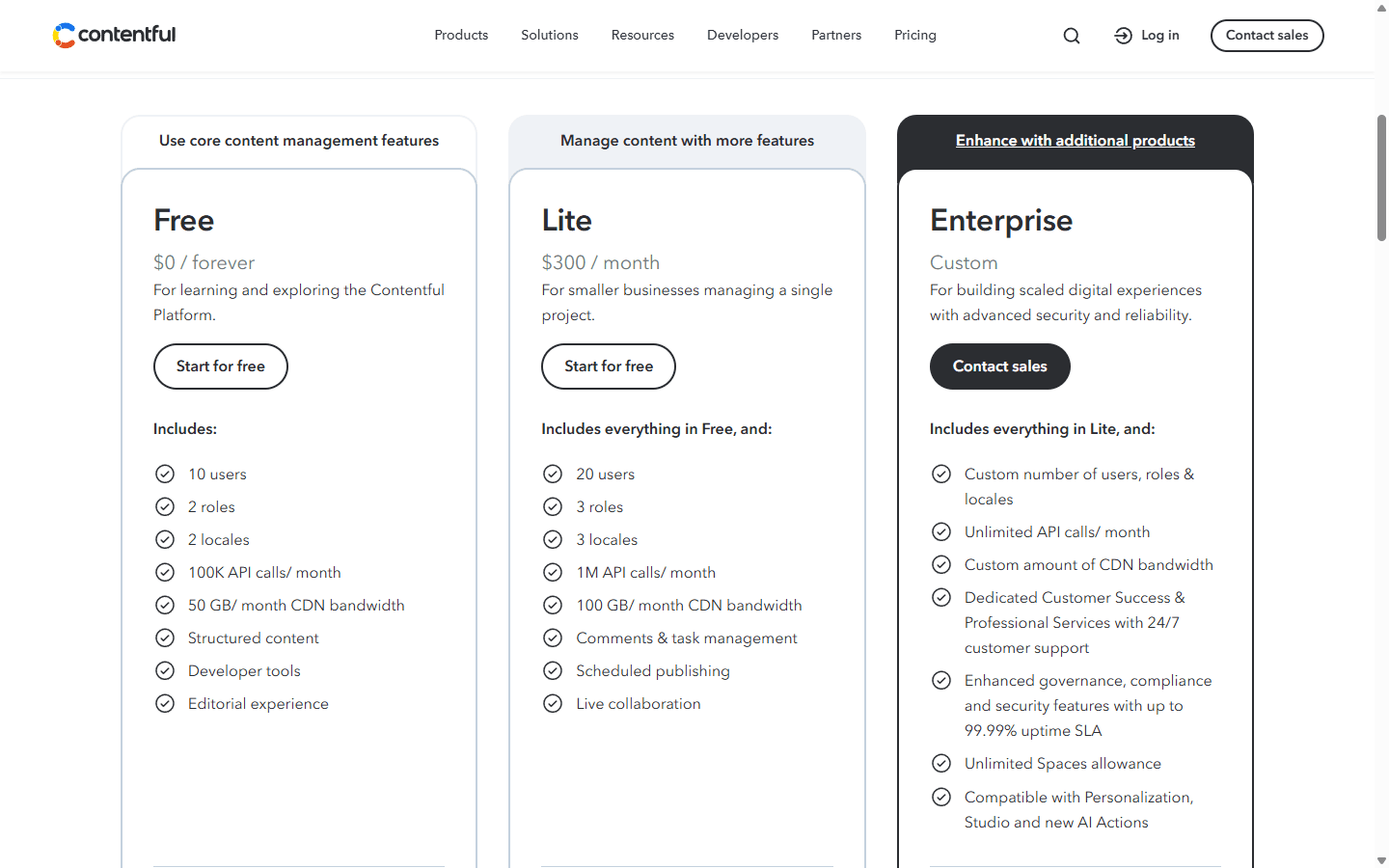
As of July 2026, Contentful lists the core Platform at $0 forever for Free, $300 per month for Lite, and custom pricing for Enterprise. Free includes up to 10 users, 2 roles, 2 locales, 100K API calls per month, 50 GB of monthly CDN bandwidth, and one Starter Space. The pricing page separately lists Starter Space quotas including 25 content types, 2 environments, and 10,000 records.
Lite raises the headline limits to 20 users, 3 roles, 3 locales, 1M API calls per month, and 100 GB of monthly CDN bandwidth. It also adds comments, task management, scheduled publishing, and live collaboration. One Starter Space remains included, while an additional Lite Space is available as a separate purchase. The detailed comparison currently lists that additional Lite Space at $850 per month.
Enterprise is negotiated. The public card lists custom users, roles, locales, and CDN bandwidth; unlimited monthly API calls; dedicated Customer Success and Professional Services with 24/7 support; enhanced governance and security; an uptime SLA up to 99.99%; and an allowance for multiple spaces.
I quote these figures only as a dated starting point. Contentful pricing has changed before, and a serious purchase needs the current order form, space licenses, expected overages, products, support, data residency, and renewal terms in writing.
| Plan | Public price | Headline allowance | My fit test |
|---|---|---|---|
| Free | $0 forever | 10 users, 2 roles, 2 locales, 100K API calls per month, 50 GB CDN bandwidth, and one Starter Space | Learning, prototypes, personal projects, and small products that can live comfortably inside hard limits |
| Lite | $300 per month | 20 users, 3 roles, 3 locales, 1M API calls per month, 100 GB CDN bandwidth, comments, tasks, scheduling, and live collaboration | A smaller business running one serious project that needs a better editorial workflow but not enterprise governance |
| Enterprise | Custom | Custom users, roles, locales, and bandwidth; unlimited API calls; premium spaces; dedicated success and support options | Multi-brand, multi-region, regulated, high-traffic, or business-critical programs that need governance and contractual support |
Budget beyond the license
The platform bill is the easy number
A headless CMS purchase moves cost around. Contentful hosts the content backend, APIs, caching, and asset delivery, which can remove a pile of custom infrastructure work. In exchange, the team funds a frontend, a content model, preview, integrations, migrations, and ongoing governance.
On a small project, developer time can cost more than years of the Free plan. On a large program, the platform contract may be small beside duplicated content work across countries and brands. I compare Contentful with the current operating system, not with a fictional CMS that runs itself for free.
The number I care about is cost per safely shipped experience. That includes editors waiting for developers, developers fixing schema mistakes, localization rework, duplicate campaign builds, incidents, migration debt, and the opportunity cost of a frontend team maintaining plumbing instead of product work.
| Cost area | Why it appears | What I budget |
|---|---|---|
| Frontend build | Contentful stores and delivers content. It does not hand you a finished website theme. | Design system, routes, components, rendering, hosting, analytics, forms, search, and release automation |
| Content model | A flexible schema can become a tidy shared language or a maze of references. | Discovery, model workshops, naming rules, validations, reference depth, and ownership |
| Migration | Old page blobs rarely map cleanly into reusable structured fields. | Inventory, transforms, media transfer, URL mapping, redirects, QA, and editor cleanup |
| Preview and publishing | Editors need to see context, while developers need predictable builds and cache invalidation. | Preview routes, tokens, visual preview, webhooks, revalidation, rollback, and release checks |
| Ongoing governance | Models, locales, roles, apps, API keys, and environments change after launch. | Access reviews, model migrations, documentation, training, monitoring, and incident ownership |
The make-or-break decision
A good content model feels boring after six months
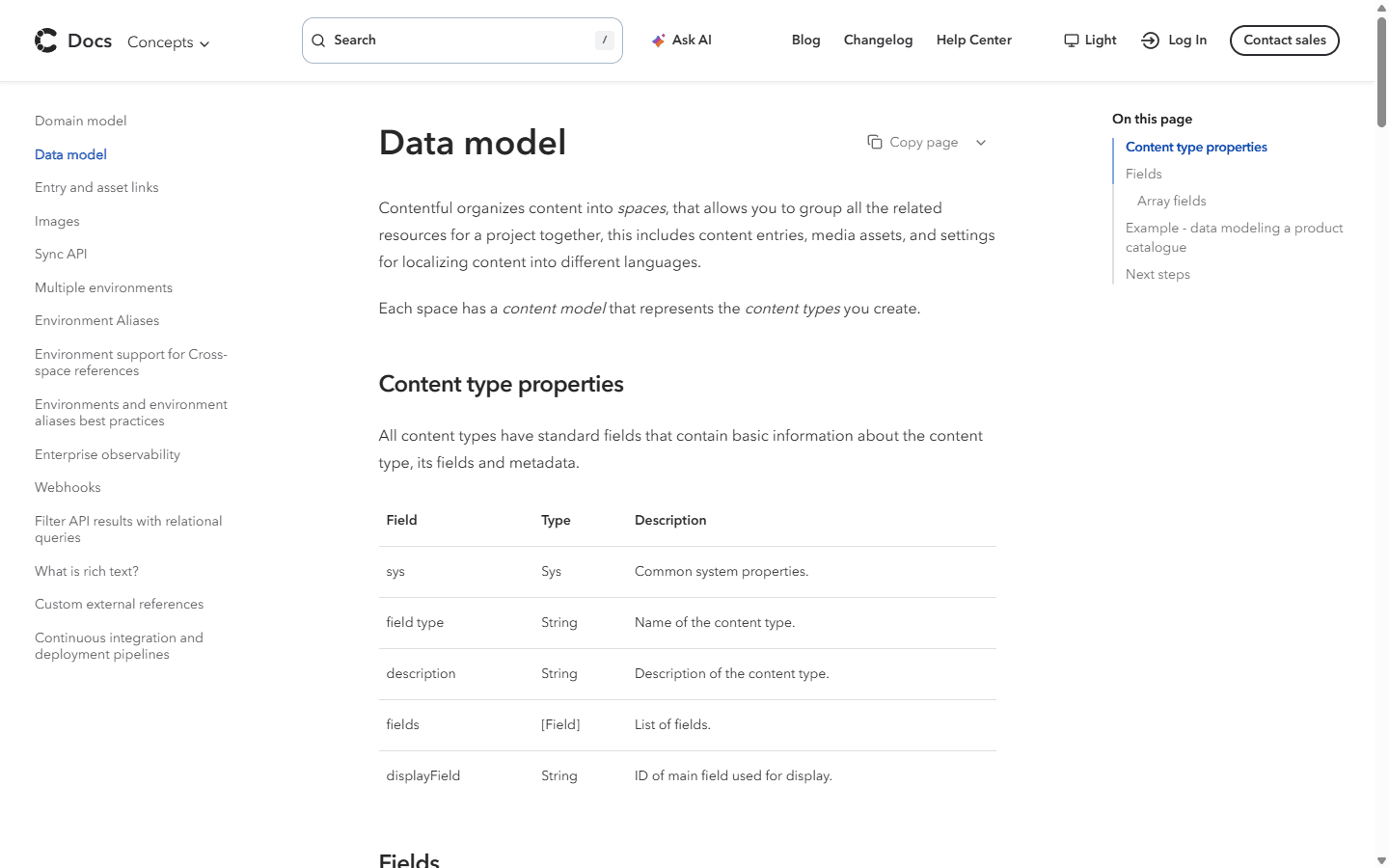
Contentful is deliberately unopinionated. I can model a page, product, promotion, navigation item, reusable banner, legal disclosure, or store location as content types and connect them with references. That freedom is the attraction and the trap.
My first workshop starts with content jobs, not page mockups. Which facts need reuse? Which fields need translation? Which relationships have business meaning? Who owns each entry? What must be validated? Which changes should affect every channel? A model copied directly from today's page sections usually ages badly.
I keep reference depth shallow enough that an editor can understand the entry in front of them. I use clear display fields, field help text, validations, intentional names, and a small set of reusable patterns. I avoid a universal 'component' type with twenty optional fields. It looks flexible to a developer and feels like tax paperwork to everyone else.
Model changes also need migrations. I test them in another environment, script repeatable changes, verify API responses, and coordinate frontend compatibility. Clicking through a production model by hand is quick until the third environment disagrees with the first two.
Where adoption succeeds or fails
Editors should not need to understand your graph
Contentful's editor is clean when the model is clean. An editor can work with entries, rich text, media, references, locales, schedules, comments, tasks, and previews without touching frontend code. That is the version stakeholders see in a polished demo.
The experience degrades when content types multiply and references nest. Editors open one entry, follow a reference, follow another, and forget which page they were trying to change. Reddit users describe long field lists and weak navigation in complex schemas. I have seen the same problem in badly modeled systems on several platforms; Contentful simply gives me enough freedom to create it myself.
I test the authoring workflow with real people before committing. I ask a marketer to launch a campaign, a translator to update one locale, and a legal reviewer to correct shared text. I watch where they hesitate. The fix may be model changes, field guidance, a custom app, better preview, or a different CMS entirely.
Contentful Studio can change the visual assembly story, but it is a separate product decision and may require development to connect components. I do not assume the core Platform plan includes the page-building experience a stakeholder imagined.
The strong side of the product
Developers get capable APIs, not a finished architecture
I generally enjoy the developer side of Contentful. REST and GraphQL cover common delivery patterns, official client libraries reduce setup, preview content has a dedicated path, webhooks can trigger builds or revalidation, and the Images API handles useful transformations. Managed delivery means I do not maintain a CMS database or patch its server.
The work moves into application architecture. I need generated types or a disciplined query layer, preview authentication, cache rules, reference resolution, locale fallbacks, rich-text rendering, image policy, webhook retries, and monitoring. A GraphQL schema that updates with the content model is convenient, but an uncoordinated model change can still break a typed frontend.
I keep Contentful access behind a small repository layer instead of scattering raw queries through components. That makes previews, tests, caching, migration, and future vendor changes less painful. It also makes the team confront what the application needs rather than mirroring every field into UI code.
After launch
Environments help, but they do not create discipline
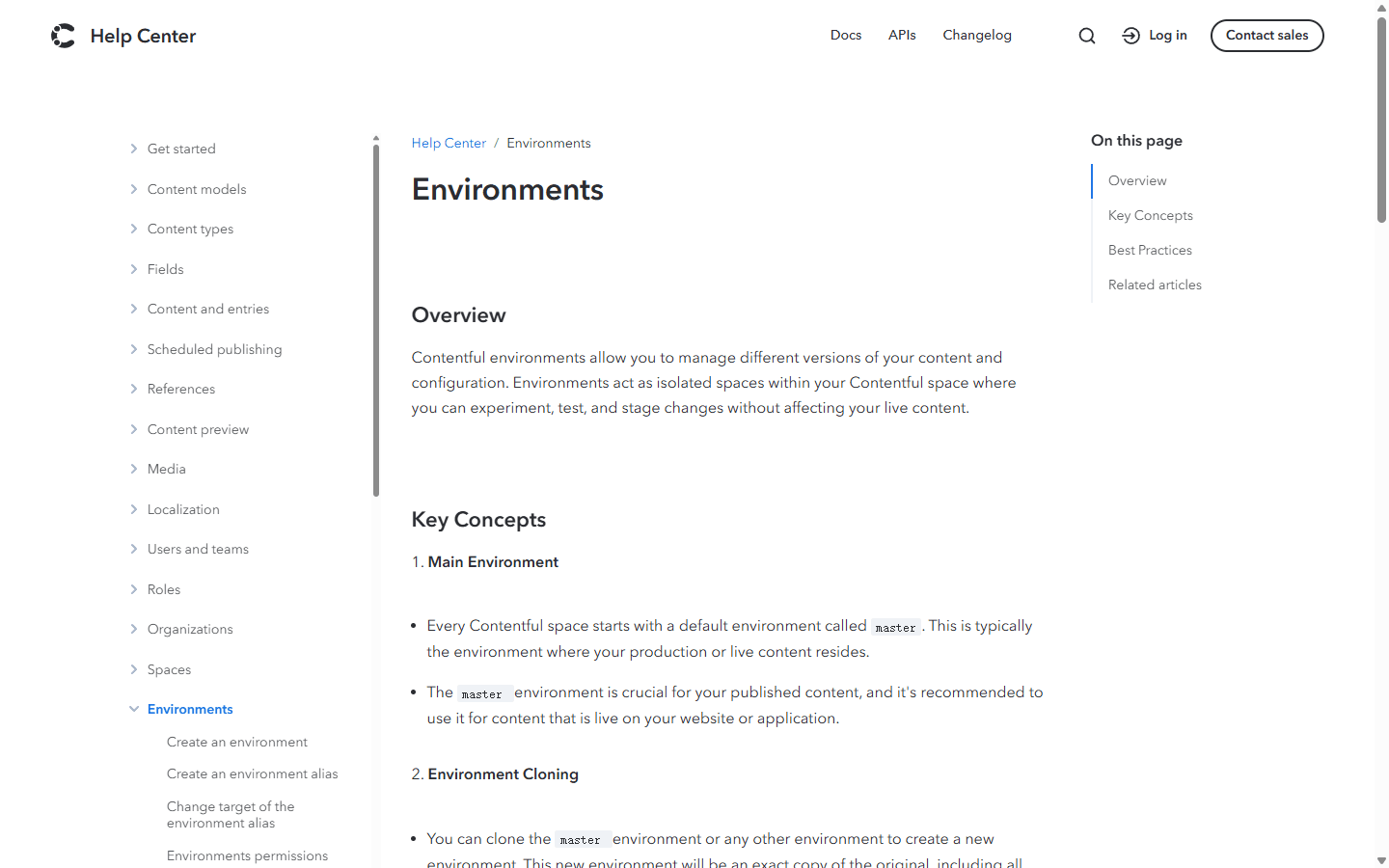
Contentful environments isolate content and configuration so teams can experiment or stage model changes away from the main environment. Environment aliases can help switch a stable name to a different target. Used well, that supports safer content-model development and release automation.
I still define who can change production, how migrations move forward, which data gets copied, how frontend branches match environments, and what rollback means. Content entries, assets, locales, content types, roles, API keys, webhooks, comments, tasks, and workflows do not all share identical environment behavior. I read the current documentation before promising a clone is a complete backup.
The operational checklist also includes API token ownership, webhook destinations, rate-limit alerts, build failures, asset bandwidth, stale users, locale growth, and space strategy. A team can avoid server patching and still accumulate a surprising amount of platform housekeeping.
Buyer fit
Who I would put on Contentful, and who I would steer away
I choose based on content reuse, channel count, editorial complexity, development capacity, governance, and the cost of change. Company size is only a rough proxy. A small product with web and mobile clients may be a better Contentful fit than a large brochure site with one editor.
I also ask who owns the frontend in three years. Contentful can outlive a React, Next.js, native-app, or commerce redesign because the content stays presentation-neutral. That advantage disappears if the model is full of fields named after one page layout.
Best for
A product or marketing organization that needs structured content across several frontends, has developers available, and values API quality, managed infrastructure, localization, and flexible modeling.
Not for
A small business that mainly wants a website builder, ready-made templates, drag-and-drop page ownership, or one predictable bill with no separate frontend project.
Free makes sense when
The project is small enough to respect its users, roles, locales, API, bandwidth, record, content-type, and environment limits without elaborate caching tricks.
Lite makes sense when
The team needs collaboration and scheduled publishing, the $300 monthly platform fee fits the business case, and one primary project will not immediately demand extra paid spaces or enterprise controls.
Enterprise makes sense when
The cost of fragmented content, duplicated builds, weak governance, unreliable support, or country-by-country operations is higher than a negotiated platform program.
Switching cost
Migration is content redesign, not data copying
The fastest migration scripts are rarely the hardest part. The hard part is deciding what old content means in the new model. A WordPress body field may contain layout, links, embeds, shortcodes, tracking, and malformed HTML. Turning that into clean entries requires business decisions.
I inventory URLs, templates, content owners, fields, media, locales, metadata, redirects, integrations, and traffic before designing the target model. I migrate a representative slice first, including the ugliest pages. A perfect set of ten blog posts proves almost nothing about the remaining five thousand.
During cutover I keep stable identifiers, test references, verify locale fallbacks, compare SEO metadata, preserve redirects, and crawl the rendered frontend. I budget time for editors to repair content that automation cannot safely interpret.
| Starting point | What changes | Typical effort |
|---|---|---|
| Page-based CMS | Pages mix content, layout, plugins, and HTML. I first separate reusable facts from presentation. | High when the old site has many custom templates, shortcodes, embedded forms, or inconsistent page structures |
| Another headless CMS | Schemas look similar on paper, but field types, references, rich text, locales, assets, drafts, and IDs rarely line up perfectly. | Medium to high depending on reference depth, publishing history, APIs, and custom editor extensions |
| Spreadsheets or PIM exports | The source may be structured, but ownership, validation, relationships, and locale rules usually need rebuilding. | Medium when identifiers are stable; high when every team uses a different definition of the same field |
| New product | There is little content to move, but early modeling mistakes can spread into every frontend. | Low migration effort, meaningful discovery effort |
Customer research
The Reddit complaints I would design around
The loudest recurring complaint is pricing after growth. Developers describe projects that fit Free comfortably, then face a large jump when they need more API headroom, collaboration, spaces, locales, roles, or enterprise-only governance. A January 2026 discussion came from a simple Next.js blog hitting the Free API limit while the owner could not justify $300 per month.
The second complaint is editorial complexity in large models. Contentful's flexibility lets teams create nested references and long field lists that become difficult to navigate. That is partly product ergonomics and partly architecture debt. Either way, the editor pays for it.
The third is expectation mismatch. Some buyers discover there are no ready-made website templates because Contentful is the content backend, not the presentation layer. Others compare the license with WordPress while ignoring the hosted APIs, CDN, image handling, security, and scaling Contentful replaces. Both comparisons can be wrong in opposite directions.
I also found a useful counterpoint: experienced developers argue that many small product teams never need to leave the Free plan. That is why I measure actual users, calls, bandwidth, locales, content types, environments, and records rather than buying for a fantasy future or rejecting the product because an enterprise project became expensive.
Four-week proof
How I decide without turning the trial into theater
I do not evaluate Contentful with a single Article content type and a hard-coded homepage. Almost every headless CMS looks charming under those conditions. I use one real slice of the business with enough relationships, locales, roles, preview, and delivery traffic to expose the operating model.
At the end, I ask editors whether the workflow is clearer, developers whether the API and model reduce work, and finance whether the twelve-month cost matches the value. If one group wins by handing a permanent burden to another, the proof did its job. It showed me not to buy yet.
| Period | Exercise | Evidence I want |
|---|---|---|
| Week 1 | Model one real content family with awkward relationships, not a toy blog post. | Product, category, campaign, author, legal copy, SEO fields, media, and at least two locales |
| Week 2 | Build delivery and preview paths in the actual frontend stack. | Published API query, preview query, image handling, caching, error states, and a working editor preview |
| Week 3 | Let editors create, review, schedule, translate, and correct content without a developer beside them. | Observed friction, support questions, role gaps, naming problems, and missing validation |
| Week 4 | Forecast twelve months of platform and operating cost under realistic growth. | Users, roles, locales, spaces, API calls, bandwidth, environments, integrations, support, and engineering time |
FAQ
Questions I hear before a Contentful project
What is Contentful?
Contentful is an API-first content platform and headless CMS. Teams create structured content in a web app, organize it into spaces and content models, then deliver published content to websites, apps, and other channels through REST or GraphQL APIs.
Is Contentful a CMS or a website builder?
Contentful is a CMS and content platform, not a conventional website builder. It manages content but does not automatically provide the finished frontend, templates, hosting setup, navigation, forms, or page design. A developer or implementation partner usually builds those parts.
How much does Contentful cost?
Contentful currently lists a Free Platform plan at $0 forever, Lite at $300 per month, and Enterprise with custom pricing. Limits and paid additions around users, roles, locales, API calls, bandwidth, spaces, support, and other products can change the full cost.
Is Contentful free for a production website?
The Free plan can support a small production project if its current quotas fit the workload. I check API calls, CDN bandwidth, users, roles, locales, records, content types, and environments before launch because the move to Lite is a meaningful price step.
Who should not use Contentful?
I would avoid Contentful when the buyer expects a ready-made site, has no frontend developer or agency, needs a simple page editor above all else, or cannot justify the implementation and governance work behind structured headless content.
Primary sources
Where I checked the current product details
- Contentful pricing and Platform plan comparison
- Contentful content platform overview
- Contentful headless CMS guide
- Contentful data model documentation
- Contentful API concepts
- Contentful environments guidance
Read related articles
Keep reading practical SwitchMyTool guides after this one.
Qodo vs Codacy in 2026: Better AI Review or Stronger Merge Gates?
I compare Qodo and Codacy by AI review, static analysis, security gates, pricing, migration cost, team fit, and common Reddit complaints.
Read more
Qodo vs Graphite Agent in 2026: Better Review Governance or a Better PR Workflow?
I compare Qodo and Graphite Agent by review quality, stacked pull-request workflow, pricing, team fit, migration cost, and common Reddit complaints.
Read more
Qodo vs Bito in 2026: Better Review Governance or Broader Developer Coverage?
I compare Qodo and Bito by review governance, Git and IDE coverage, repository rules, pricing, team fit, migration cost, and Reddit complaints.
Read more