 SwitchMyTool

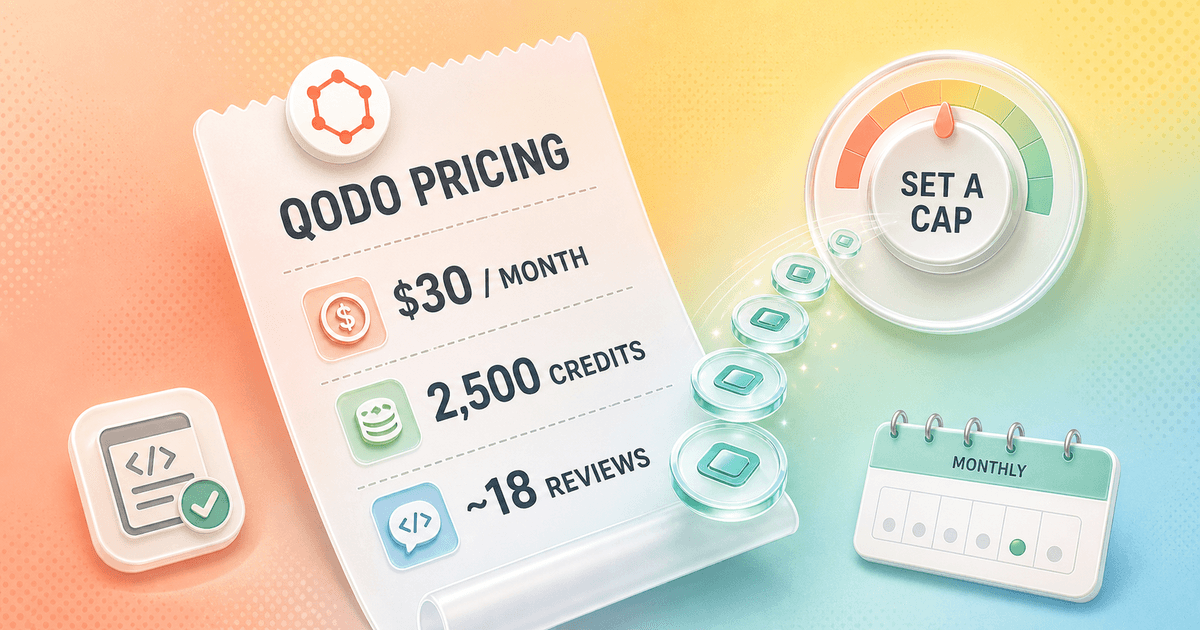
Qodo pricing looks cheap if I read only the first number: $30 a month. It looks less simple when I ask the question that matters: how much code review does 2,500 credits buy for my team?
Qodo does not charge Pro Team by developer seat. It sells a shared monthly credit pool for up to 30 users. That can be a bargain when twenty engineers produce eighteen meaningful reviews. It can feel expensive when three engineers produce giant pull requests that chew through the same pool.
I would not buy Qodo from the plan name. I would run the 14-day trial, measure credits per real pull request, and set a hard overage cap before the first invoice. The pricing model rewards teams that know their review volume. It punishes guessing.
My verdict
The $30 plan is a useful pilot budget, not a promise of cheap unlimited review
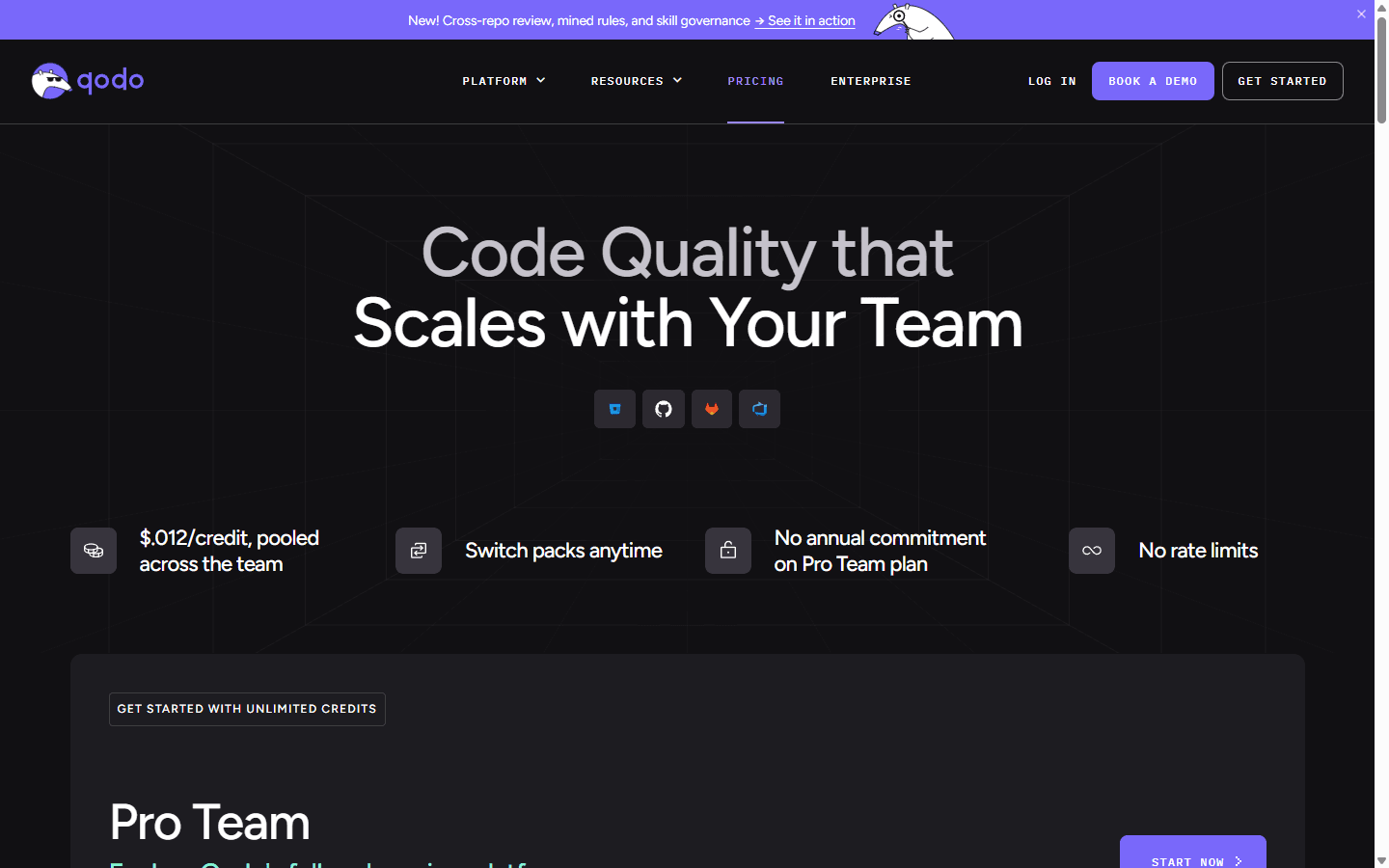
My short verdict on qodo pricing is that the shared pool is friendlier than per-seat pricing for a growing engineering team, but less predictable than a flat subscription. The official rate is $0.012 per credit, and the $30 pack contains 2,500 credits.
Qodo estimates that pack at about 18 reviews. Straight division puts the list-price estimate near $1.67 per review, but that is my calculation, not a guaranteed rate. Qodo says small pull requests use fewer credits and larger or more complex reviews use more. A neat average can collapse the moment a team merges one heroic 4,000-line refactor.
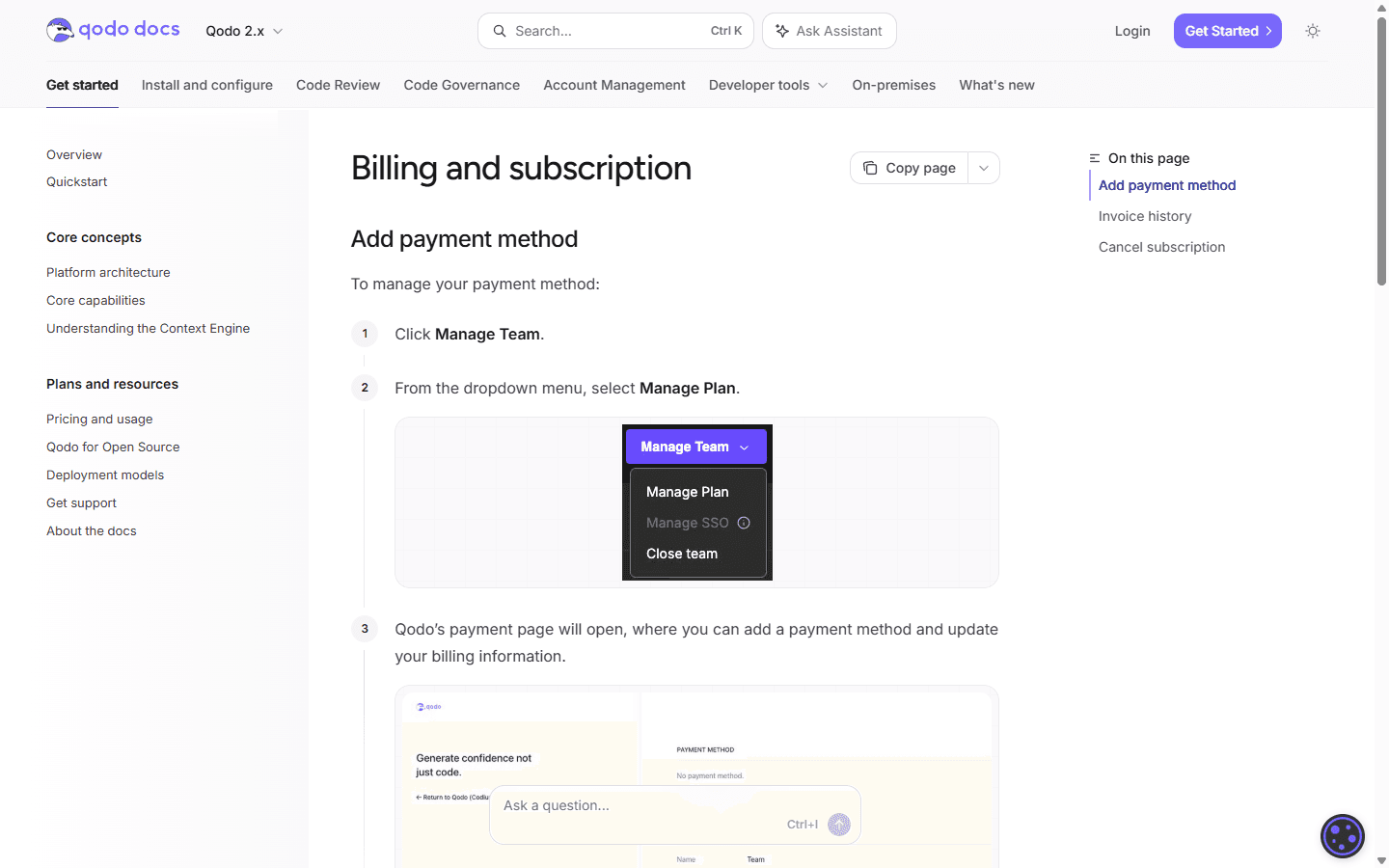
I like that Pro Team has monthly billing, no annual commitment, no repository limit, and a customer-set overage cap. I dislike that unused base credits expire at the end of the cycle. A team with uneven release weeks needs to watch both overage and waste.
Plans
Qodo pricing plans are credit packs wrapped around the same Pro Team product
| Plan | Price | Published allowance | My take |
|---|---|---|---|
| 14-day trial | $0 | Unlimited credits and reviews during the trial | No card required; reviews pause when the trial ends |
| Pro Team Starter | $30/month | 2,500 credits; Qodo estimates about 18 reviews | Best starting point for a small pilot or light review volume |
| Pro Team Standard | $60/month | 5,000 credits; Qodo estimates about 36 reviews | Same per-credit price with twice the monthly pool |
| Pro Team Scale | $240/month | 20,000 credits; Qodo estimates about 144 reviews | For teams with steady review volume across several repositories |
| Enterprise | Custom | Custom usage for teams above 30 users | Adds SSO, audit logs, BYOK, governance, deployment choices, and priority support |
The three published Pro Team packs scale linearly. The $60 plan doubles both price and credits from the $30 plan. The $240 plan provides eight times the starting pool. There is no bulk discount hidden in those headline packs because the per-credit rate stays at $0.012.
What changes at Enterprise is not merely volume. Qodo adds SSO and SAML, audit logs, BYOK, governance analytics, advanced self-learning, single-tenant SaaS or on-premises deployment, and a dedicated support relationship. If I need those controls, comparing Enterprise with a $30 starter pack is theatre. I am buying governance and deployment options, not just more reviews.
Usage math
Credits make sense only after I measure my own pull requests
A Qodo credit is a meter for review activity, not a request and not a developer. The dashboard shows the team's balance and burn rate. When base credits run out, reviews continue at the same per-credit rate until the monthly overage cap is reached.
That cap is the feature I would configure first. Without it, a busy release month can quietly become a billing experiment. With it set too low, reviews can pause at the worst time. I would begin with a small buffer above the selected pack, turn on notifications, and give one person authority to raise the limit.
Base credits expire each cycle, so I would not choose the $240 pack because a spreadsheet says the team might need it someday. I would use the trial's actual burn, remove automated noise, and then buy the smallest pack that covers a normal month plus a modest release-week buffer.
Free access
The trial is generous. The permanent free plan does not exist.
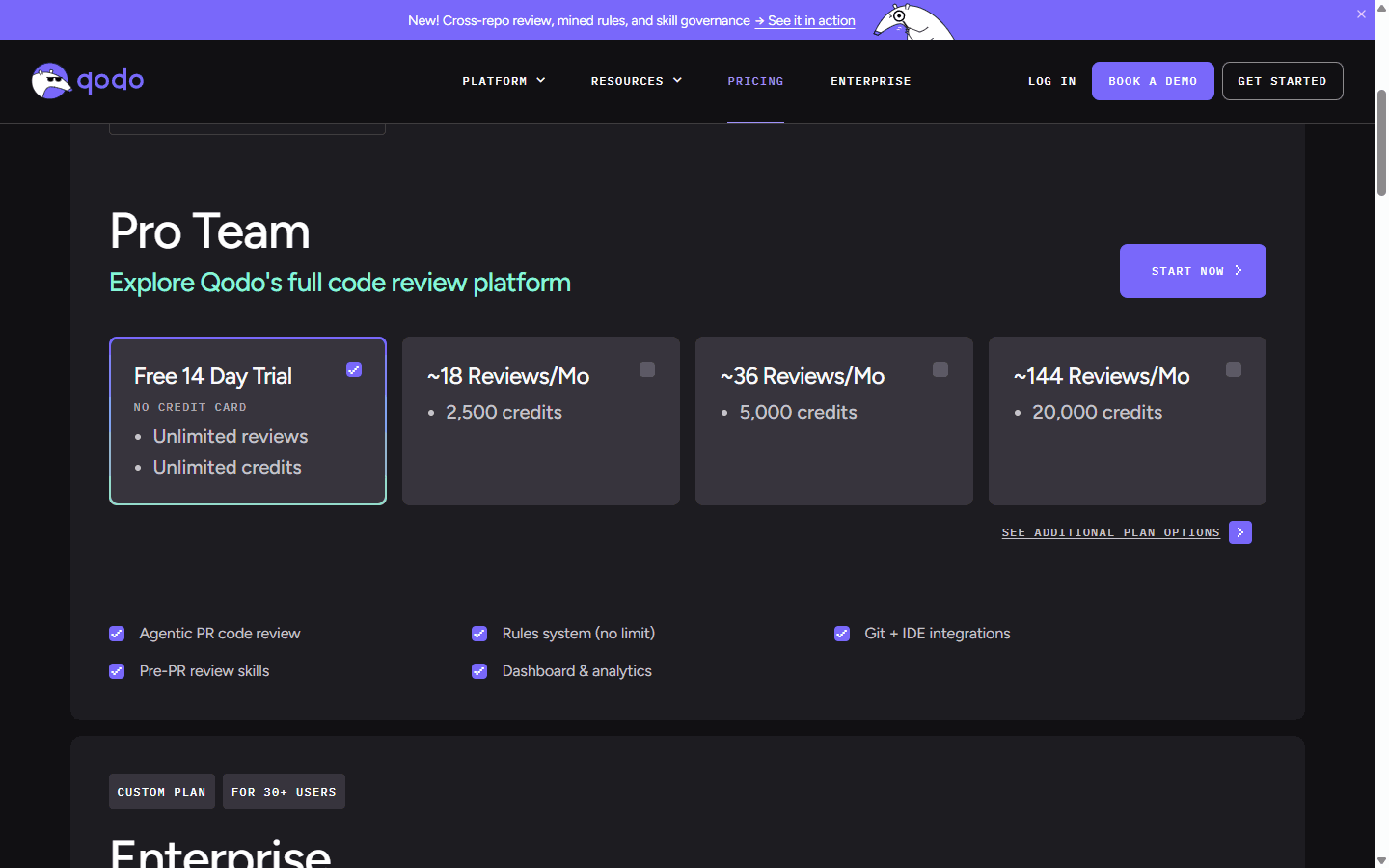
Qodo offers a 14-day trial with unlimited reviews and unlimited credits, and it does not require a credit card. Admin access is required to install the app. At the end of the trial, reviews pause and Qodo recommends a pack based on the volume the team generated.
There is no permanent free tier for a normal private team. Qualified open-source projects can apply to the Qodo for Open Source program. For a solo developer comparing free reviewers, that distinction matters more than the generous trial banner.
Buyer fit
I would pay when the shared pool replaces seats, not when it merely adds another meter
Best for
Teams of up to 30 people that review across several repositories and prefer one shared usage pool instead of buying a seat for every engineer.
Also a good fit
Teams with predictable pull-request volume, clear coding rules, and enough review work to justify tuning the system.
Not for
Solo developers who need a permanent free tier, teams with wildly spiky review volume, or buyers who refuse usage-based billing.
Be careful when
Your pull requests are routinely huge, generated files dominate the diff, or nobody owns the overage cap and review configuration.
The pricing model gets interesting when many engineers contribute code but the team's total PR volume remains moderate. Qodo says engineers do not need individual Qodo accounts, and Pro Team supports up to 30 users. Ten or twenty occasional contributors can share one pool instead of forcing a paid seat onto every person who opens a pull request.
The opposite case is a poor fit: a small team shipping large, complex changes every day. Usage billing exposes the real cost of those reviews, but exposure is not the same as comfort. If finance wants one fixed number and engineering refuses to split pull requests, the monthly discussion will become tiresome quickly.
Customer research
Reddit complaints cluster around noise, context, and uncertain usage
In code-review discussions on Reddit, developers repeatedly describe AI reviewers as eager juniors: fast, confident, and occasionally unaware of an in-house library two folders away. Qodo is often mentioned as a context-aware option, but it is not immune. One recent comparison thread included a blunt complaint that Qodo produced noise and wrong suggestions.
Another recurring complaint is distrust around recommendation threads themselves. Developers question whether praise is genuine or vendor-led. I take that seriously. I care less about a comment saying one tool “catches more” and more about whether the same ten real pull requests produce findings the team accepts, rejects, and acts on.
Pricing anxiety amplifies both problems. A false positive is annoying on a flat plan. It feels worse when the team believes it paid credits for the interruption. That is why configuration is part of the purchase, not optional cleanup after launch.
Setup cost
The app install is easy. Teaching it what not to review is the real migration.
| Work | What I would do | Effort |
|---|---|---|
| Install and permissions | An admin connects the Git provider and chooses repositories. Engineers do not all need separate Qodo accounts. | Low |
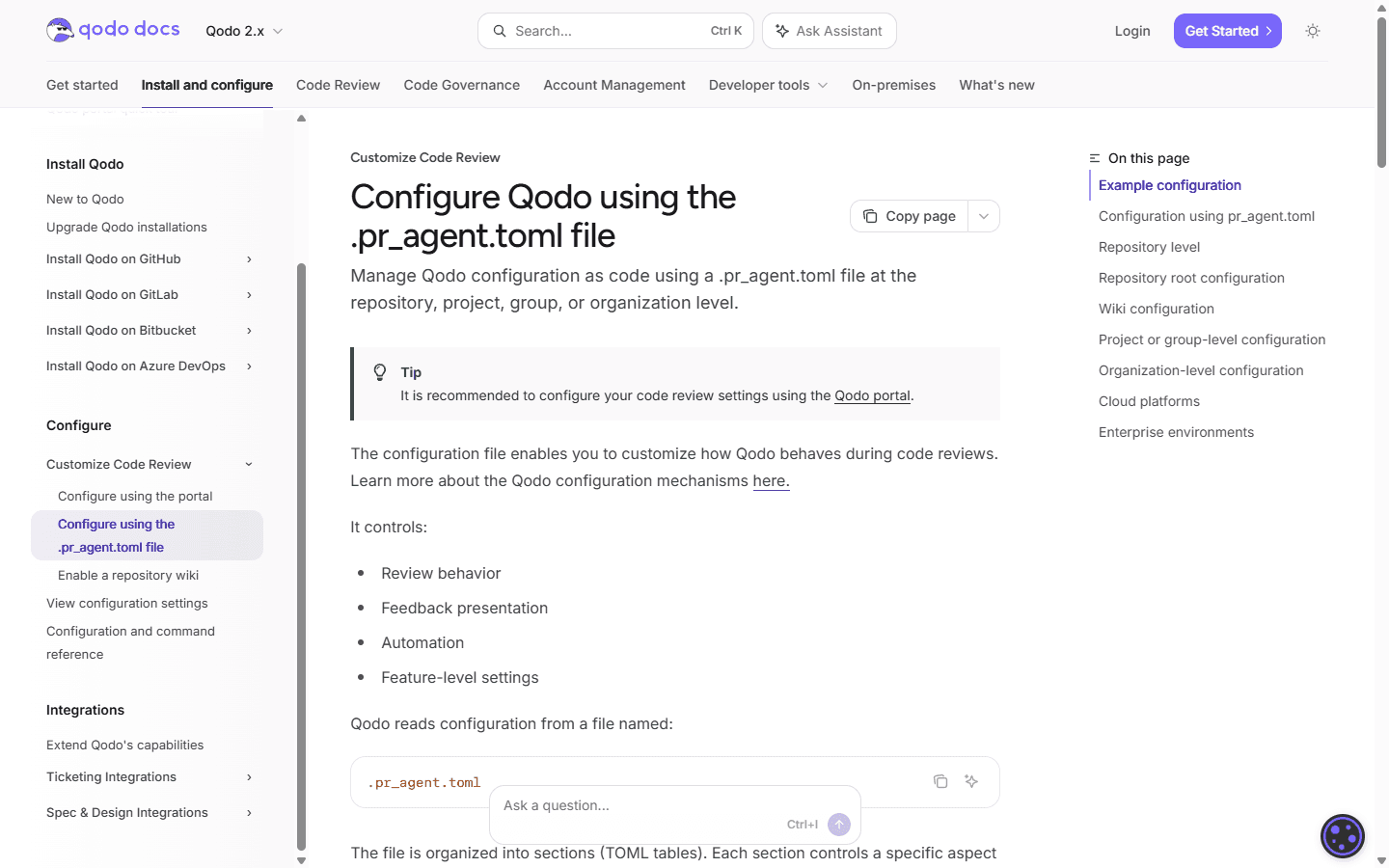
| Rules and configuration | Move real review standards into the portal or .pr_agent.toml, then remove vague preferences that create noisy comments. | Medium |
| Usage controls | Set an overage cap, assign a billing owner, and exclude generated or low-value changes before the first full month. | Low |
| Developer habits | Teach the team which findings can block a merge, which should be dismissed, and when a human reviewer owns the decision. | Medium |
I would not enable every repository on day one. I would choose one active service, one ordinary web application, and one repository with enough history to expose context problems. Then I would carry over only rules that can change a merge decision: security boundaries, testing requirements, forbidden dependencies, and architectural constraints.
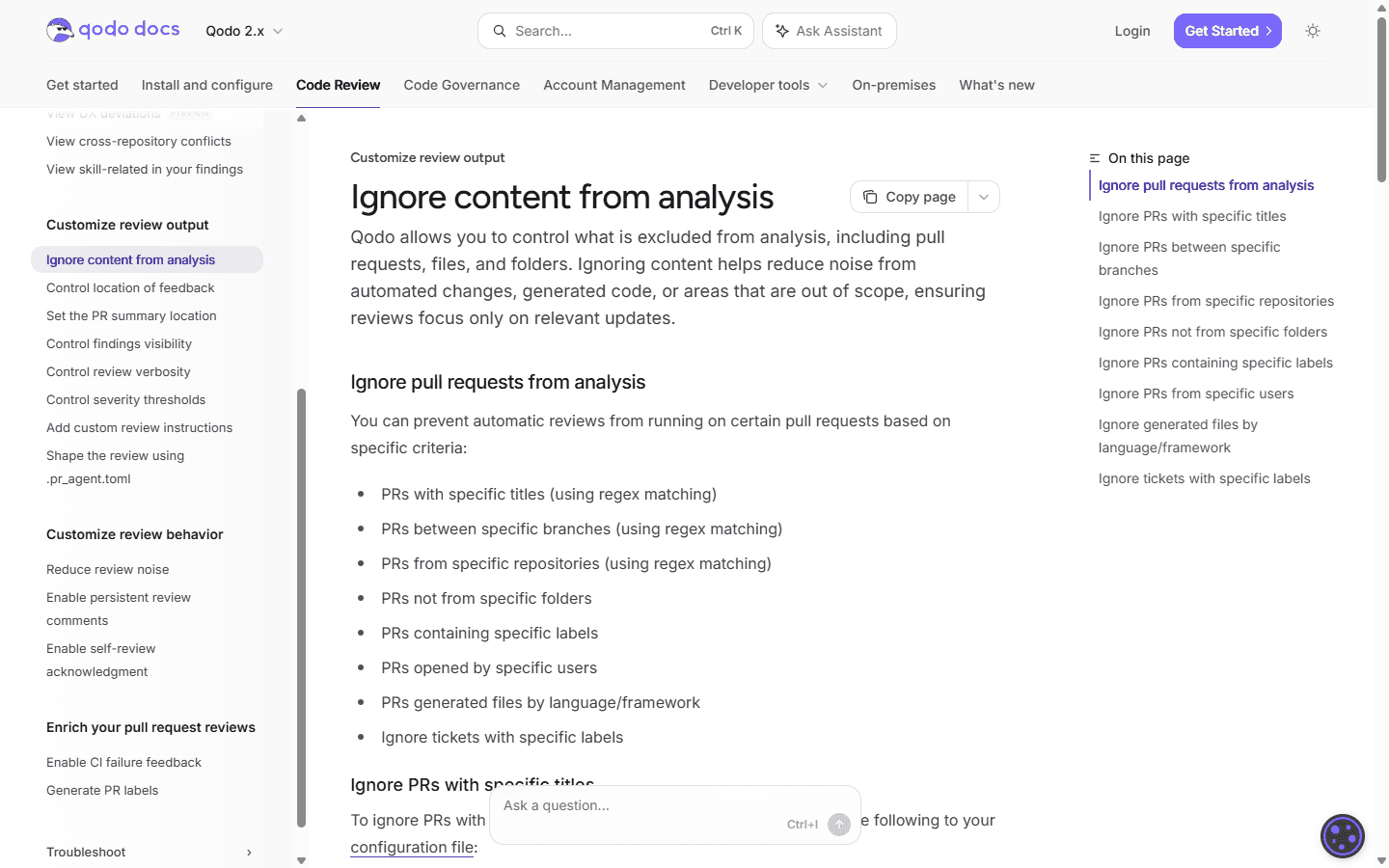
Qodo can exclude pull requests by title, branch, repository, folder, label, user, and generated-code pattern. Those exclusions are budget controls as much as review controls. There is little value in spending credits to critique a lockfile update or a generated client that nobody will edit by hand.
Buying process
My 14-day Qodo pilot would track accepted findings and credits, not comment volume
During the free trial, I would log twenty representative pull requests if the team can produce them. For each one I would record credits consumed, changed lines, review duration, findings accepted, findings dismissed, and any consequential issue Qodo missed. A long review with twelve comments is not better than a short review with one real bug.
After the first five reviews, I would tighten exclusions and rules. After ten, I would estimate a normal month. Only then would I choose a pack. If the estimate sits just above 2,500 credits, I would compare a $30 pack plus a conservative overage cap with the $60 pack. Because base credits expire, buying the bigger pool “just in case” can be the more expensive habit.
Finally, I would assign ownership. One engineer owns review quality, one admin owns billing alerts, and the team agrees that human review still owns product intent and merge responsibility. AI review is useful leverage. It is not a receipt for outsourced judgment.
FAQ
Qodo pricing questions I would settle before paying
How much does Qodo cost?
Qodo Pro Team starts at $30 per month for 2,500 credits, which Qodo estimates at about 18 reviews. Published larger packs include $60 for 5,000 credits and $240 for 20,000 credits. Enterprise pricing is custom for teams above 30 users.
Does Qodo have a free plan?
Qodo does not offer a permanent free tier. It offers a 14-day trial with unlimited reviews and credits and no credit card. Qualified open-source projects can apply for free access through Qodo for Open Source.
What is a Qodo credit?
A credit is Qodo's usage unit for code review. Smaller pull requests use fewer credits, while larger or more complex reviews use more. Credits are pooled across the team rather than assigned to individual seats.
What happens when Qodo credits run out?
Reviews move into overage at the same per-credit rate until the team reaches its customer-set monthly spending cap. Qodo sends notifications before reviews pause, and an owner can raise the cap to resume them.
Do unused Qodo credits roll over?
The current Qodo pricing FAQ says base credits expire at the end of each monthly cycle and the next cycle starts with a fresh pool. That makes pack sizing important for teams with uneven review volume.
Sources
Official pages and community discussions used for this guide
- Qodo plans and pricing
- Qodo AI code review guide and published pack prices
- Qodo billing and subscription documentation
- Qodo ignore-content documentation
- Reddit discussion about Qodo context and review quality
- Reddit comparison of AI code review tools
Read related articles
Keep reading practical SwitchMyTool guides after this one.
Qodo vs Codacy in 2026: Better AI Review or Stronger Merge Gates?
I compare Qodo and Codacy by AI review, static analysis, security gates, pricing, migration cost, team fit, and common Reddit complaints.
Read more
Qodo vs Graphite Agent in 2026: Better Review Governance or a Better PR Workflow?
I compare Qodo and Graphite Agent by review quality, stacked pull-request workflow, pricing, team fit, migration cost, and common Reddit complaints.
Read more
Qodo vs Bito in 2026: Better Review Governance or Broader Developer Coverage?
I compare Qodo and Bito by review governance, Git and IDE coverage, repository rules, pricing, team fit, migration cost, and Reddit complaints.
Read more