SwitchMyTool


The surfer seo vs ahrefs decision looks like a tool comparison. It is really a workflow question: do you need better content production, or do you need better SEO intelligence before anyone writes a word?
I would not buy these tools for the same reason. Surfer is the tool I reach for when an article already has a target and the team needs a sane way to brief, write, refresh, and check the page against the live search results. Ahrefs is the tool I reach for when the team still has to choose targets, understand competitors, inspect backlinks, crawl a site, track rankings, and explain why one page deserves attention before another.
That difference sounds obvious until the invoice arrives. A solo blogger sees two SEO tools and hopes one will do everything. An agency sees two dashboards and imagines a cleaner process. A founder sees two monthly bills and wants the answer to be cheaper than it is. The honest answer is that either tool can be wasteful if you buy it for the wrong job.
This guide uses official Surfer and Ahrefs pages for product and pricing context, then folds in customer-research patterns from Reddit-style complaints: price anxiety, credits, over-optimization, learning curve, and the quiet pain of moving a team from one SEO habit to another. No one needs another feature checklist that pretends the choice is neutral. You need to know which tool gets you closer to publishing work that earns search traffic.
My buying rule
- Choose Surfer first when your keyword list already exists and the bottleneck is writing, refreshing, and briefing content that can compete on a live SERP.
- Choose Ahrefs first when you still need keyword discovery, competitor research, backlink data, site audits, rank tracking, and a broader view of why pages win.
- Do not buy both because a dashboard comparison feels responsible. Buy both only when one person owns research and another person owns content production.
- The expensive mistake is treating Surfer like a full SEO suite or treating Ahrefs like a writing coach. They overlap around content, but they are built for different jobs.
The real split
Surfer helps after a topic is chosen. Ahrefs helps you decide which topics deserve a shot.
Surfer starts from the page. A content team wants to rank for a phrase, so the tool helps it create or improve a document, check coverage, compare the article with competing pages, and give writers a shared target. The official pricing page reflects that product shape: documents, AI visibility prompts, integrations, workspaces, internal linking, content ideas, and optimization features show up as plan differences.

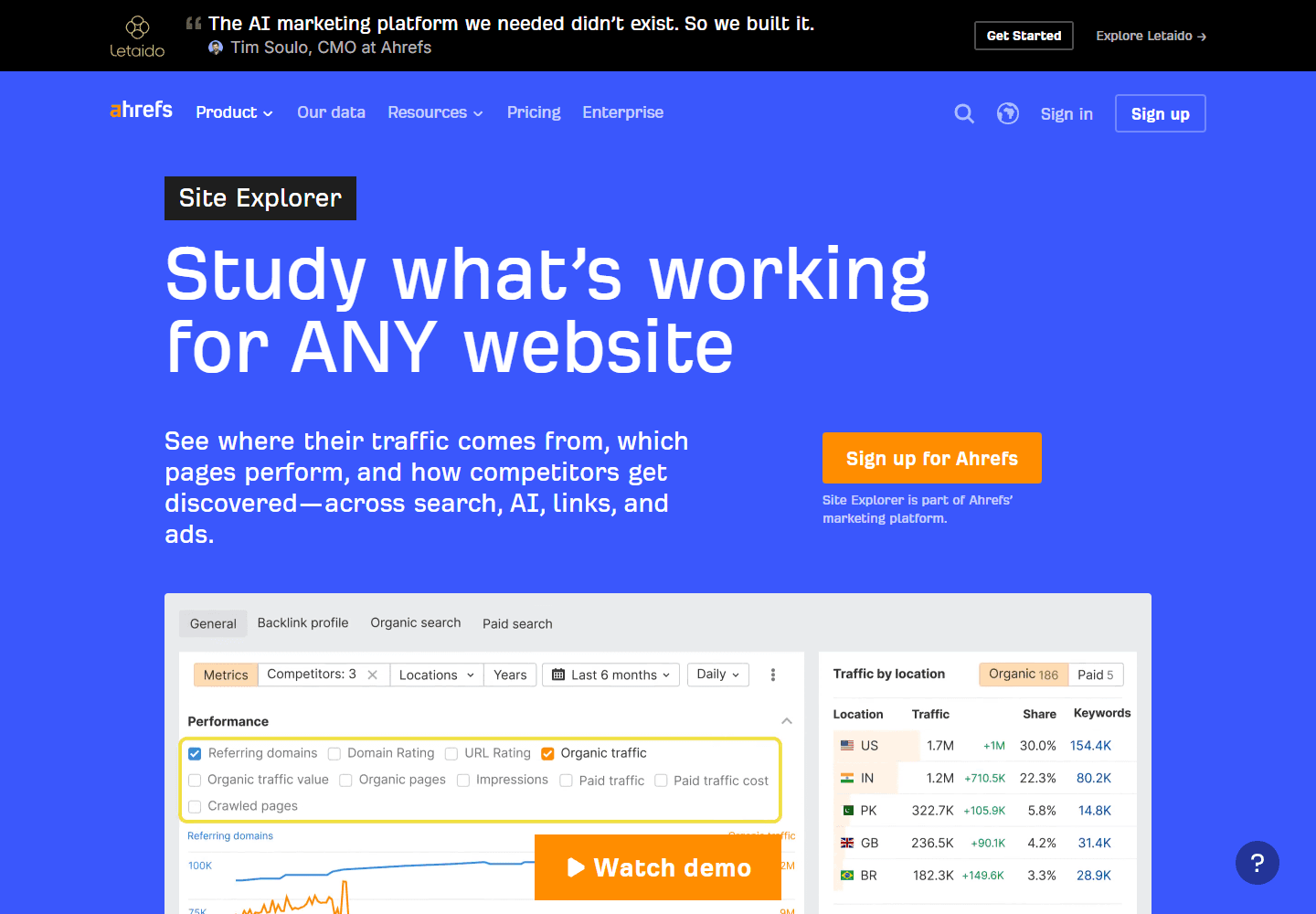
Ahrefs starts from the market. Its Site Explorer page is built around studying any website: traffic sources, top pages, competitors, organic search, paid search, links, and discovery across search and AI. That is a different starting point. It tells you where the opportunity might be, which pages already work, and what kind of authority or crawl health you are up against.
This is why a surfer seo vs ahrefs comparison goes sideways when people ask which one is better. Better for what? If you have a messy content queue and ten writers asking for clearer briefs, Surfer can feel immediately useful. If you have no clue which keywords matter, Ahrefs is the more responsible first purchase.
I have seen teams try to use Ahrefs as a writing brief by dumping keyword rows into a doc. Writers hate that. I have also seen teams use Surfer as if it could tell them an entire market strategy. That usually creates polished articles aimed at the wrong battles. The tool is not the strategy. It is the part of the process you pay to make less stupid.
Plain decision table
Which one should come first?
| Situation | Buy first | Why |
|---|---|---|
| You are starting a new site | Ahrefs | You need topic discovery, competitor maps, link gaps, technical issues, and rank tracking before a content optimizer has enough direction. |
| You already have keywords from GSC, clients, or an SEO lead | Surfer | The job is turning known targets into briefs, drafts, updates, and internal linking tasks without rebuilding your research stack. |
| You run a content agency | Usually both, but separate the jobs | Ahrefs can feed strategy. Surfer can standardize briefs and updates. The handoff matters more than owning two logins. |
| You are a solo blogger on a tight budget | Ahrefs first if research is weak; Surfer first if writing output is weak | A cheap stack with Google Search Console, one paid data tool, and clear publishing rules beats a pile of subscriptions. |
| You care about backlinks and technical SEO | Ahrefs | Surfer may help pages read better, but it is not where you investigate links, crawl health, or competitor authority. |
| You mostly refresh old articles | Surfer | Content scoring, SERP notes, and update workflows are more directly tied to refresh work than broad backlink intelligence. |
The table hides one uncomfortable truth: many teams are not ready for either tool. If you publish once every two months, do not track conversions, never refresh old content, and have no editor, the better move may be Google Search Console, a spreadsheet, and a stricter publishing habit. Paid tools amplify a workflow. They do not create one from scratch.
If you do have a workflow, start where the pain is most expensive. Research pain means you keep choosing weak topics, missing competitor moves, ignoring links, and discovering technical issues late. That points to Ahrefs. Production pain means good topics die in bloated drafts, editors rewrite the same advice, and refreshes never happen. That points to Surfer.
Pricing reality
The first bill is only the visible cost.

At the time I captured the official page, Surfer showed Standard at 99 USD per month, Pro at 182 USD per month, and Peace of Mind at 299 USD per month when billed yearly. Do not treat those numbers as evergreen. Pricing pages move. Treat the screenshot as a snapshot of the buying shape: document volume, AI visibility prompts, optimization features, team collaboration, and workflow features increase as you move up.
That means Surfer is easy to justify when those units map to real work. If your team creates or refreshes dozens of pages, a document-based workflow can save editorial time. If you publish four articles per year and mostly want SEO confidence, the bill will feel silly by month three.
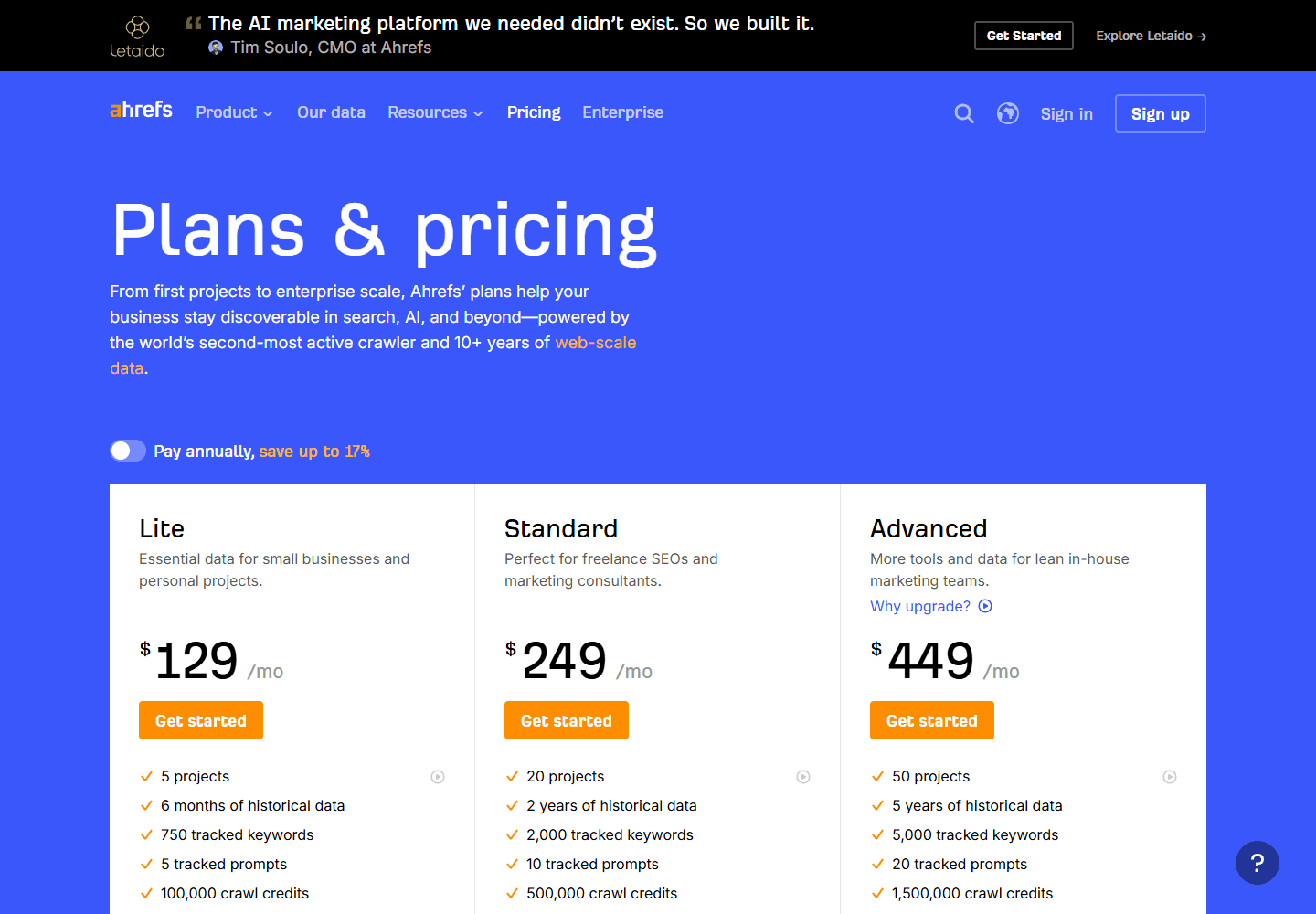
Ahrefs showed Lite at 129 USD per month, Standard at 249 USD per month, and Advanced at 449 USD per month on the official pricing page I captured. The plan cards also make the operational limits visible: projects, historical data, tracked keywords, tracked prompts, and crawl credits. For a working SEO, those units matter because they match the jobs you do every week.
The complaint is predictable: small sites often need only part of that data, but the suite price still lands as a serious monthly commitment. This is where Reddit threads get grumpy about Ahrefs. The anger is not always about bad software. It is often about paying for a research engine when the buyer only needed three answers and a little confidence.
| Question | Surfer | Ahrefs |
|---|---|---|
| Core job | Content optimization, briefs, content updates, SERP notes, content scoring, AI visibility positioning. | SEO research suite: keywords, backlinks, competitor analysis, site audits, rank tracking, crawl data, and content research. |
| Best first user | Writer, editor, content manager, or consultant who already knows what topic they need to publish. | SEO strategist, founder, consultant, or marketer who needs to choose what to work on and prove why. |
| What it will not fix | Weak topic selection, missing backlinks, thin technical SEO, and a site with no authority. | A messy article brief, bland draft, slow editorial process, or writers who need page-level guidance. |
| Pricing feel | Starts lower than Ahrefs in the official pricing screenshot, but the practical cost depends on documents, prompts, workspaces, and how many articles you run. | Starts higher, and the official page makes limits visible through projects, tracked keywords, tracked prompts, crawl credits, and plan tiers. |
| Best proof before paying | Refresh one decaying article and write one new article against a competitive SERP. Compare publish time and search-console movement. | Pick one competitor and map topics, links, top pages, and technical issues. Compare the number of decisions you can make from the data. |
Choose Surfer first
Buy Surfer first when content production is the bottleneck.
Surfer makes the most sense when your team already knows which pages to create or refresh. Maybe a consultant gives you the keyword plan. Maybe Google Search Console shows decaying posts. Maybe your product team knows the comparison pages that keep coming up in sales calls. In that situation, you do not need another week of keyword research. You need a better way to turn a target into a page.
This is where Surfer earns its keep. A content score is not strategy, and it should not boss the article around like a tiny spreadsheet with opinions. But a structured brief can stop common mistakes: missing subtopics, skipping intent, under-covering basic questions, forgetting internal links, and handing a writer a blank doc with make it SEO friendly at the top. That phrase has ruined enough Tuesdays.
Best for
Teams that already have a keyword backlog and need repeatable briefs, content updates, SERP-based notes, and writer-friendly direction.
Not for
Teams expecting a full backlink database, serious technical crawling, competitor link gap analysis, or an all-in-one SEO operating system.
Migration cost
Low to medium. Export briefs, preserve your editorial templates, move content notes into your CMS or docs, and decide which tool replaces the content score habit.
Reddit-style complaint
People complain about chasing content scores, paying for another writing workflow, and feeling pushed toward over-optimized articles that sound less like the site.
The migration cost away from Surfer is mostly editorial. You need to preserve what the team learned: brief templates, common SERP notes, internal-linking habits, and the tone rules that prevented every article from sounding like it was written by a nervous checklist. Export what you can, but do not pretend the export is the whole asset. The real asset is the shared editing judgment that formed around the tool.
The bigger risk is score addiction. Reddit complaints around content optimizers often circle the same issue: people chase the number until the page becomes bloated. That can happen with any optimization tool. A score is useful when it catches a missing angle. It is harmful when it convinces you to add six awkward phrases to a paragraph that was already clear.
My practical test is simple. Pick one article that is slipping but still has impressions. Update it with Surfer, but force the editor to reject any recommendation that makes the page less useful. Then compare the new version with the old one. If the tool made the writer faster and the article better, it has a job. If it only made the page longer, cancel before the annual plan becomes a personality trait.
Choose Ahrefs first
Buy Ahrefs first when you need the map, not a prettier draft.
Ahrefs is the better first purchase when you do not know what to write, which competitors matter, why your pages are stuck, or whether the site has link and crawl problems. That is the normal state for many small teams. They are not failing because they lack a content score. They are failing because they choose topics from vibes, publish against stronger sites, ignore links, and never check whether Google can crawl the important pages cleanly.
Site Explorer, keyword research, backlink data, top pages, site audit, and rank tracking are not glamorous. They are the boring machinery that prevents content teams from writing into a wall. Ahrefs is expensive because it sells data infrastructure, not just a writing surface. That does not make the price painless, but it does explain why comparing it with Surfer on content scoring alone is the wrong fight.
Best for
SEO operators who need keyword research, competitor pages, backlink intelligence, audits, tracked keywords, and a research base for more than one article.
Not for
Writers who only need a clean brief and on-page guidance. Ahrefs can inform content, but it does not replace an editorial system by itself.
Migration cost
Medium to high. You need to rebuild projects, tracked keywords, alerts, reports, competitor lists, and team habits around one source of SEO truth.
Reddit-style complaint
The recurring gripes are price, credit anxiety, confusing plan limits, and the feeling that a small site has to pay enterprise-adjacent money for data.
Migrating into Ahrefs is less about importing files and more about changing how decisions get made. Someone needs to own projects, competitor sets, tracked keywords, reports, audits, and the weekly habit of turning data into work. Without that owner, Ahrefs becomes a very expensive place to occasionally search a keyword and feel productive.
Migrating away from Ahrefs is harder if the team has built historical reporting, client dashboards, backlink review, and rank tracking around it. Before you leave, export the current decision assets: keyword groups, competitor lists, top-page notes, backlink prospects, crawl issues, and reporting assumptions. Otherwise the migration cost shows up later as meetings where everyone asks where that number came from.
Reddit complaints about Ahrefs often focus on cost and credits, but the quieter complaint is fit. A solo blogger may not need the depth every month. A consultant with several clients may need it daily. The same price can be outrageous or sensible depending on whether the tool drives decisions that lead to revenue.
When both make sense
Two tools can work, but only if the handoff is explicit.
There is a version of the stack where both Surfer and Ahrefs are worth paying for. It usually lives inside an agency, an in-house growth team, or a publisher with enough content velocity to make separate research and production tools rational. Ahrefs finds the opportunity. Surfer helps turn that opportunity into a page. That is clean.
The messy version is more common. One person pulls keywords from Ahrefs, another person builds a Surfer brief, a writer follows the score too literally, an editor rewrites half the article, and no one records what changed. Now the team owns two tools and still has no process. Software cannot save a handoff nobody designed.
The clean handoff
Week 1
Use Ahrefs or your existing research source to choose ten topics. Write down why each topic is worth publishing: search intent, traffic potential, competitors, and business value.
Week 2
Run three of those topics through Surfer. Build briefs, outline sections, and note where the tool helps writers avoid thin coverage.
Week 3
Publish or refresh two articles. Track editor time, writer confusion, internal links added, and whether the draft became more useful or merely more optimized.
Week 4
Review results. If research decisions were the hard part, keep Ahrefs. If briefing and updating were the hard part, keep Surfer. If both were hard and revenue supports it, keep both with separate owners.
If you run both, name the owner for each stage. Ahrefs owns research: topics, competitors, backlinks, audits, traffic estimates, and rank tracking. Surfer owns production: briefs, content coverage, updates, and optimization checks. The editor owns the final article. That last line matters. A tool can suggest coverage. It cannot decide whether a paragraph sounds like your company.
Also set a cancellation date before you subscribe. Give the stack one content cycle. If the team cannot point to faster briefs, better topic selection, cleaner refreshes, or revenue-linked search movement, the stack is not justified. We might need it is how subscriptions become office furniture.
Buying mistakes
The fastest way to waste money is to buy against anxiety.
The anxious Surfer purchase sounds like this: our articles are not ranking, so we need an optimization tool. Maybe. Or maybe the site has no authority, the keywords are too competitive, the pages have no original angle, and the internal links are a hallway with the lights off. Surfer can help with page coverage. It cannot make a weak strategy good.
The anxious Ahrefs purchase sounds like this: we need serious SEO data. Again, maybe. Or maybe the team already has enough topic ideas and simply avoids publishing because every draft gets stuck in review. Ahrefs can reveal opportunities. It will not turn a hesitant content process into a weekly shipping rhythm.
Watch for dashboard theater. If a tool gives you more screenshots for stakeholder updates but fewer shipped improvements, it is not helping. The output should be concrete: pages updated, links earned, internal links added, briefs approved, technical issues fixed, topics killed before they waste time, and articles that serve a reader better than the current search result.
My recommendation
If I had to pick one, I would start with the missing muscle.
For a brand-new site, I would usually start with Ahrefs or a cheaper research path before buying Surfer. New sites need to understand demand, competition, links, and technical health. A content optimizer can make a page neater, but it will not tell you whether the topic should have existed in the first place.
For a solo blogger with a pile of Search Console data and old posts losing traffic, I would consider Surfer first for one or two months. Not forever by default. Use it to build a refresh system, fix the pages that already have impressions, and learn what your editorial team keeps missing. If the tool teaches the process, it may be worth keeping. If it only produces scores, move on.
For a consultant or agency, I would separate research and production. Ahrefs is easier to justify when it supports several clients, audits, link work, and reporting. Surfer is easier to justify when writers, editors, and content managers use it every week. The stack becomes expensive only when nobody can point to the work each tool owns.
The surfer seo vs ahrefs answer is not a universal winner. It is a question about your current constraint. If your constraint is knowing where to compete, buy the map. If your constraint is turning chosen topics into better pages, buy the production system. If you cannot name the constraint, keep the credit card out of it until you can.
FAQ
Questions people ask before paying for either tool.
Is Surfer SEO better than Ahrefs for content writing?
Surfer is usually better for page-level content optimization and briefs. Ahrefs is better for deciding what to write, which competitors matter, and whether the site has authority or technical issues holding it back.
Is Ahrefs enough without Surfer SEO?
Yes, if you have a strong editorial process. Ahrefs can give you keywords, competitor pages, links, audits, and rank tracking. You still need a separate method for turning that research into a useful article.
Should a solo blogger buy Surfer SEO or Ahrefs first?
Buy Ahrefs first if you do not know which topics deserve work. Buy Surfer first if you already have topics from Google Search Console or clients and your bottleneck is producing better briefs and updates.
Can Surfer SEO replace Ahrefs?
Not cleanly. Surfer can improve content workflow, but it does not replace Ahrefs for backlinks, competitor research, site audits, rank tracking, or broader SEO data.
Can Ahrefs replace Surfer SEO?
It can replace Surfer only for teams that already know how to brief, edit, and optimize content without a scoring workflow. If writers need structured guidance, Ahrefs alone may feel too research-heavy.
Sources