SwitchMyTool

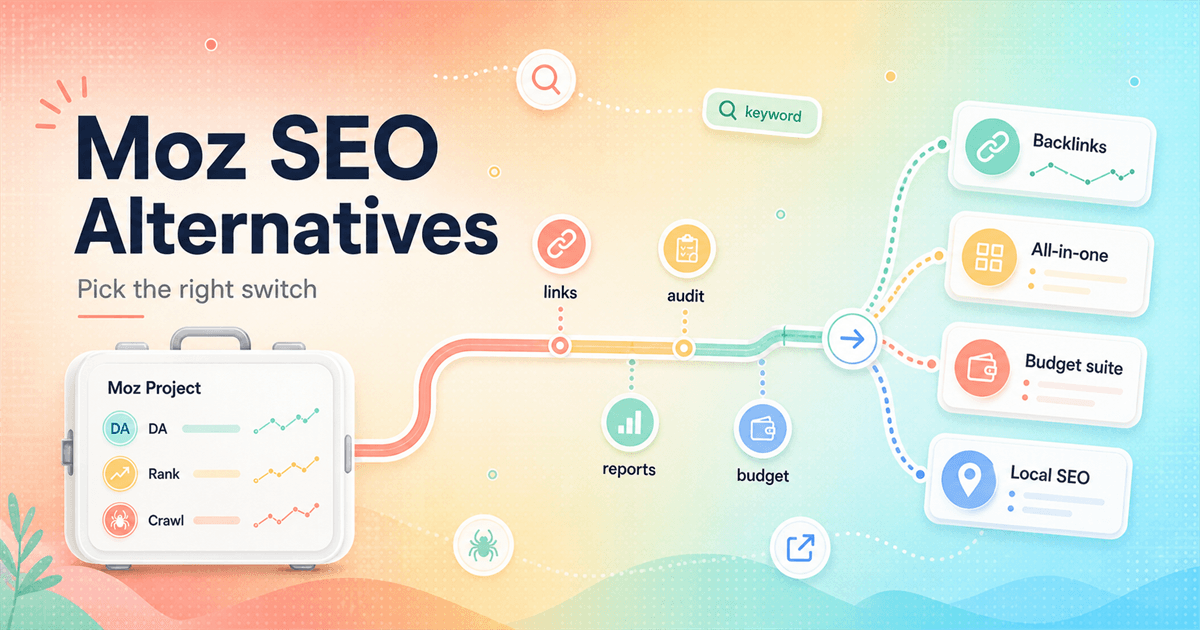
Moz is still one of the easiest SEO suites to explain to a client. The problem starts when your work outgrows what makes Moz feel friendly in the first place.
People search for moz seo, seo moz, moz alternative, and moz alternatives for slightly different reasons. Some want to know whether Moz Pro is still worth paying for. Some inherited an old account and want to know if the data still holds up. Some like Domain Authority but feel the rest of the workflow is getting cramped. A few are just trying to escape a monthly bill that made sense three websites ago.
I would not treat Moz as a bad tool. That is too easy and not very useful. Moz has a real place: approachable SEO reporting, recognizable authority metrics, keyword tracking, crawl basics, and a product that does not punish beginners for opening the wrong menu. If you learned SEO through Whiteboard Friday or old SEO Moz posts, that comfort is not imaginary.
The harder question is whether comfort is still the job. If your weekly work now depends on link gaps, competitor top pages, PPC overlap, multi-client reporting, AI search monitoring, or cheaper rank tracking, you may need a different tool. This guide compares Moz with Ahrefs, Semrush, SE Ranking, Mangools, and a few add-on paths so you can switch for a reason instead of switching because Reddit made you feel behind.
My buying rule
- Keep Moz if you want a friendly SEO platform, familiar authority metrics, keyword tracking, crawl basics, and a lower learning curve for a small team.
- Switch to Ahrefs if link research, competitor pages, keyword depth, and crawl credits matter more than a gentle interface.
- Switch to Semrush if your SEO work spills into PPC, content planning, local visibility, reporting, and broader marketing operations.
- Switch to SE Ranking or Mangools if the real problem is price, not capability. They can be easier to justify for solo operators and small agencies.
Start with fit
Moz is best when SEO needs to feel explainable.
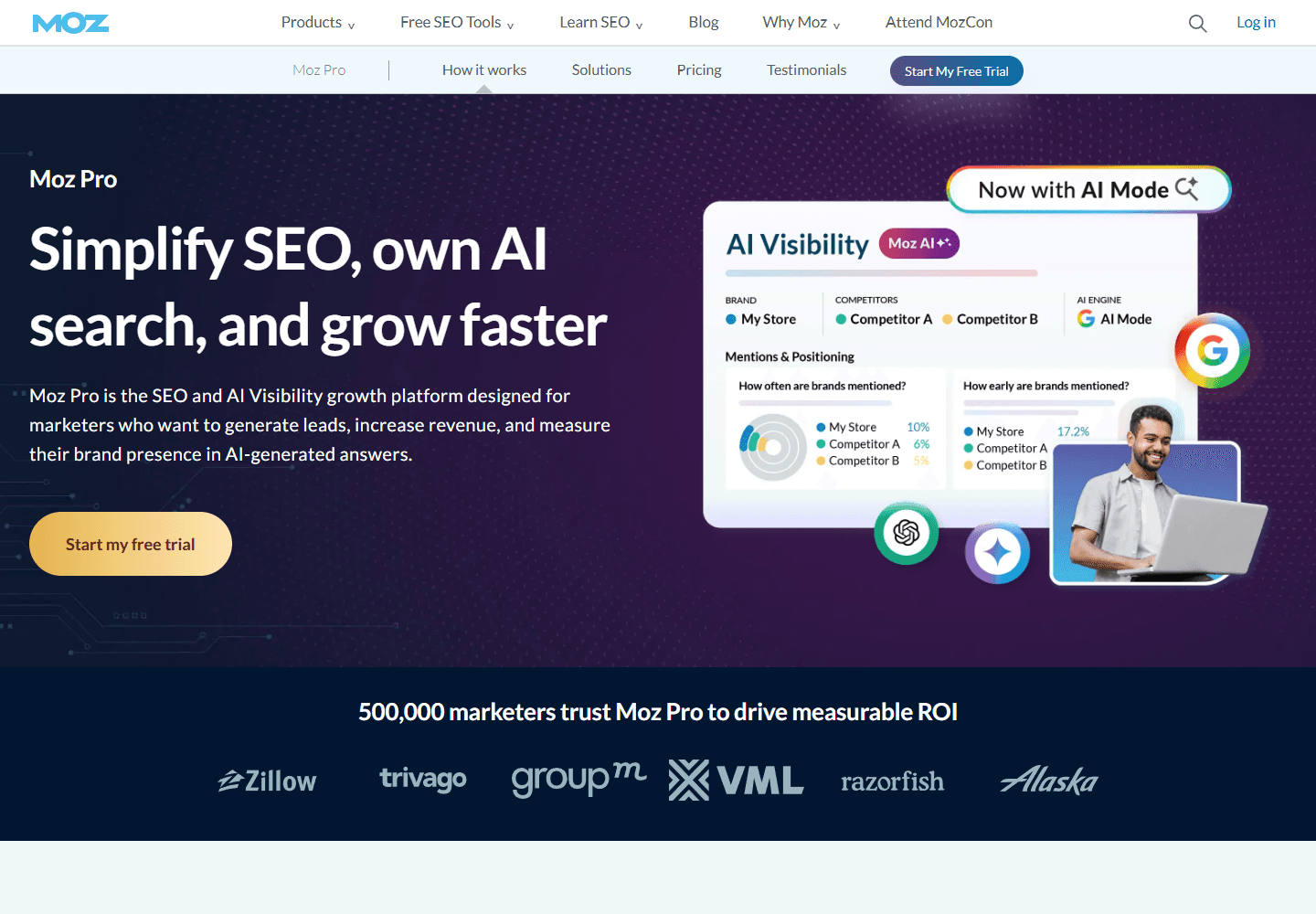
Moz Pro now presents itself as an SEO and AI visibility platform. The official page talks about generating leads, increasing revenue, measuring brand presence in AI-generated answers, and using Moz AI features. That is a modern pitch, but the core reason people stay with Moz is still practical: it gives small teams a less intimidating way to talk about rankings, links, crawl issues, and authority.
That friendliness matters. Many founders and content managers do not want to live inside a research cockpit. They want to know which keywords moved, whether a site crawl found obvious problems, and whether a prospect domain looks stronger than it did last quarter. Moz gives them language for that.
The weakness shows up when the work gets more specialized. If a link builder asks for deep competitor link intersections, Moz may feel light. If an agency wants flexible client reporting across dozens of accounts, it may feel too simple. If a technical SEO wants crawler-level control, Moz is not the main tool. That does not make Moz obsolete. It means Moz belongs to a certain type of job.
Best for
Beginners, small teams, consultants, founders, and client-facing marketers who need an SEO platform that people can understand without a month of tool training.
Not for
Heavy backlink research, enterprise SEO operations, deep technical crawling, big agency reporting, or teams that want one platform for SEO, PPC, local, and content operations.
Migration cost
Medium. The painful part is not exporting data. It is replacing Moz campaigns, tracked keywords, saved reports, competitor sets, and familiar DA language in stakeholder conversations.
Reddit common complaint
Users tend to question data depth, pricing for small sites, and whether Moz has kept pace with Ahrefs and Semrush for serious research-heavy SEO work.
Reddit complaint patterns
Data confidence
Reddit threads about Moz often circle around whether its link and keyword data feels deep enough compared with Ahrefs or Semrush.
Old habits
Some people still say seo moz because they learned SEO through Moz years ago. That brand memory is useful, but it can also hide newer workflow needs.
Price pressure
Small-site owners complain less about any single feature and more about paying for a suite when they only need rank tracking, crawl checks, or a few keyword exports.
Migration drag
Teams hesitate because switching means rebuilding campaigns, tracked keywords, saved reports, client dashboards, and the language they use around Domain Authority.
Pricing shape
Moz is approachable, but the bill still needs a job.
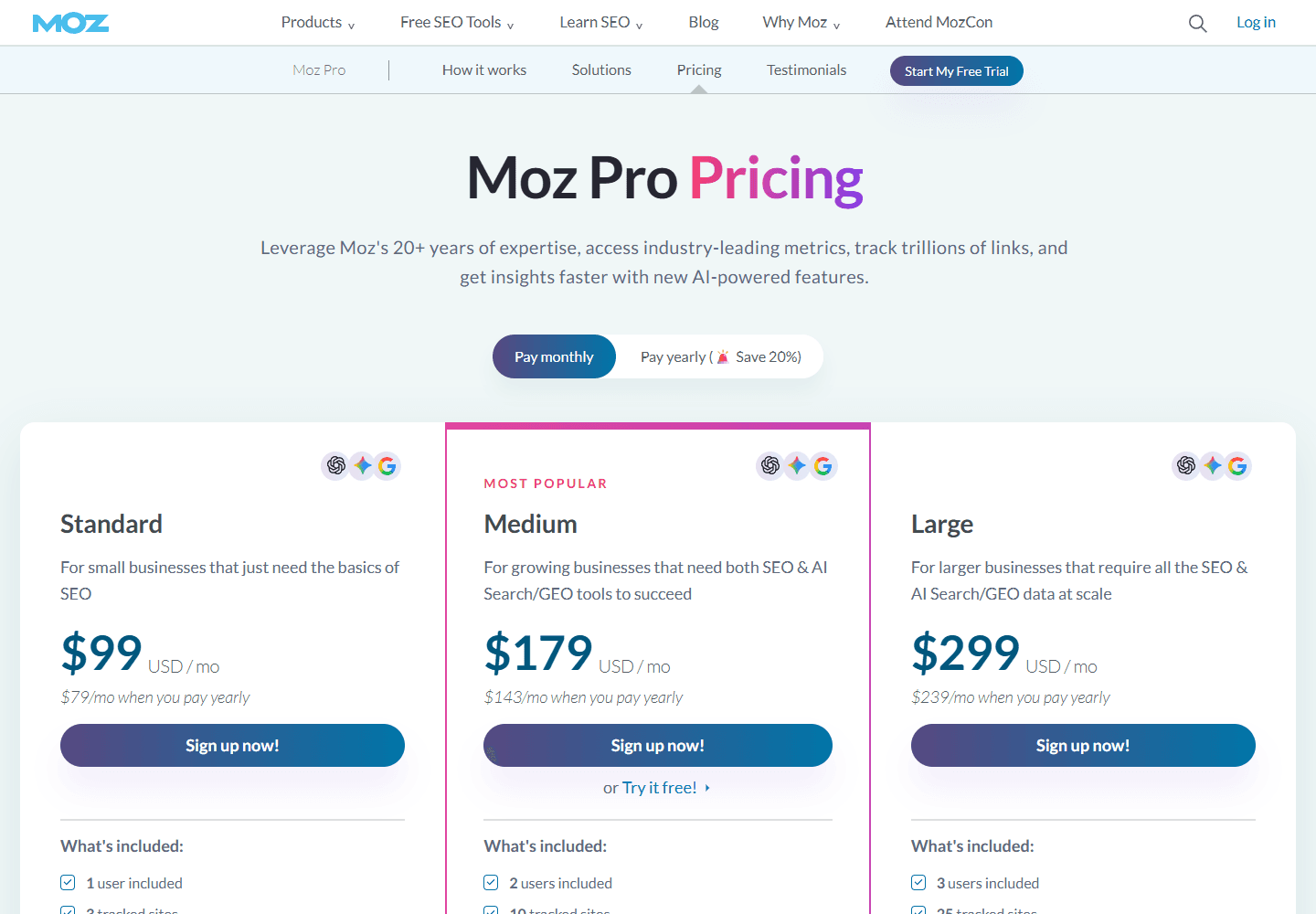
The Moz Pro pricing screenshot I captured shows Standard at 99 USD per month, Medium at 179 USD per month, and Large at 299 USD per month when paid monthly, with lower monthly equivalents when paid yearly. Pricing pages change, so use the official page as the source before you buy. The useful lesson is the shape of the plans: Moz sells a broad SEO platform with users, tracked sites, tracked keywords, and AI-search features layered in.
That can be a good deal if Moz covers your weekly work. It is a bad deal if you only open it twice a month to check Domain Authority and feel vaguely SEO-responsible. A lot of software waste starts that way. The subscription is not painful enough to cancel, but not useful enough to change decisions.
Before you look for a moz alternative, write down the three jobs you actually need. Keyword research? Link prospecting? Client reports? Site audits? Local rankings? AI visibility? If the list is fuzzy, every alternative will look good for ten minutes and annoying by Friday.
| Situation | Best move | Why |
|---|---|---|
| You are learning SEO or managing one small site | Stay with Moz or test Mangools | Moz keeps the learning curve manageable. Mangools can be cheaper if you mostly need keyword research and lightweight tracking. |
| You care most about backlinks and competitor pages | Ahrefs | Ahrefs is the stronger research engine when links, top pages, content gaps, and competitor visibility drive the work. |
| You need a broader marketing suite | Semrush | Semrush is built for SEO plus PPC, content, local, reports, and agency operations. It can be too much, but that is sometimes the point. |
| You run recurring client reports on a budget | SE Ranking | SE Ranking gives agencies a lot of rank tracking, audit, reporting, and client workflow value without jumping straight to the priciest suites. |
| You use Domain Authority in sales or client language | Keep Moz in the stack | DA is still widely recognized. Even if another tool owns daily research, Moz metrics may remain useful in reports and link conversations. |
| You need a desktop technical crawler | Add Screaming Frog, do not replace Moz with it | Screaming Frog solves a different job. It is a crawler, not a hosted SEO suite with rankings, links, and reports. |
Best for link-led SEO
Ahrefs is the obvious Moz alternative when backlinks and competitor pages drive the work.
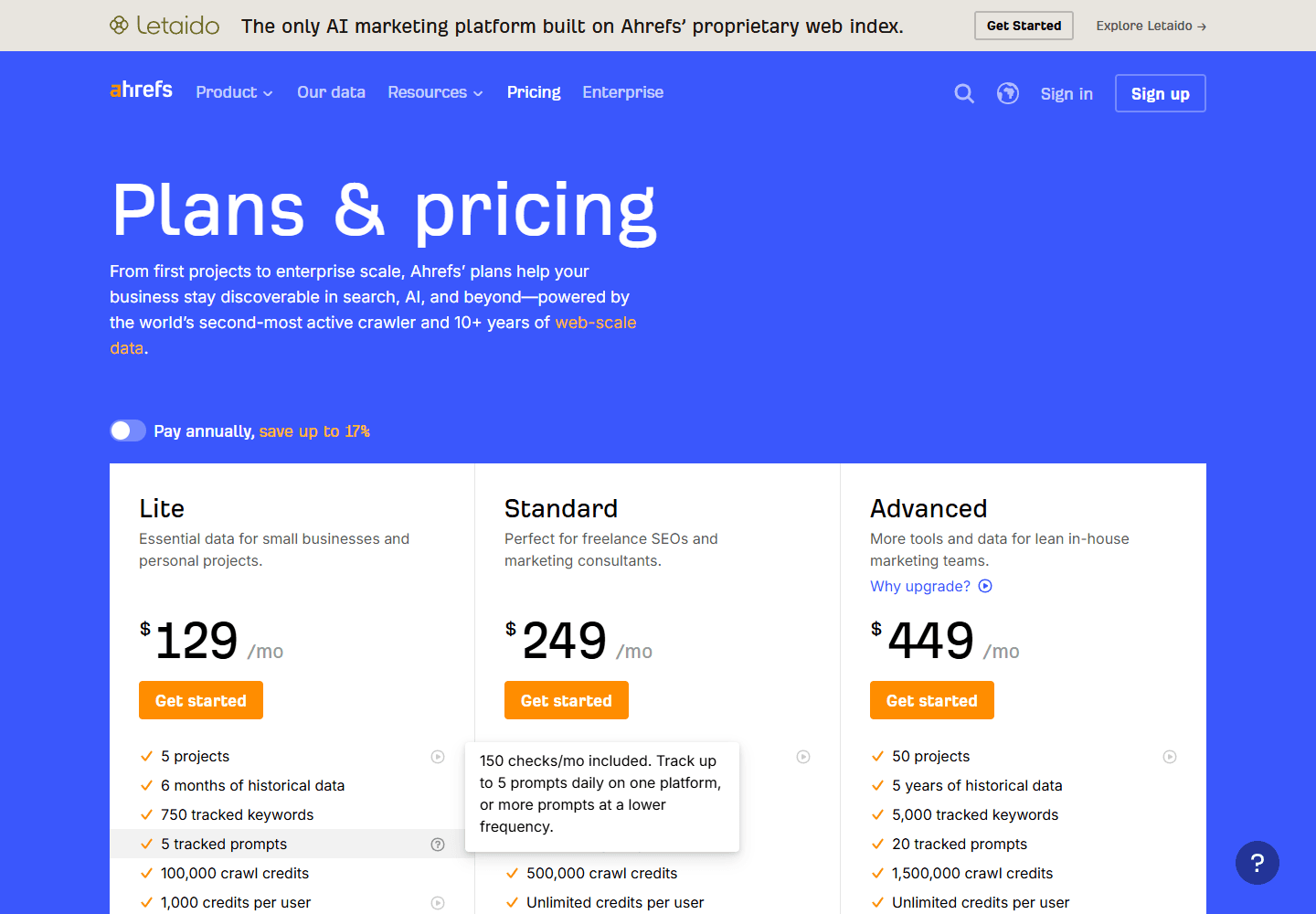
Ahrefs is the tool I would test first if your Moz complaint is data depth. The official pricing page puts projects, historical data, tracked keywords, tracked prompts, crawl credits, and user credits right on the plan cards. That tells you what Ahrefs thinks it sells: a research engine for people who make SEO decisions from large datasets.
The main reason to switch from Moz to Ahrefs is not that Ahrefs has a louder fan club. It is that link research, competitor top pages, content gaps, and keyword exploration can become the center of your workflow. If you are deciding which pages to build, which competitors to chase, and which links explain the gap, Ahrefs is usually more useful than a friendlier dashboard.
The downside is cost and complexity. Reddit complaints about Ahrefs often mention pricing, limits, credits, and the feeling that a small site has to rent a very serious machine to answer a few questions. That criticism is fair for light users. Ahrefs makes more sense when the data changes what you do every week.
Best broad suite
Semrush is the Moz alternative when SEO is only part of the job.
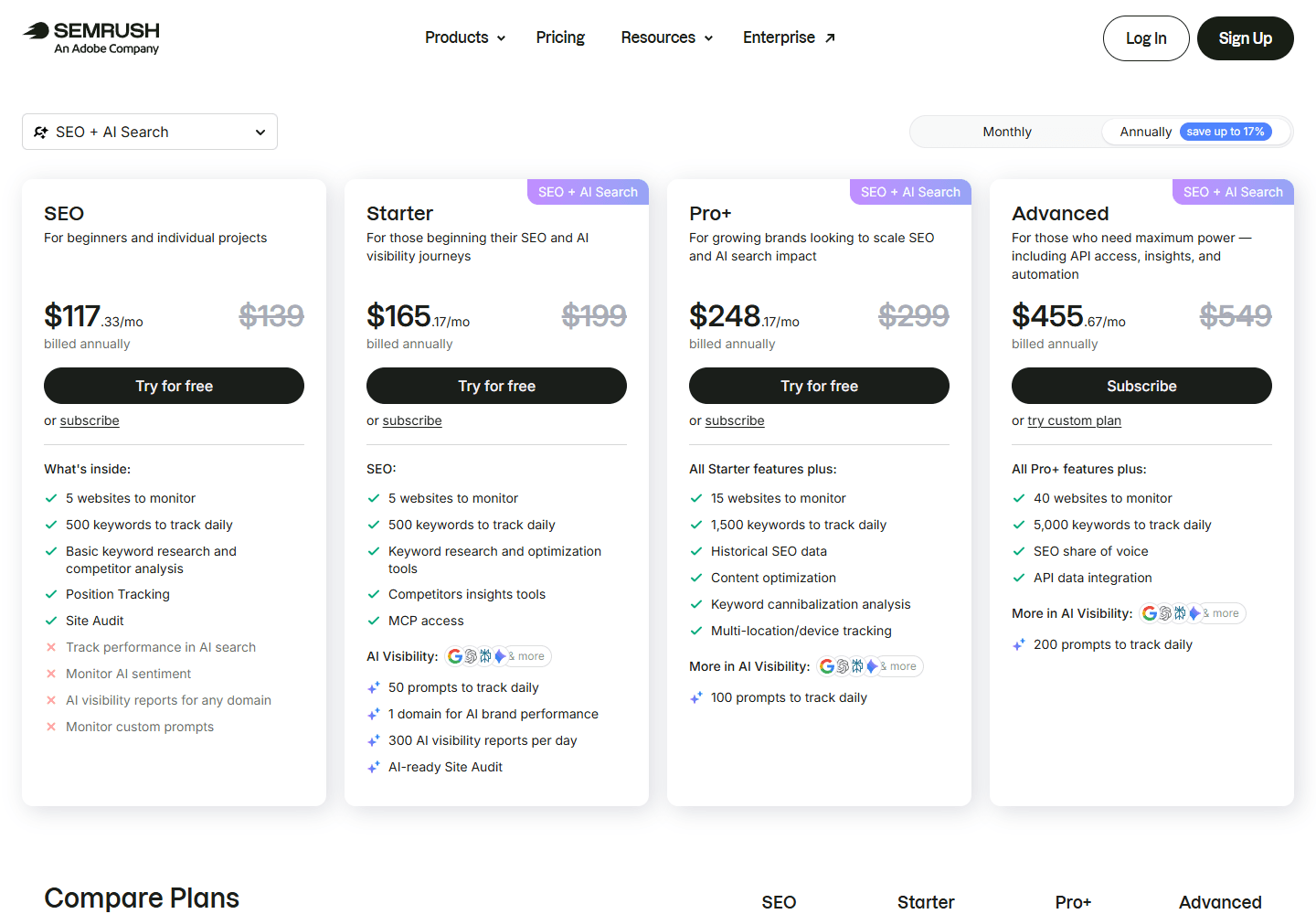
Semrush is rarely the quiet choice. It is a large platform, and the pricing page now leads with SEO plus AI Search tiers. The product footprint can stretch into competitive research, content, PPC, local, reporting, and agency workflows. That is exactly why some teams love it and some solo operators bounce off it.
If Moz feels too small because your team wants broader marketing operations, Semrush is a serious test. It can replace several disconnected tools, especially for agencies that need reports, competitive context, keyword work, and paid-search overlap in one place. The reporting story also tends to matter when clients are paying for monthly proof of work.
The risk is dashboard sprawl. If you buy Semrush because it has every module, you may spend the first month clicking around and the second month wondering which parts matter. Semrush needs an owner. Someone has to decide which reports count, which projects get tracked, which tools are ignored, and which insights turn into work.
Best agency budget fit
SE Ranking is the Moz alternative for repeatable delivery without buying the biggest suite.
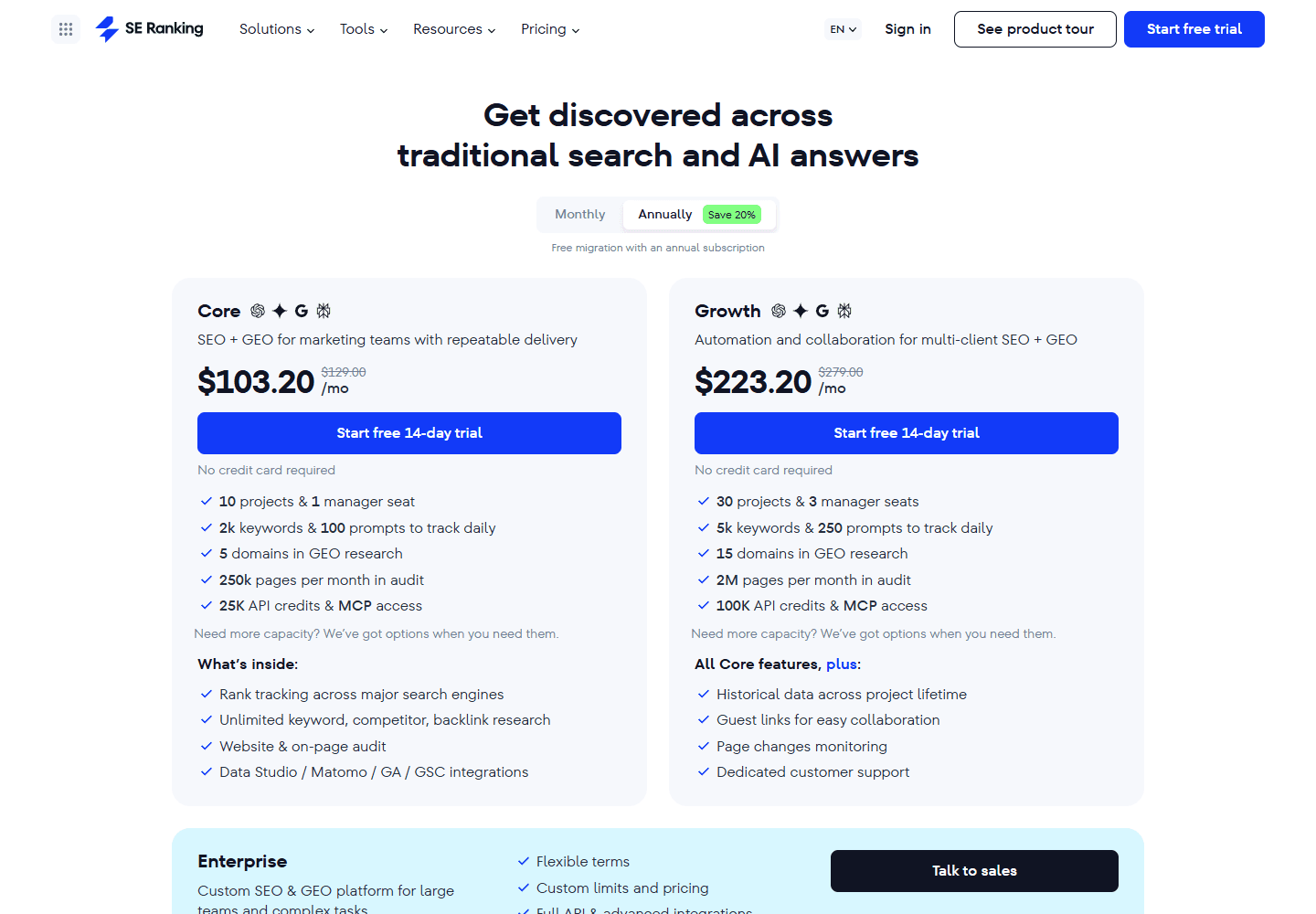
SE Ranking belongs in the conversation when you want a practical SEO platform at a more manageable price shape. The official page I captured shows Core and Growth plans with projects, manager seats, tracked keywords, prompts, audit pages, API credits, and reporting-friendly features. That is a strong pitch for small agencies and consultants.
I would test SE Ranking if Moz feels too limited but Ahrefs or Semrush feels like bringing a forklift to move a chair. It gives you rank tracking, audits, keyword and competitor workflows, and reporting in a package that can be easier to sell internally. That matters when the buyer is not a full-time SEO nerd and just wants the client work to run on time.
The tradeoff is depth. If your whole strategy depends on the strongest backlink index you can get, Ahrefs is still the more obvious test. If you need every marketing surface in one platform, Semrush may fit better. SE Ranking wins when the job is consistent SEO delivery, not maximum data firepower.
Best simpler switch
Mangools is the Moz alternative for people who want less tool, not more.
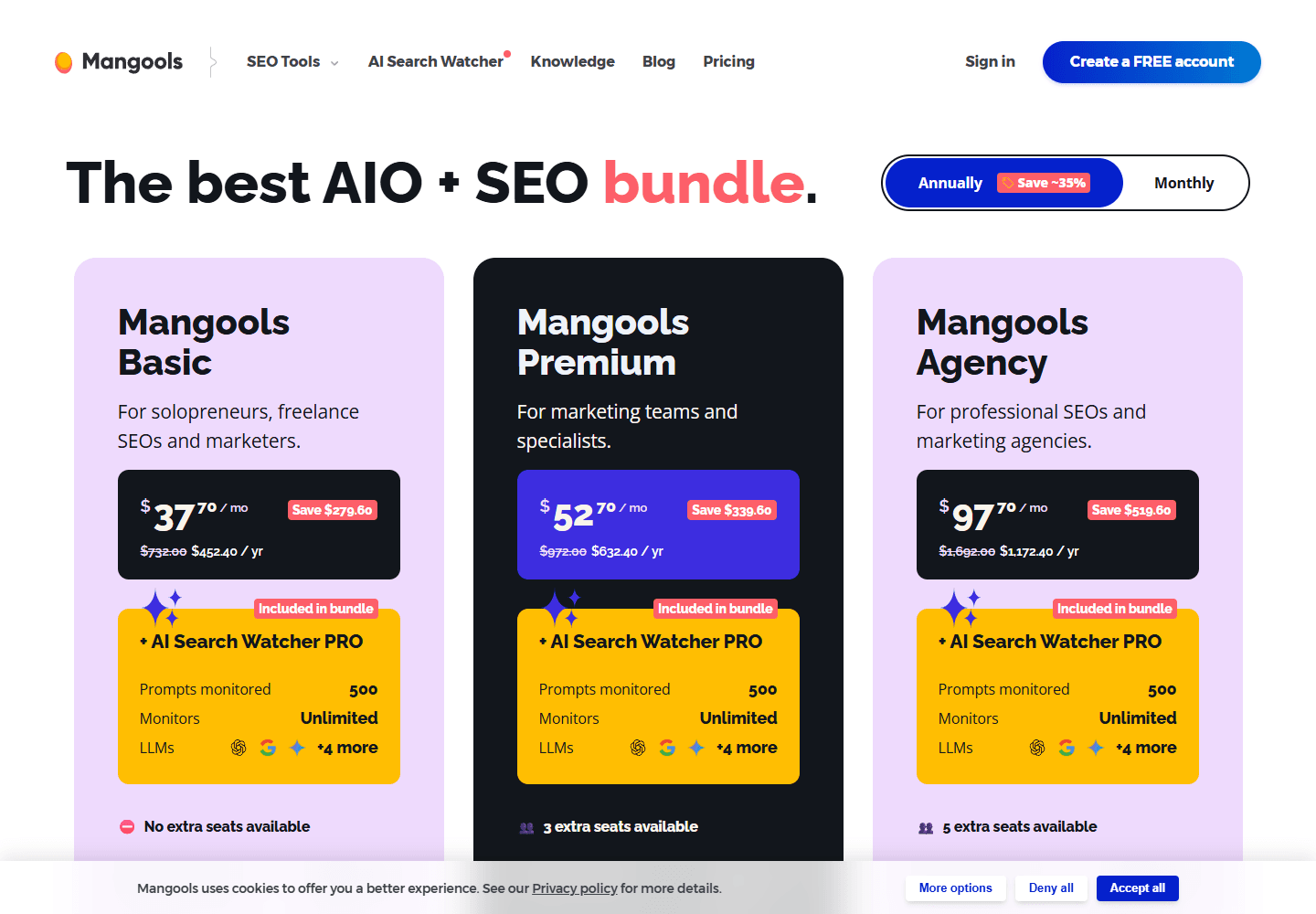
Mangools is not trying to look like the command center at a search-engine submarine. That is part of the appeal. Its pricing page presents a bundle for solopreneurs, freelance SEOs, marketers, professional SEOs, and agencies, with KWFinder, SERPChecker, SERPWatcher, LinkMiner, SiteProfiler, and newer AI Search Watcher positioning around the package.
If Moz feels expensive because you only need lightweight keyword research, SERP checks, rank tracking, and a basic backlink view, Mangools is worth testing. It can be easier to teach to a content person or founder. It is also less likely to turn a two-hour keyword session into a full afternoon of competitive archaeology.
The reason not to choose Mangools is also clear: you may outgrow it. A complex agency, technical SEO team, or link-heavy operation will probably want more depth. But if your current pain is that Moz is more subscription than workflow, a lighter tool can be a better fix than a bigger suite.
Side-by-side
Pick the alternative by the work it owns.
| Tool | What it is best at | Best fit | Skip if |
|---|---|---|---|
| Moz Pro | Friendly SEO suite with Keyword Explorer, Link Explorer, site crawl, rankings, competitive research, and recognizable authority metrics. | Beginners, small teams, consultants who like DA/PA, and teams that want useful SEO basics without a maximalist dashboard. | Link-depth comparisons, advanced agency reporting, and users who want the largest possible data engine. |
| Ahrefs | Research-heavy SEO suite with strong backlink, keyword, competitor, top-page, rank, and crawl workflows. | SEOs who choose topics and links from data every week. | Writers or owners who only need a simple Moz alternative for light rank tracking. |
| Semrush | Broad marketing platform that stretches beyond SEO into paid search, content workflows, local, and reporting. | Agencies and in-house teams that want one large operational platform. | Solo bloggers who will only use three reports and then feel guilty about the bill. |
| SE Ranking | Practical SEO and GEO suite with rank tracking, audits, keyword and competitor tools, reporting, and client-friendly pricing shape. | Small agencies, consultants, and teams that need repeatable delivery without buying the biggest suite. | Teams that need Ahrefs-level link research or Semrush-level marketing breadth. |
| Mangools | Lightweight SEO bundle with keyword research, SERP checks, rank tracking, backlink checks, and now AI search watcher positioning. | Solopreneurs, affiliate site owners, and marketers who want a simpler, cheaper Moz alternative. | Complex agencies, enterprise reporting, deep crawl work, or heavy backlink operations. |
Migration cost
Switching from Moz is mostly a reporting and language problem.
The technical migration is boring. Export keyword lists, download reports, save crawl issues, record competitors, and copy the project setup. The human migration is where teams get stuck. Moz often becomes the vocabulary of the SEO program. People say DA, tracked campaign, visibility, crawl issues, and spam score because those are the numbers they are used to seeing.
A new tool will not match those numbers perfectly. It should not. Ahrefs has its own metrics. Semrush has its own metrics. SE Ranking and Mangools have their own limits and labels. The migration will feel broken if you expect identical dashboards. Instead, decide which old metric maps to which new decision.
Campaigns
Export tracked keywords, locations, competitors, and reporting cadence before touching billing. This is the stuff people forget until Monday's client update.
Reports
Save the last three reports for each important site. You need a baseline when the new tool shows different numbers, because it will.
Metrics language
Decide what replaces Domain Authority, Page Authority, spam score, visibility, and ranking labels in client or stakeholder conversations.
One-cycle overlap
Run Moz and the new tool side by side for one reporting cycle. Cancel only after the new workflow has survived a real deadline.
My preferred migration is one reporting cycle. Keep Moz active, set up the new tool, rebuild the same projects, and run the weekly workflow in both. Do not compare every number. Compare decisions. Did the new tool help you choose a better topic, find a better competitor, catch a crawl issue, or produce a report faster? If not, you did not switch. You just redecorated the same uncertainty.
This is also where Reddit complaints become useful. People are often not mad because one tool lacks one feature. They are mad because switching did not remove the underlying chore. If no one owns the weekly SEO process, Ahrefs will feel expensive, Semrush will feel bloated, SE Ranking will feel like another dashboard, and Mangools will feel too light. The tool is not the owner. You still need one.
My recommendation
Start with the missing job, not the loudest brand.
If you are happy with Moz and the work gets done, do not switch because a forum thread made you insecure. Moz still has a place for small teams, client education, approachable reporting, and familiar authority metrics. There is no prize for replacing a tool that already fits.
If the missing job is link-led research, test Ahrefs. If the missing job is broad marketing operations, test Semrush. If the missing job is affordable client delivery, test SE Ranking. If the missing job is a lighter workflow for a solo site, test Mangools. If the missing job is technical crawling, add a crawler instead of pretending a suite will do everything.
The best moz alternative is not the tool with the longest feature page. It is the one that changes the next four weeks of work. A good switch should make topic choices clearer, reports easier, links less mysterious, audits more actionable, or rank tracking less expensive. If it cannot do one of those things, keep Moz and spend the money somewhere less shiny.
FAQ
Questions people ask before moving away from Moz.
What is the best Moz alternative for backlink research?
Ahrefs is usually the first Moz alternative to test if backlink research, competitor top pages, and link gaps drive your SEO decisions.
Is Moz SEO still worth using?
Moz SEO is still worth using when you want a friendlier SEO suite, recognizable authority metrics, keyword tracking, crawl basics, and a lower learning curve.
Why do people search for seo moz instead of Moz SEO?
A lot of older SEO education used the phrase SEO Moz before the brand simplified around Moz. The search intent today usually means Moz tools, Moz Pro, or Moz alternatives.
Which Moz alternatives are best for small agencies?
SE Ranking is a strong first test for small agencies because it balances rank tracking, audits, reports, and client workflow. Semrush is stronger when the agency also needs broader marketing tools.
Should I cancel Moz before testing another tool?
No. Run one reporting cycle in both tools. Export campaigns, rankings, reports, and link notes first, then cancel only after the new workflow can handle your normal weekly work.
Sources