SwitchMyTool

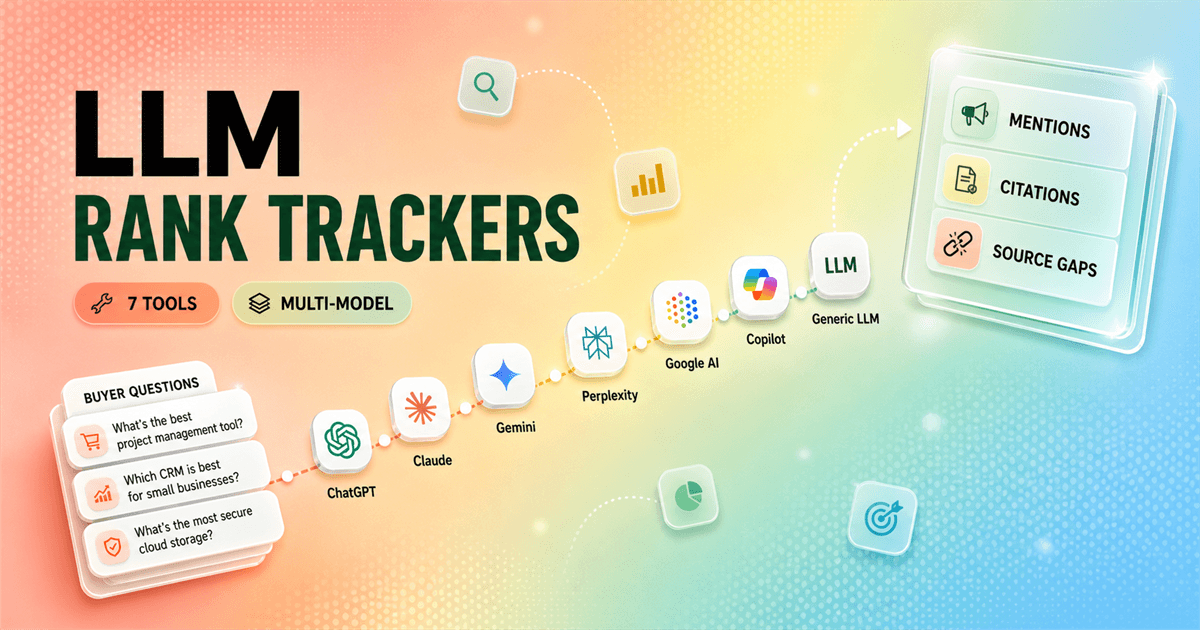
I have spent enough time around rank trackers to know how quickly a clean chart can hide a messy measurement. Traditional search at least gives us a URL, a query, a country, a device, and a position. LLM answers can change when one word in the prompt changes, when the assistant retrieves fresh sources, or when the provider quietly updates the model.
That does not make tracking useless. It makes the buying test stricter. The best LLM rank tracker should show me the evidence behind the score, let me control important buyer questions, repeat them consistently, separate models and markets, preserve cited URLs, and export enough data to survive a vendor change.
I narrowed this list to seven products with current public pages, useful multi-model coverage, and a clear reason to exist. Some are affordable monitors. Others are closer to an AI-search operating system. I would not pay the latter's price to answer the former's question.
My verdict
LLMrefs is my best overall pick, but the right answer depends on what happens after the chart moves.
LLMrefs is the best LLM rank tracker for most SEO and content teams in this group. Its $79 monthly plan includes 500 prompts, all supported AI engines without separate engine fees, citation and competitor analysis, and a keyword-led workflow that feels familiar without pretending AI answers are ten blue links.
Rankscale is the stronger choice when engine selection, market coverage, flexible schedules, and technical visibility matter more than simplicity. Knowatoa is the one I would shortlist for a small team that needs clear content and source actions. AthenaHQ belongs in an established program with a real owner and budget. Writesonic earns its place when the same team also creates and refreshes content. ZipTie offers the cleanest public check-based economics, while Geneo is the easiest low-cost credit experiment.
My blunt rule is simple: do not buy a broad GEO platform until a manual 25-prompt baseline has already produced a decision. If nobody changed a page, brief, outreach target, comparison, or reporting habit after the baseline, a larger dashboard will probably become another expensive tab.
Best overall
LLMrefs for broad engine coverage, keyword-led setup, citations, competitors, and approachable public pricing.
Best control
Rankscale for detailed engines, regions, schedules, research, technical checks, and credit-based scale.
Best action layer
Knowatoa for teams that want visibility gaps connected to sources, content work, and recurring reporting.
Best budget test
Geneo for a low monthly price, free trial credits, history, competitors, and pay-as-you-go flexibility.
Measurement first
An LLM rank is a repeated sample, not a permanent position.
I use the word rank because that is what buyers search for, but I do not report an LLM position as if it were a Google position. There is no stable page of ten answers. A brand may appear first in one response, vanish in the next, and return as a citation when browsing or retrieval changes.
A useful tracker reduces that uncertainty through repetition and transparency. It should keep the prompt fixed, identify the model or consumer surface, record location and language, run enough samples to expose volatility, and store the complete answer. Aggregation is useful only after the raw evidence remains available.
This is also why the best online LLM rank tracker is not necessarily the one with the prettiest visibility score. I want to know how that score was built. If the vendor cannot explain whether it queries an API, a consumer interface, a search-grounded mode, or a mixture, I will not build a board report around it.
| Metric | What it measures | How I use it |
|---|---|---|
| Mention rate | How often the brand appears across repeated answers | Useful when the prompt set, market, model, and cadence stay fixed |
| Citation rate | How often an answer links to a page on the brand's domain | Stronger evidence than an unlinked name drop, but still not a click |
| Share of voice | Brand appearances compared with named competitors | Shows whether category visibility is improving relative to the market |
| Answer position | Where a brand appears in a list or narrative response | Directional only because answer order can change between runs |
| Source influence | The domains and pages repeatedly used to support answers | Turns a dashboard into content, digital PR, documentation, or outreach work |
| Business outcome | AI referrals, assisted conversions, qualified leads, and sales mentions | Prevents a visibility score from becoming an expensive vanity metric |
Side-by-side
The seven tools solve different versions of the same problem.
Headline pricing is a poor comparison because every vendor sells a different unit. One sells keywords, another prompts, another checks, another credits, and another bundles rank tracking with content production. I model the actual workload before I compare plans: prompts multiplied by models, markets, repetitions, brands, and monthly cadence.
The table uses publicly available starting prices and limits I could verify on July 14, 2026. Annual billing, add-ons, custom contracts, and model coverage can change, so I would confirm the final order form before migrating any reporting workflow.
| Tool | Public starting point | Useful allowance | Best for | Main caution |
|---|---|---|---|---|
| LLMrefs | $79/mo | 500 prompts across major AI engines; keyword-led setup | SEO teams that want broad model coverage without enterprise pricing | At least weekly keyword updates are slower than daily crisis monitoring |
| Rankscale | From €20/mo | 17+ engines, broad regional coverage, credit-based monitoring | Teams that need granular engines, markets, schedules, and technical analysis | Credit math needs a real workload model before purchase |
| Knowatoa | $59/mo Starter | 30 questions, daily refreshes, 2,790 answers processed monthly | Small teams that want monitoring tied to content and source gaps | Full seven-engine coverage sits on the $199 Growth plan |
| AthenaHQ | $295+/mo | 3,600 credits and visibility across up to eight major LLMs | Established brands with a real GEO owner and reporting budget | Too expensive for a speculative ten-prompt experiment |
| Writesonic | $249/mo, or $199/mo annually | 100 tracked prompts on Basic plus SEO, audit, and content workflows | Content teams that want to move from visibility gap to published fix | Buying the full suite just for rank tracking wastes money |
| ZipTie | $69/mo | 500 checks across ChatGPT, Perplexity, and Google AI Overviews | Lean SEO teams that value transparent check limits and optimization tasks | Three-engine coverage is narrower than the broadest multi-model tools |
| Geneo | $39.90/mo | 1,000 credits, competitor analysis, history, and GEO optimization | Budget-conscious teams and agencies testing a credit model | Credits require more planning than a simple prompt allowance |
Best overall
1. LLMrefs turns keywords into a multi-model evidence set.
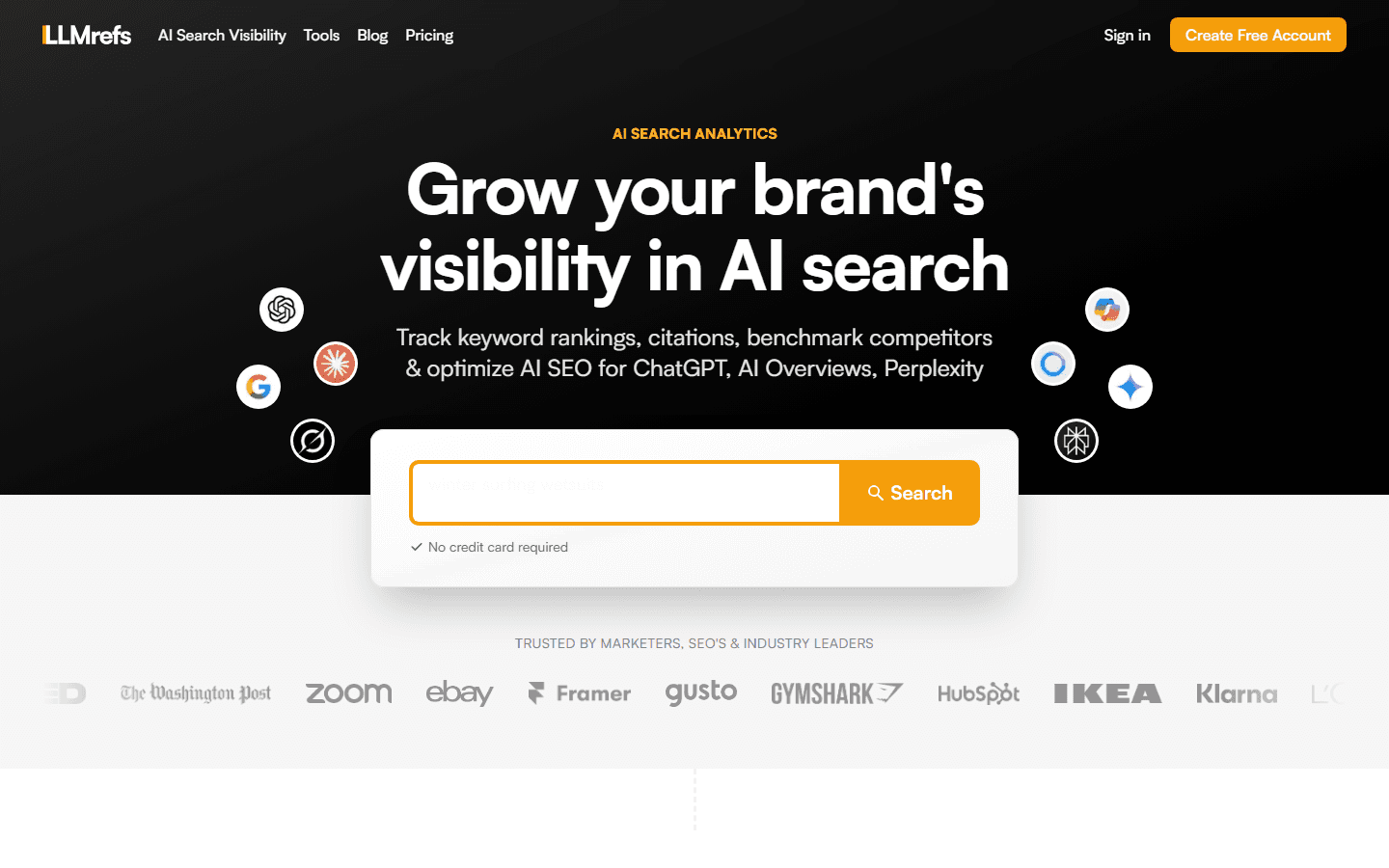
LLMrefs is the first product I would trial for a conventional SEO team. The setup starts with keywords rather than forcing me to invent hundreds of exact prompts. The platform expands that topic into conversations, then aggregates brand position, share of voice, citations, sources, and competitors across ChatGPT, Google AI Overviews, AI Mode, Gemini, Perplexity, Claude, Grok, Copilot, Meta AI, and DeepSeek.
That keyword-led approach is useful when the team already has a category map but does not yet have a mature prompt library. It reduces setup theater. I can start with the topics buyers and sales teams already recognize, inspect the generated prompt coverage, then remove nonsense before it enters a monthly report.
The public All in One plan is $79 per month and includes 500 tracked prompts with all AI search engines included. LLMrefs says each keyword is updated at least weekly and supports segmentation by engine and country. That cadence is sensible for strategy. I would not use it as my only monitor during a fast reputation issue or launch where daily movement matters.
My first test would use ten commercial topics and five deliberately awkward branded questions. I would compare the raw sources with Search Console landing pages, digital PR targets, and competitor comparison content. If the tool only tells me that visibility moved, I have learned little. If it identifies recurring sources and missing topic coverage, the subscription can earn its keep.
Best for
SEO and content teams that want broad model coverage without buying an enterprise platform.
Not for
Teams that need minute-by-minute alerts, deep enterprise governance, or a guaranteed daily refresh for every topic.
Setup cost
Low to moderate. Keyword-led discovery is faster, but brand aliases, competitors, markets, and irrelevant generated prompts still need review.
First proof
Find one repeated citation gap that becomes a useful page update, outreach target, or comparison brief within the trial.
Best control
2. Rankscale gives me the widest configuration surface.
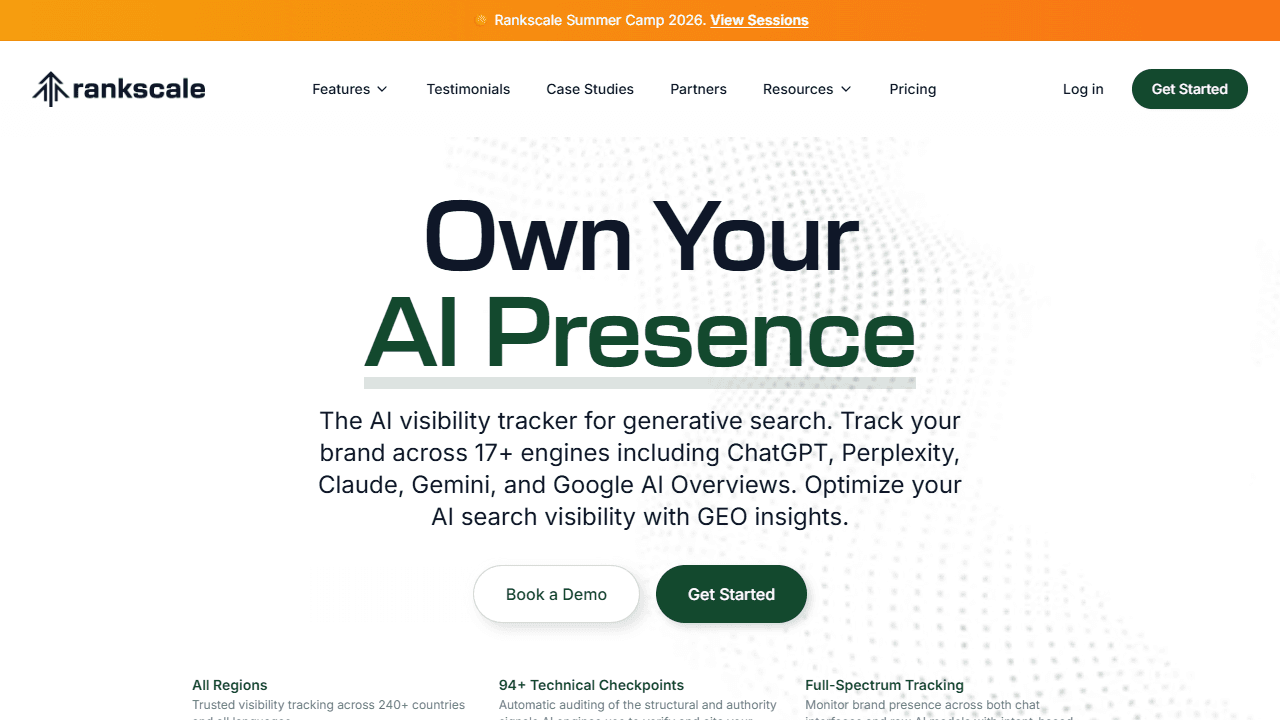
Rankscale is the product I would investigate when a client asks for several models, countries, languages, and schedules instead of one simple weekly score. Its public material lists 17-plus engines, coverage across more than 240 countries, and monitoring intervals from hourly to monthly. Search terms are unlimited; usage is governed by credits and the engines selected for each run.
The depth goes beyond mention counting. Rankscale lists citation analysis, sentiment, competitor benchmarking, prompt research, fan-out tracking, shopping analysis, source-box analysis, technical page audits, custom dashboards, and shareable reporting. That breadth can replace several improvised workflows, but it also creates more places to configure the wrong thing.
Plans start at €20 according to Rankscale's current factual and pricing material. I would not compare that number directly with a $79 prompt plan. I would build a worksheet for 30 prompts, five models, two markets, and weekly runs, then ask the sales or support team to confirm the monthly credit burn. Credits are only friendly when the buyer understands what consumes them.
Rankscale is my best LLM rank tracker software choice for technical operators who want knobs and exports. It is not my first recommendation for a founder who wants one answer by Friday. The platform rewards a named owner who can maintain entity rules, interpret sampling, and stop stakeholders from treating a weighted score as census data.
Best for
Agencies, international teams, and technical SEO programs that need configurable models, locations, schedules, and dashboards.
Not for
A small business that wants a fixed monthly allowance and a nearly automatic first report.
Setup cost
Moderate to high. The platform is flexible, so taxonomy, credits, model choice, markets, and reporting definitions need an owner.
First proof
Reproduce one market or model difference consistently enough to change a localized content or source strategy.
Best action layer
3. Knowatoa is strongest when monitoring must produce a work queue.
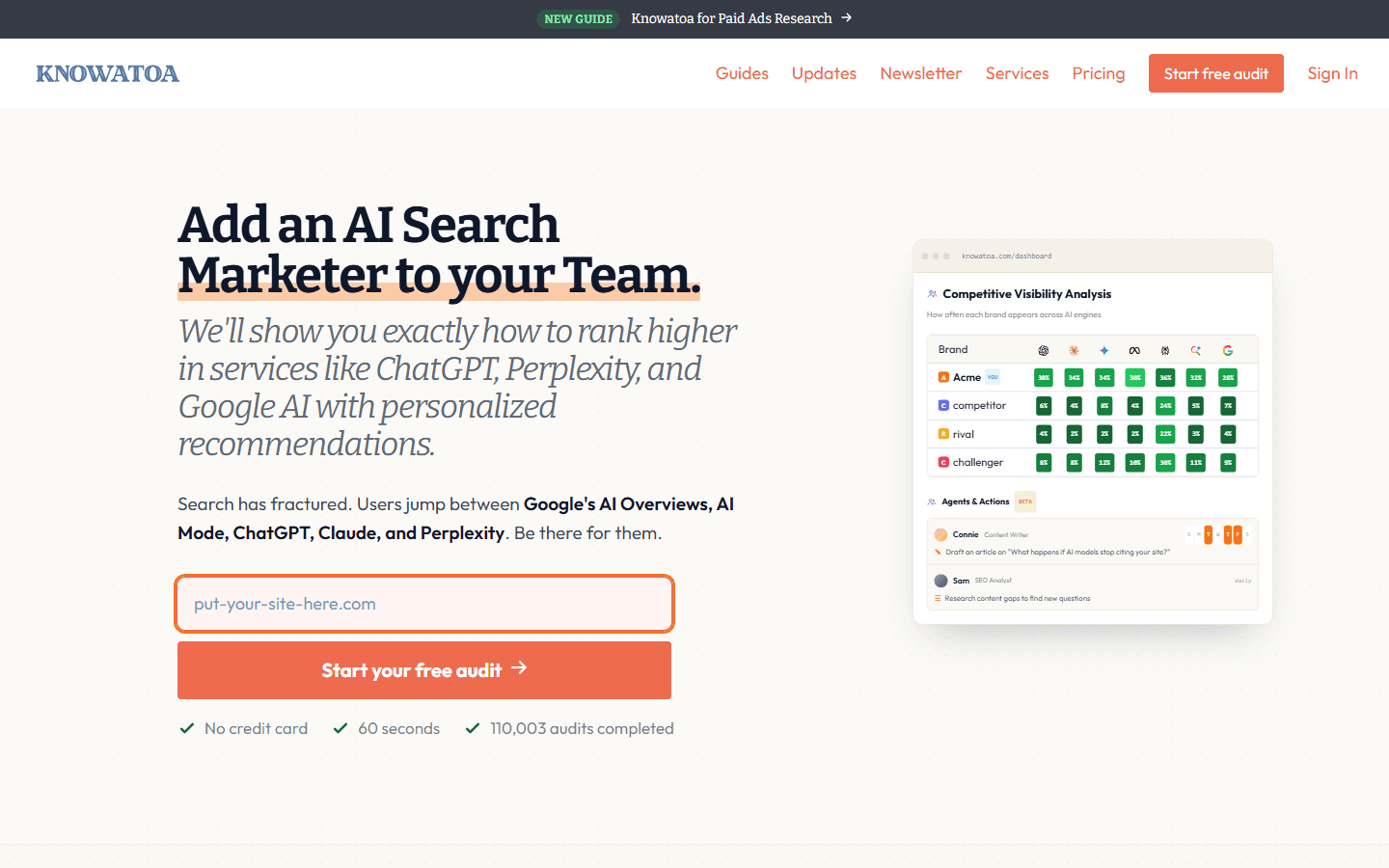
Knowatoa feels less interested in winning the biggest-dashboard contest. Its workflow connects visibility to the questions a brand misses, the domains AI systems trust, competitor coverage, content gaps, and scheduled agents that can research or draft work. That is closer to how I want a small team to operate: monitor, inspect, assign, publish, and measure again.
The $59 Starter plan currently includes 30 questions, daily refreshes, 2,790 processed answers per month, competitor tracking, source opportunities, sentiment, and CSV export. Starter focuses on ChatGPT, Google AI Overviews, and AI Mode. The $199 Growth plan expands to 100 questions and the broader set that includes Claude, Gemini, Meta AI, and Perplexity, plus reporting integrations such as API, MCP, and Looker Studio.
That tier boundary matters. Thirty well-chosen questions can support one focused brand. It is not enough for a ten-client agency unless each client enjoys being represented by three questions, which would be comedy rather than measurement. Growth is the real multi-model plan, so I would use $199 in any serious seven-engine cost comparison.
I like Knowatoa for a team that already publishes but lacks prioritization. I would start with questions lifted from sales calls, customer interviews, comparison-page searches, and objections. Then I would judge the platform on whether its source and gap recommendations survive a human review. Automated drafts are convenient; choosing the wrong problem faster is not.
Best for
Lean marketing teams that need daily evidence, source gaps, and a clear path from monitoring to content work.
Not for
Large agencies expecting broad model coverage on the $59 headline plan.
Setup cost
Moderate. Thirty focused questions are manageable, but good aliases, competitors, and editorial ownership still matter.
First proof
Take one competitor-only question through source research, a published improvement, and a measured follow-up run.
Best established program
4. AthenaHQ makes sense after AI visibility has an owner.
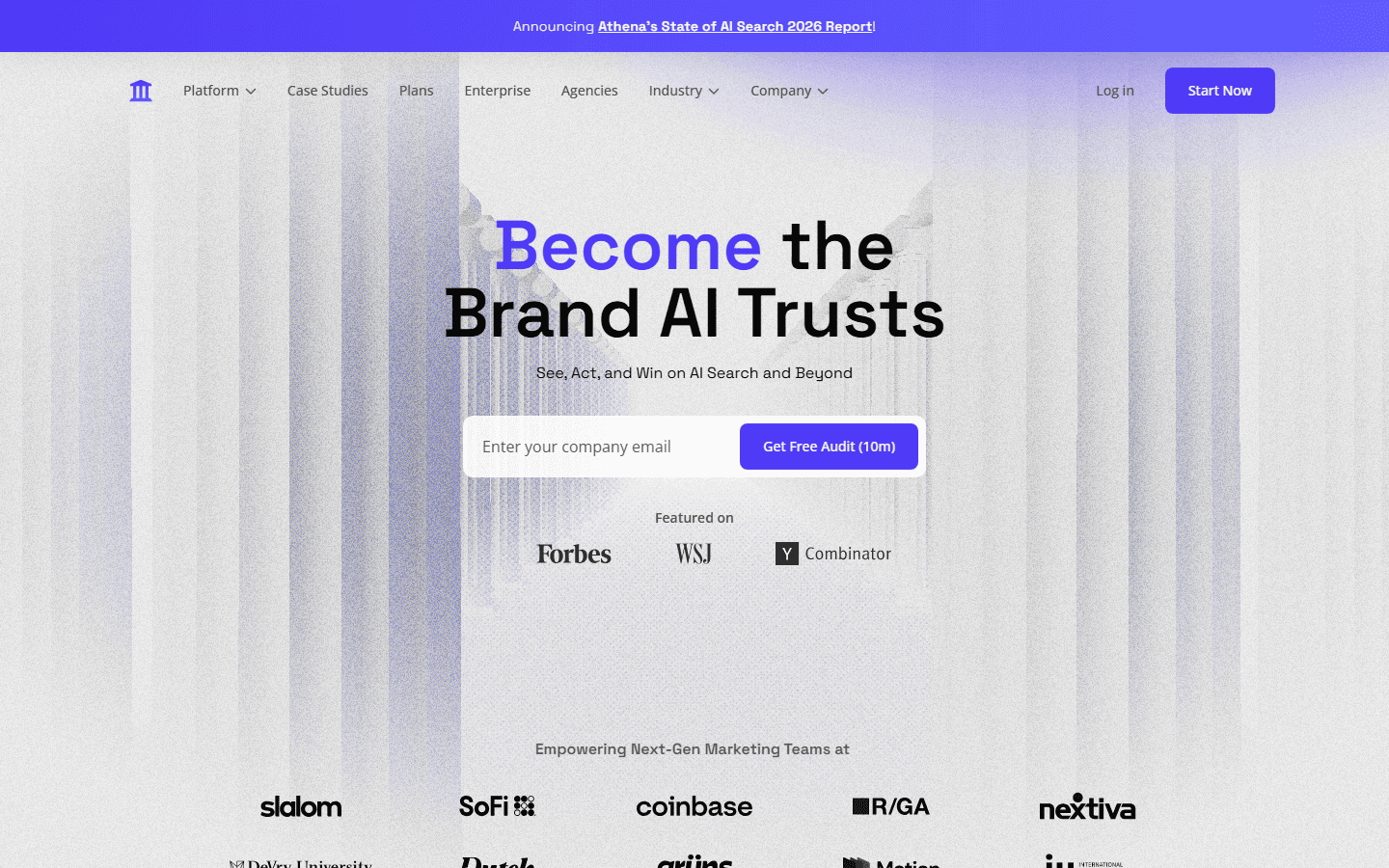
AthenaHQ is where I would look when the organization has moved past curiosity. Its self-serve pricing starts at $295 per month, with 3,600 credits and visibility across up to eight major LLMs. The product combines cross-model monitoring with competitor analysis, citation and authority intelligence, on-page and off-page analysis, and content optimization.
The value is organizational depth, not a cheaper way to run prompts. A brand with several markets, a PR team, an SEO team, executive reporting, and a meaningful non-brand discovery problem can use a broader operating layer. A solo consultant tracking 20 questions probably cannot justify spending $3,540 per year before tax just to learn that a competitor appears more often.
I would also inspect how credits map to models, markets, repeated runs, and analysis jobs. A generous-looking credit number can disappear quickly when one business question becomes several model-market combinations. The trial or demo should include the exact workload, not a polished sample account.
AthenaHQ is a fit when a named GEO lead can turn citation intelligence into coordinated content, technical, PR, and partnership work. Without that owner, its sophistication becomes shelfware with better typography.
Best for
Mid-market and enterprise brands with cross-functional AI-search work and an established reporting audience.
Not for
A first experiment, a tiny prompt set, or a team without time to act on the findings.
Setup cost
High. Credit planning, taxonomy, competitors, markets, permissions, reporting, and ownership all need definition.
First proof
Connect one citation or authority gap to a coordinated PR, content, and technical change with a measurable follow-up.
Best content workflow
5. Writesonic is compelling when the same team must fix what it finds.
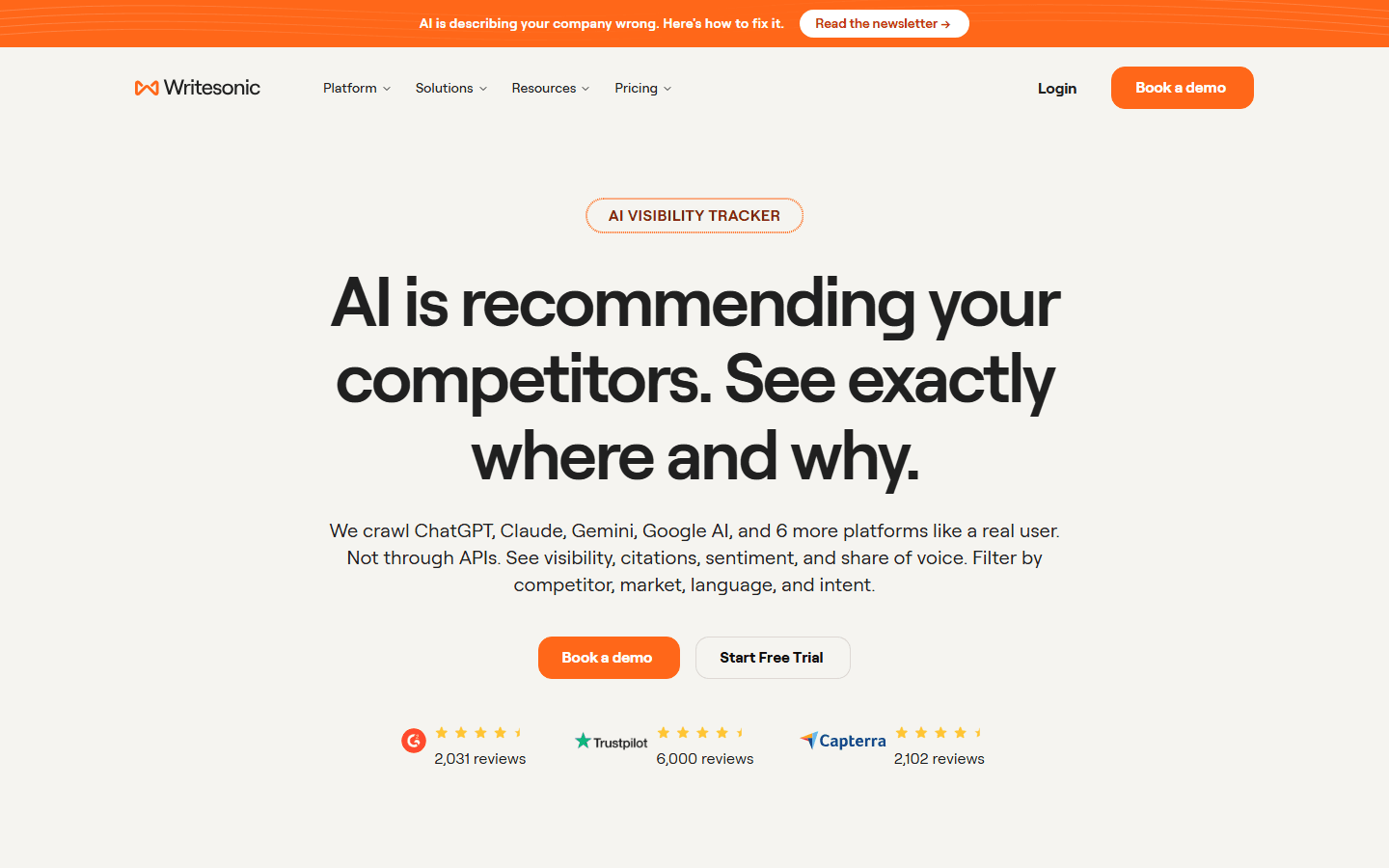
Writesonic does not sell a narrow tracker. It combines AI visibility with SEO audits, content planning, article production, optimization, and an action layer. The public Basic plan is $249 monthly or $199 per month with annual billing. It includes 100 tracked AI prompts, two users, two projects, 100 articles, and 40 site audits covering 1,200 pages.
On Basic, the current documentation lists ChatGPT, Gemini, and Google AI Overviews. The higher Growth plan adds deeper analysis and more volume, while Enterprise expands model coverage to services such as Perplexity, Claude, Copilot, Grok, Google AI Mode, and others. That packaging is important: the broadest visibility story is not the entry-level buying experience.
I would choose Writesonic when the content operation already wants the rest of the platform. A missed prompt can become a brief, an article update, a technical task, or outreach work without exporting three spreadsheets. That shorter loop is valuable if editorial review remains strong.
I would not choose it as the best online LLM rank tracker for a team that already has a mature content stack. Paying for generation, audits, and workflow features twice is not integration; it is duplicate rent. In that case, a dedicated monitor with clean exports is easier to defend.
Best for
Content-led teams that want monitoring, SEO auditing, briefs, production, and optimization in one subscription.
Not for
Teams that already like their content stack and only need independent visibility evidence.
Setup cost
Moderate. Project setup is straightforward, but the broader suite needs editorial rules and clear approval ownership.
First proof
Turn one missed topic into a reviewed update and show whether citations or competitor share improve on the next cycle.
Best transparent allowance
6. ZipTie makes the monthly check math easy to understand.
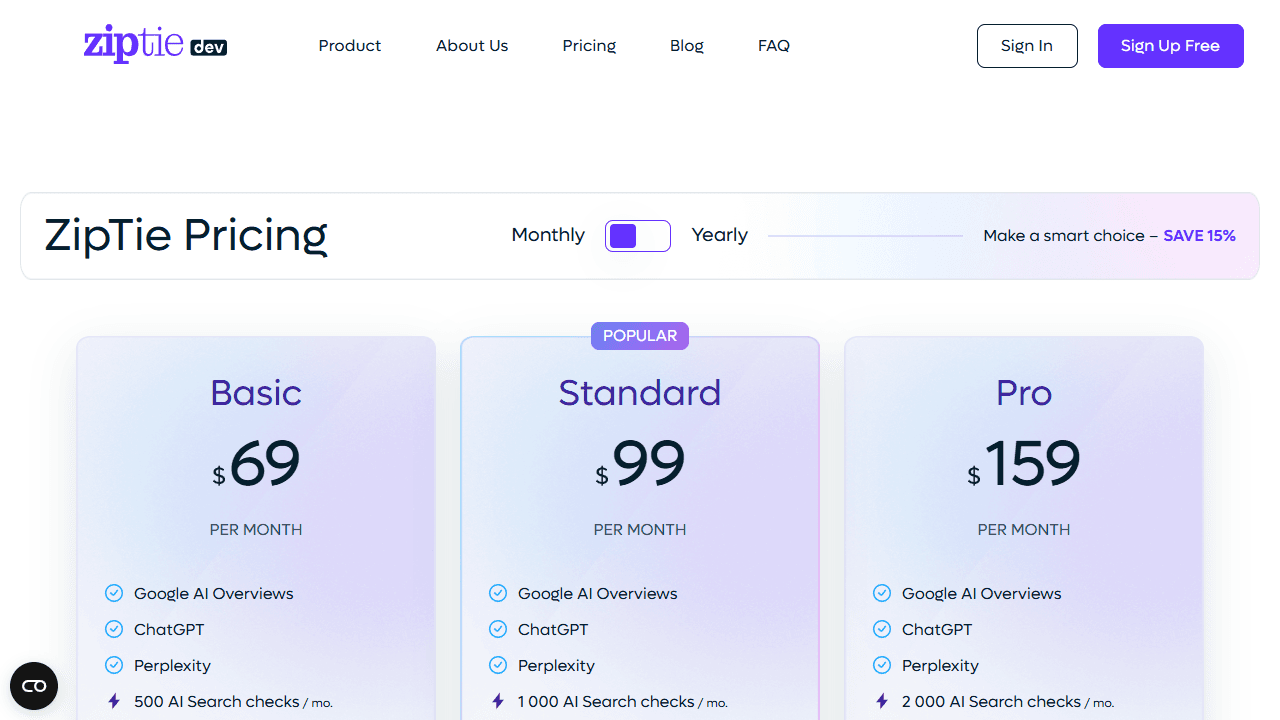
ZipTie publishes the cleanest allowance in this list. The $69 Basic plan includes 500 monthly AI search checks across Google AI Overviews, ChatGPT, and Perplexity, plus five data summaries and ten content optimizations. Standard is $99 for 1,000 checks, while Pro is $159 for 2,000.
That makes a pilot easy to model. Twenty-five questions checked weekly use roughly 100 checks before additional markets or repetitions. The Basic plan leaves room to test a second cluster without pretending the allowance is infinite. A 14-day trial includes 75 checks, which is enough to inspect the workflow and compare a small result set manually.
ZipTie also tries to close the gap between monitoring and page-level action. I care about that because a visibility tool that cannot suggest a credible next investigation becomes an alerting service for anxiety. I would still review every recommendation against the actual answer, cited sources, product truth, and search demand.
The tradeoff is model breadth. ChatGPT, Perplexity, and Google AI Overviews cover important discovery surfaces, but they do not represent every buyer or market. If Claude, Gemini, Copilot, or another model is commercially important, I would confirm current add-ons or choose broader coverage instead of forcing one platform to fit.
Best for
Small SEO teams that want predictable check limits, three important surfaces, and built-in optimization tasks.
Not for
A multi-model mandate that explicitly requires Claude, Gemini, Copilot, Grok, or DeepSeek in one base plan.
Setup cost
Low to moderate. The allowance is clear; good question selection and manual result validation remain the real work.
First proof
Use the trial to verify 15 buyer questions manually and judge whether the recommended changes are specific enough to ship.
Best budget credit test
7. Geneo is the easiest place to test whether credits suit the workflow.
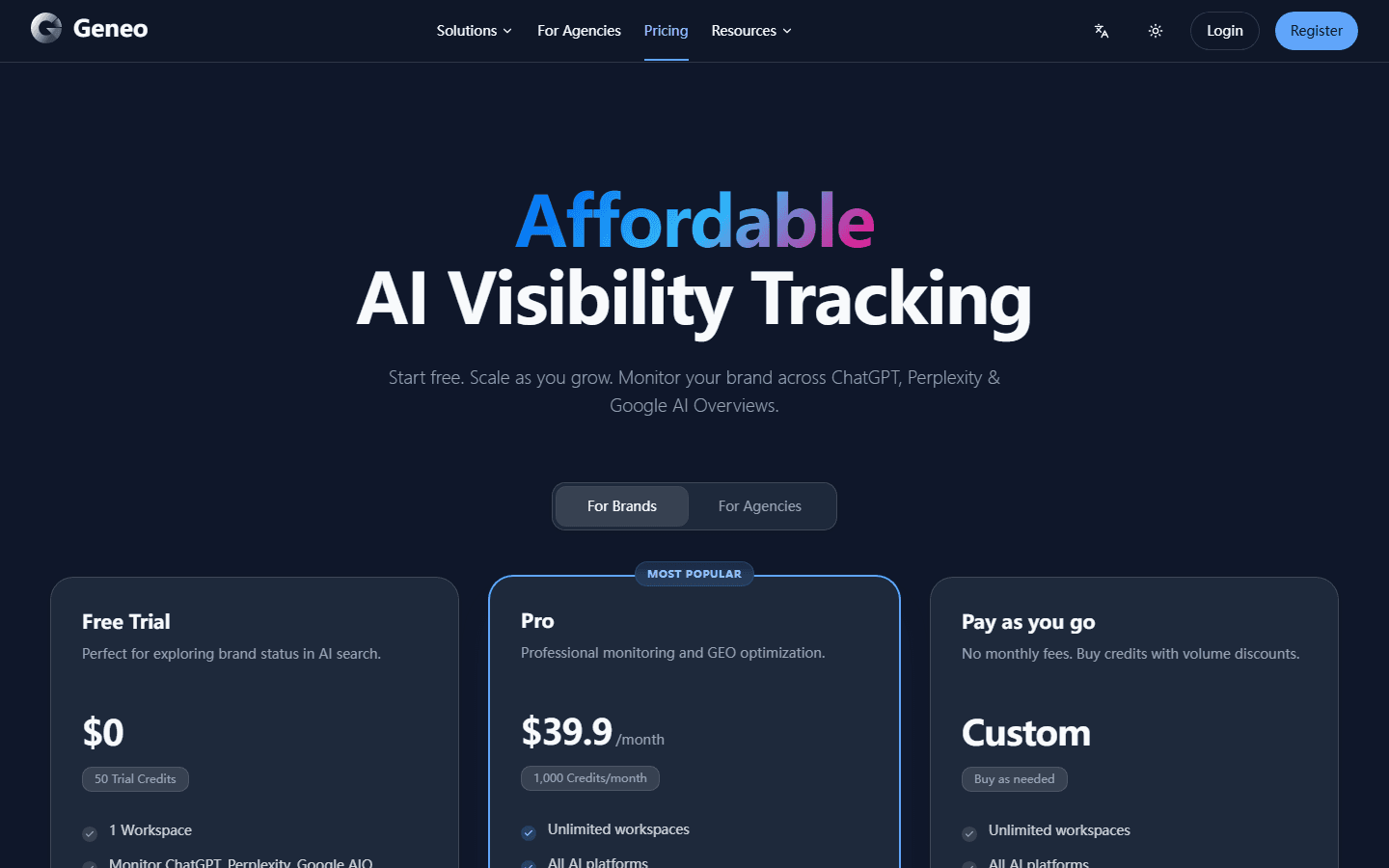
Geneo is the lowest-priced full subscription in this shortlist. Its Pro plan is $39.90 per month with 1,000 credits, competitor analysis, historical data, prompt monitoring, and GEO optimization. The free trial includes 50 credits, while pay-as-you-go packs start at $50 for 1,000 credits and remain valid for 12 months.
The official pricing page frames coverage around ChatGPT, Perplexity, and Google AI Overviews. That is enough for a budget baseline, especially when the goal is weekly monitoring rather than a global executive dashboard. Unlimited workspaces on Pro are attractive, although I would confirm the practical credit economics before spreading a small balance across many clients.
Credit systems are useful when work arrives in bursts. A consultant can run a deeper audit before a planning cycle, pause, and return later without maintaining a larger recurring allowance. They are less comfortable when leadership expects a fixed number of brands, prompts, models, and daily runs every month.
I would use the free credits to compare Geneo's outputs with a manual sheet, then estimate the cost of one complete reporting cycle. If the platform saves collection and analysis time without hiding the raw answers, it is a rational first paid step. If the credit meter makes the team avoid useful checks, the cheap plan is not actually cheap.
Best for
Small teams, consultants, and agencies that want an affordable recurring plan plus optional pay-as-you-go capacity.
Not for
Programs that require the broadest model set, enterprise governance, or a simple prompt-per-month contract.
Setup cost
Low for a pilot, moderate for agency use because workspaces and credits still need allocation rules.
First proof
Complete one full monthly report with free or Pro credits and calculate the actual cost per useful decision.
Buyer fit
Buy a tracker when collection is the bottleneck, not when strategy is missing.
The strongest fit is a team with a real category, a known competitor set, recurring buyer questions, regular publishing or PR work, and someone accountable for interpreting the evidence. The software saves repeated collection, preserves history, and makes model and market comparisons possible at a scale a spreadsheet cannot sustain.
Agencies also have a legitimate reason to buy, but only when the per-client allowance works. Divide prompts, checks, or credits by active clients before signing. A plan that looks generous for one brand can become useless when twelve clients share it and every report needs two markets.
The weakest fit is a very young brand with no clear positioning, no sales-question library, and no capacity to publish or earn third-party references. An LLM tracker will describe that absence with decimals. It will not manufacture authority, product clarity, or customer proof.
Good fit
A named owner, 25 or more high-value questions, recurring content or PR work, several relevant models, and monthly stakeholder reporting.
Poor fit
No category definition, no action budget, no reliable brand aliases, or a desire for one permanent rank number.
Agency test
Calculate questions × models × markets × repetitions × clients before comparing headline plan prices.
Success signal
The tool changes a prioritized page, source strategy, comparison, briefing process, or sales narrative, then helps measure the result.
Customer research
Reddit's common complaint is not missing features. It is missing trust.
Across Reddit discussions, I keep seeing five objections. Answers are not repeatable enough to deserve a precise rank. Prompt demand is largely unknown. API output may not match the consumer experience. Prices feel high compared with mature SEO suites. And many products stop at monitoring without explaining what a team should do next.
Those complaints are fair. One recent discussion about LLM visibility tools emphasized the need for manual prompt control in agency work and warned that the category is moving too quickly for a long commitment. Another thread questioned why basic tracking costs $200 to $500 per month when the resulting score can be difficult to explain. A separate discussion about seeing pages in LLMs argued that manual or automated prompt sampling is inexpensive enough to challenge the premium pricing.
I do not read that as a reason to avoid every product. I read it as a procurement checklist. Ask the vendor to show the raw answer, explain collection, define every score, demonstrate custom prompts, disclose model and market differences, export the evidence, and map one finding to a realistic action. If the demo cannot survive those questions, the dashboard will not survive a skeptical client.
I also keep a manual control group. Five to ten important prompts run outside the platform will not prove the tool perfectly accurate, because the systems are inherently variable. They will reveal whether the vendor's story is directionally plausible and whether its citations, model labels, and answer details are auditable.
- Agency discussion about prompt control, platform choice, and fast-moving tools
- Discussion about pricing, volatility, sampling cost, and explainability
- Discussion about citations, manual tracking, and the lack of stable prompt-volume data
- Discussion about combining prompt samples, crawler activity, analytics, and manual checks
Migration cost
The historical baseline is more valuable than the login.
Switching LLM trackers looks easy because prompts are just text. The expensive part is reconstructing the conditions around that text. A prompt without its market, language, model, cadence, brand rules, competitors, and metric definition is not a portable time series.
Before I cancel a platform, I export raw answers and citations, not only summary charts. I document how the vendor calculates share of voice and rank. I record every brand alias and exclusion. Then I overlap the old and new products for at least two collection cycles. The numbers will not match exactly; I need enough overlap to explain why.
For client or executive reporting, I mark the methodology change in the report instead of pretending the trend line continued untouched. A cleaner baseline is more credible than a smooth fictional one.
| Move | What to preserve | Why it matters |
|---|---|---|
| Prompt library | Prompt text, keyword cluster, buyer stage, locale, language, and cadence | History becomes difficult to compare if the new tool rewrites prompts automatically |
| Entity rules | Brand aliases, product names, domains, competitors, and excluded meanings | Loose entity matching can inflate mentions or miss product-level visibility |
| Raw evidence | Answers, citations, timestamps, model names, locations, and exports | A chart without the underlying answer is hard to audit after a model changes |
| Metric definitions | Share-of-voice formulas, rank weighting, sentiment rules, and sampling method | Two vendors can use the same label and produce materially different numbers |
| Reporting layer | Dashboards, scheduled exports, client views, API jobs, and stakeholder notes | Rebuilding the final reporting mile often costs more than moving the prompts |
My 30-day test
I make the tool earn one decision before I scale it.
- 1. Build 25 questions. I use five category-discovery questions, five use-case questions, five comparisons, five objections, and five branded evaluation prompts. Sales language beats a synthetic keyword dump.
- 2. Choose only relevant models. I do not track ten engines to make the dashboard look important. I pick the surfaces customers, analytics, and sales conversations actually indicate.
- 3. Preserve a manual control. I run a small subset outside the platform, record complete answers and citations, and compare the direction rather than demanding identical output.
- 4. Ship one change. I update one page, brief, comparison, documentation section, or source strategy. Monitoring without a controlled action cannot prove practical value.
- 5. Re-run and connect outcomes. I inspect mentions, citations, competitor share, AI referrals, assisted conversions, and sales feedback. Visibility is an input, not the final business result.
- 6. Price the real year. I include annual commitment, extra models, markets, brands, prompts, users, exports, integrations, and the labor needed to maintain the program.
If the platform produces one credible action, preserves enough evidence to defend it, and saves more collection time than it creates in review work, I keep it for another quarter. If the team mainly admires the score, I cancel and return to the smaller manual baseline.
FAQ
Questions I would settle before buying LLM rank tracking software.
What is the best LLM rank tracker in 2026?
LLMrefs is my best overall choice for an SEO team that wants broad model coverage, understandable keyword-led setup, citations, competitors, and a public $79 monthly price. Rankscale is stronger for granular engine and market control, Knowatoa is better for turning gaps into work, AthenaHQ suits established programs, Writesonic fits content operations, ZipTie offers transparent checks, and Geneo is the most approachable credit-based budget test.
Can an LLM rank tracker show a stable number-one position?
No. LLM answers change with model version, prompt wording, market, retrieval, timing, and repeated runs. Treat answer position as one directional metric alongside mention rate, citation rate, share of voice, source influence, and business outcomes.
What should the best LLM rank tracker software export?
It should export the original prompt, complete answer, cited URLs, model or surface, market, language, timestamp, brand and competitor matches, and metric definitions. A polished score without raw evidence is difficult to audit or migrate.
Is there a free online LLM rank tracker?
Several vendors offer free audits or trials, but a spreadsheet remains the cleanest free baseline. Run a stable set of buyer questions across the models that matter, record mentions and citations, and repeat on a fixed cadence. Move to paid software when manual collection, markets, clients, or reporting become the bottleneck.
How many prompts should I track?
I start with 25 to 40 prompts tied to category discovery, use cases, comparisons, objections, branded evaluation, and problem-first research. That is enough to reveal patterns without spending the first month monitoring synthetic questions nobody in sales has heard.
Do I still need Google rank tracking?
Yes. Traditional rankings, Google Search Console, analytics, conversions, AI referrals, crawler activity, and LLM visibility answer different questions. An LLM tracker should add a measurement layer, not erase the search and revenue data you already trust.
Primary sources