SwitchMyTool

The first AI visibility dashboards made me feel productive for about six minutes. Then I asked the annoying question: which page shaped this answer, and what am I supposed to do on Monday morning? A brand score could not tell me.
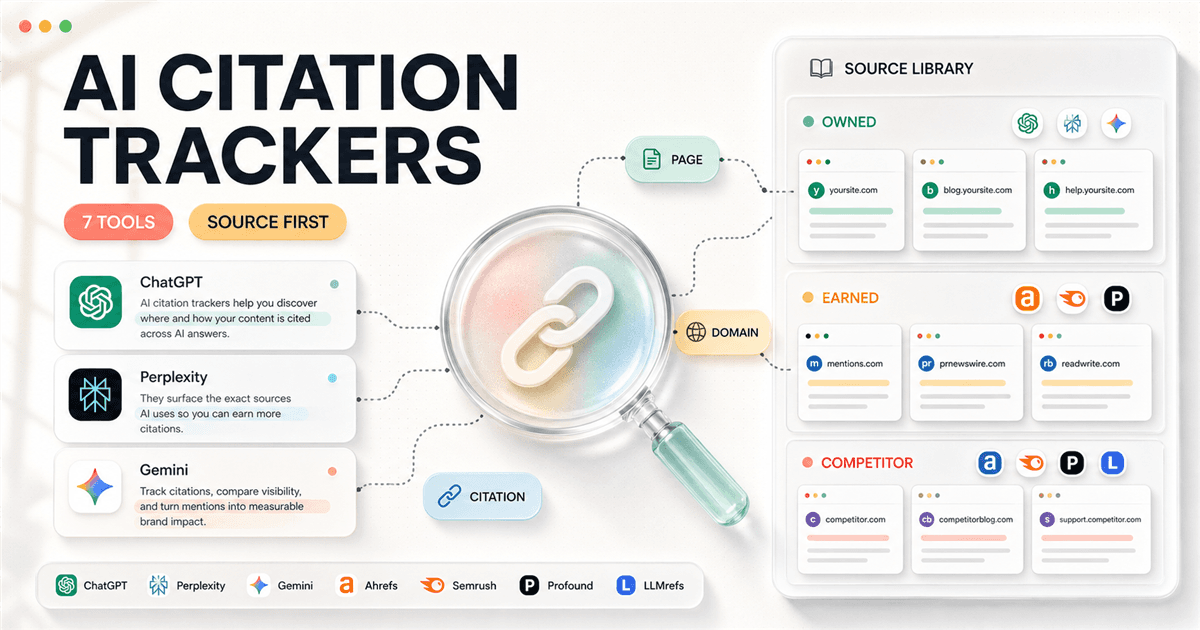
That is why I judge an AI citation tracker differently from a generic mention monitor. I want the exact cited URL, the complete answer, the source domain, the model and market, the competitor source beside it, and enough history to see whether a page or publisher keeps returning.
I compared seven products with distinct reasons to buy. The best AI citation tracker is not automatically the platform with the largest index or the prettiest share-of-voice line. It is the one that turns a noisy answer sample into a page to improve, a publisher to approach, or a claim to correct.
My verdict
Profound is my best dedicated citation tracker; LLMrefs is the more sensible buy for most lean SEO teams.
Profound wins the citation-specific job because it treats sources as a working system. I can separate owned, competitor, earned-media, social, institutional, and custom sources; compare citation share; inspect top pages and domains; watch selected URLs; and turn recurring publishers into outreach targets. That is a much better operating model than admiring one blended visibility score.
The catch is price and coverage. Profound Starter is $99 per month when billed yearly, tracks 50 prompts, and covers ChatGPT only. Growth costs $399 per month when billed yearly, adds three answer engines, 100 tracked prompts, daily collection, and up to 9,000 monthly responses. I would not buy Growth until a team already has a citation workflow and an owner who can act on it.
LLMrefs is my practical value pick at $79 per month. It includes 500 tracked prompts across its supported major engines, citation and competitor analysis, and a keyword-led setup an SEO team can learn quickly. Ahrefs Brand Radar is the strongest discovery layer, Semrush is the easiest extension of an existing SEO stack, Rankscale gives technical teams more control, Writesonic connects monitoring to content work, and Geneo is the lowest-risk budget pilot.
Best dedicated tracker
Profound for source categories, citation share, watched pages, publisher discovery, and action workflows.
Best value
LLMrefs for broad engine coverage, 500 prompts, citations, competitors, and a public $79 monthly price.
Best discovery index
Ahrefs Brand Radar for researching cited pages and domains across a very large search-backed prompt set.
Best budget pilot
Geneo for free trial credits, a $39.90 Pro plan, history, competitors, and pay-as-you-go capacity.
Measurement first
A citation, a mention, and a visit are three different events.
A mention is useful because it shows that the assistant recognizes the brand in the category. It does not prove that the assistant retrieved the brand's website. A citation is narrower: a specific page or domain appears as supporting evidence. That source may belong to the brand, a competitor, a publisher, Reddit, YouTube, a directory, or an institution.
Traffic is narrower again. Someone must click from the answer and arrive with enough referral information for analytics to recognize the source. Many cited answers produce no click, and some AI-assisted journeys lose clean attribution before the visit or conversion. I never combine citation share and referral traffic into one heroic number.
The useful question is not whether citations replace rankings. They do not. Citation data adds a source-intelligence layer. It tells me which documents answer engines trust for a controlled prompt set, whether my own pages participate, and which independent sources repeatedly shape the category story.
| Signal | What happened | How I use it |
|---|---|---|
| Brand mention | The answer names the brand but may not link to it. | Useful for narrative and category presence, not proof that the model used your page. |
| Owned citation | The answer links to a page on a domain you control. | Shows which product pages, documentation, studies, or articles are being reused. |
| Earned citation | The answer cites an independent publisher, community, directory, or institution. | Reveals where PR, partnerships, reviews, and community participation can matter. |
| Competitor citation | The answer uses a competitor page as evidence for the category question. | Exposes formats and claims your own source library may be missing. |
| Referral visit | A person clicks from an AI product and reaches the site. | Connects visibility to analytics, but never captures every citation or assisted visit. |
| Business outcome | A citation or visit contributes to a qualified lead, sale, signup, or support deflection. | Prevents citation share from becoming a new vanity metric. |
Side-by-side
Seven tools, seven different ways to pay for a controlled sample.
Prices below reflect public first-party pages available when I reviewed this category. Annual billing, extra domains, users, engines, markets, prompts, or credits can change the real total. I would model one complete reporting cycle before comparing headline prices.
I also separate a discovery index from custom tracking. A large pre-collected database is excellent for finding prompts and sources you did not know to monitor. A smaller custom prompt set is better for measuring a deliberate intervention. The strongest workflow often needs both, but not every team needs to buy both on day one.
| Tool | Public entry price | Citation evidence | Best for | Main caution |
|---|---|---|---|---|
| Profound | $99/mo annually | Every cited source, source categories, citation share, watched pages, outreach intelligence | Mature AEO teams that need source-level decisions | Starter tracks ChatGPT only; useful multi-engine work starts higher |
| LLMrefs | $79/mo | 500 tracked prompts, major AI engines, citations, competitors, keyword-led setup | SEO teams seeking the best value-to-coverage balance | Weekly updates are not suited to daily issue monitoring |
| Ahrefs Brand Radar | From $199/mo | Large search-backed prompt index, top cited pages and domains, custom prompt checks | Teams that need broad discovery plus existing Ahrefs data | All-platform access costs $699 monthly |
| Semrush AI Visibility | $99/mo per domain annually | 25 daily custom prompts, cited pages, citations, competitor and prompt research | Existing Semrush teams that want AI and SEO in one workflow | Base limit is tight for several products or markets |
| Rankscale | From EUR20/mo | 17+ engines, URL and domain patterns, citation share, regions, flexible schedules | Technical teams and agencies that want granular control | Credit economics need workload planning |
| Writesonic | $249/mo monthly | 100 prompts on Basic plus citations, audits, content, and optimization workflows | Content teams that want to act inside the same platform | Expensive when tracking is the only required feature |
| Geneo | $39.90/mo | 1,000 credits, citations, competitors, history, and pay-as-you-go options | Small teams testing whether automated monitoring saves time | Narrower platform and governance depth than enterprise products |
1. Best dedicated citation intelligence
Profound is the one I would choose when the source map matters more than the score.
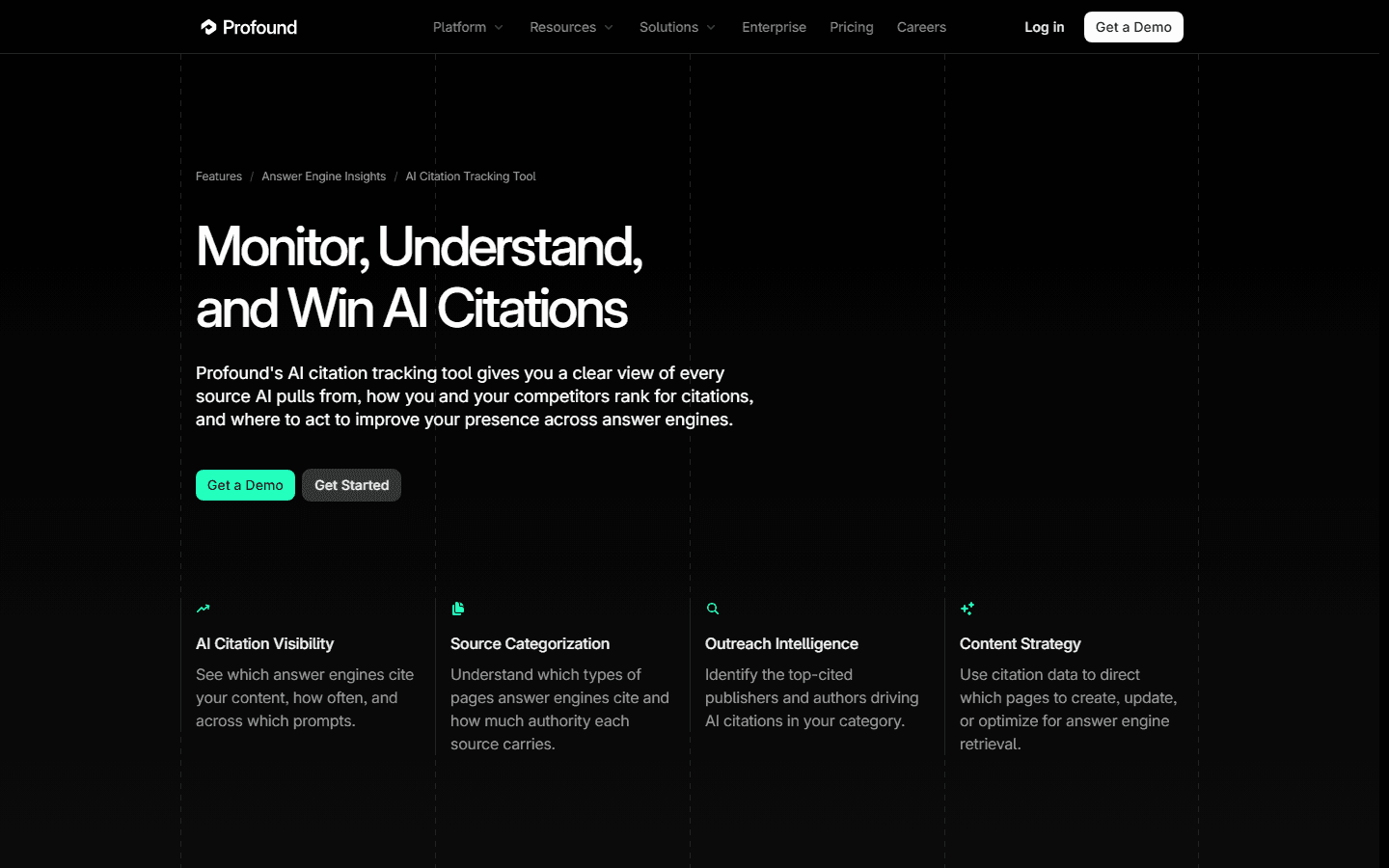
Profound's citation view answers the question I care about most: what supplied the answer? It records cited sources across tracked prompts, compares citation share against competitors, ranks top domains and pages, and lets a team filter by platform, topic, prompt, or source category. Watched Pages add a useful controlled layer for important URLs after a content change.
The category system is the real differentiator. Owned, Competitor, Earned Media, PR Wire, Social, and Institution are not cosmetic labels. They change the response. A missing owned citation suggests a page or retrieval problem. A dominant competitor source suggests a content-format gap. A recurring publisher creates a PR or partnership target. A strong institutional source may indicate that original data or documentation matters more than another opinion post.
Profound also says it collects daily from consumer answer-engine experiences rather than relying only on APIs. That distinction matters because buyers often complain that automated API output does not resemble what they see in the product. It still remains a controlled sample, but the method is closer to the surface a customer uses.
I would buy Profound for an established AEO program, not for curiosity. Starter's $99 annual-billing price looks approachable, but ChatGPT-only coverage and 50 prompts limit comparative work. Growth at $399 annually billed is the realistic multi-engine tier. The product earns that jump only when source intelligence already feeds content, digital PR, reporting, and executive decisions.
Best for
Brands, agencies, and AEO teams with a named owner, recurring analysis, and content or PR capacity.
Not for
A solo operator who only wants to check whether ChatGPT mentioned the brand this week.
Migration cost
Moderate to high because source categories, watched pages, prompt tags, and historical citation share all need mapping.
First test
Classify the top 50 sources for one commercial topic and turn three recurring gaps into named actions.
2. Best value for an SEO team
LLMrefs gives me enough evidence without forcing an enterprise program around it.
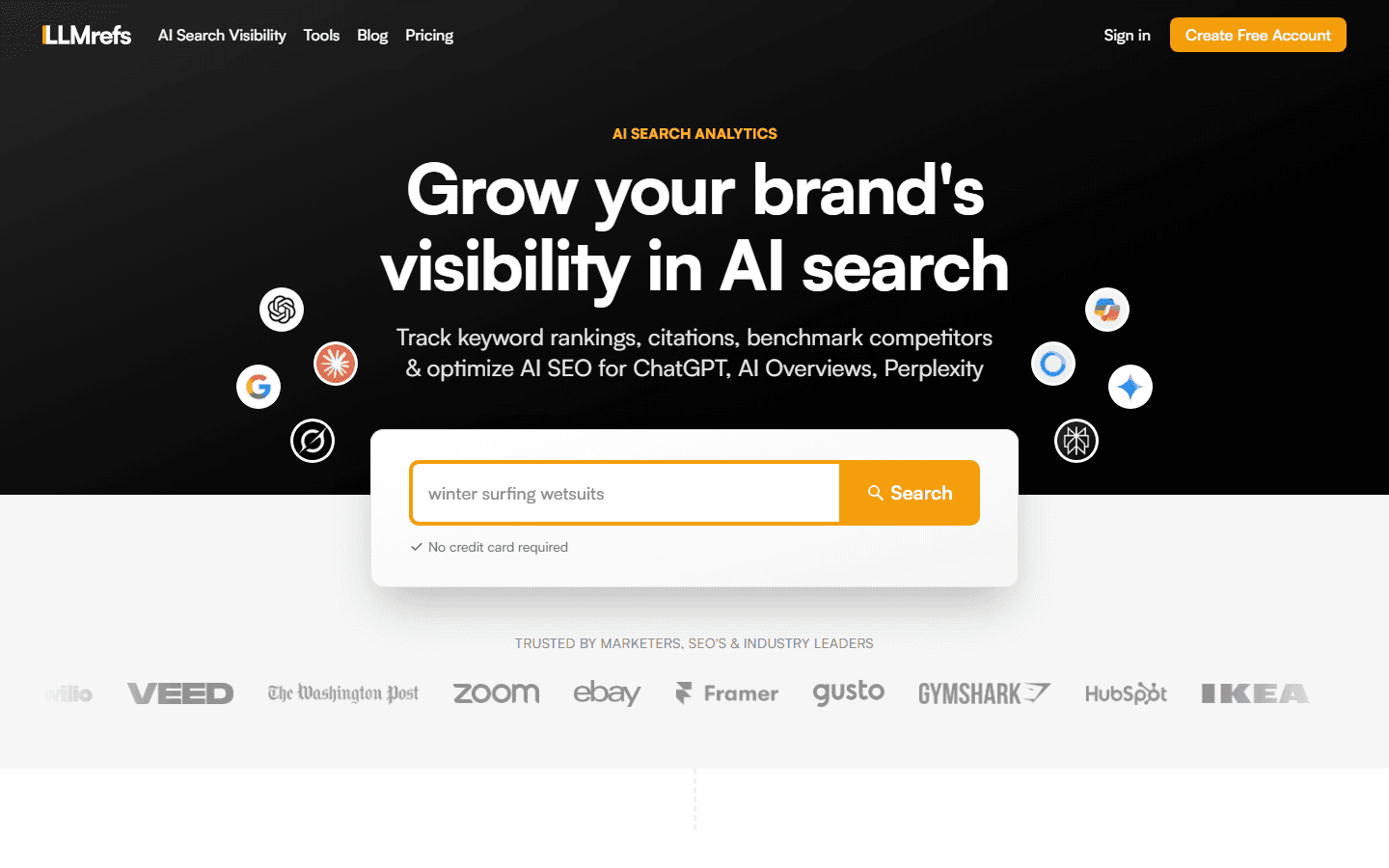
LLMrefs feels closest to the way a practical SEO team already works. I begin with a keyword or topic, expand into relevant AI questions, track supported answer engines, inspect citations and competitors, and decide which source or page deserves work. That learning curve is easier than adopting a large AEO operating system before the team has a reliable prompt library.
The $79 monthly plan includes 500 tracked prompts and supported major engines rather than charging a separate fee for every surface. That is enough for one meaningful brand program or a carefully rationed agency pilot. I would split the allowance across discovery, comparisons, objections, use cases, and high-intent category questions instead of importing hundreds of near-duplicate keywords.
The tradeoff is cadence. LLMrefs says tracked keywords update at least weekly, which is fine for content planning and monthly reporting but weak for a product recall, reputation flare-up, or fast-moving launch. I also want to confirm export detail and historical access during a live trial, because raw answer portability matters more to me than a polished trend line.
For most teams asking for the best AI citation tracker without an enterprise budget, this is where I would start. It offers enough models, prompts, citations, and competitor context to establish whether source monitoring changes the work. If it does, the team can later justify a more specialized platform with evidence rather than enthusiasm.
Best for
SEO and content teams that want broad coverage, source evidence, and familiar setup at a transparent mid-market price.
Not for
Teams that need daily incident monitoring, complex source taxonomies, or enterprise access controls.
Migration cost
Low to moderate if the team exports prompt groups, source URLs, competitors, and historical snapshots before moving.
First test
Track 40 commercial questions for one month and identify ten repeat domains plus five owned-page gaps.
3. Best broad source discovery
Ahrefs Brand Radar is strongest before I even know which prompts deserve tracking.
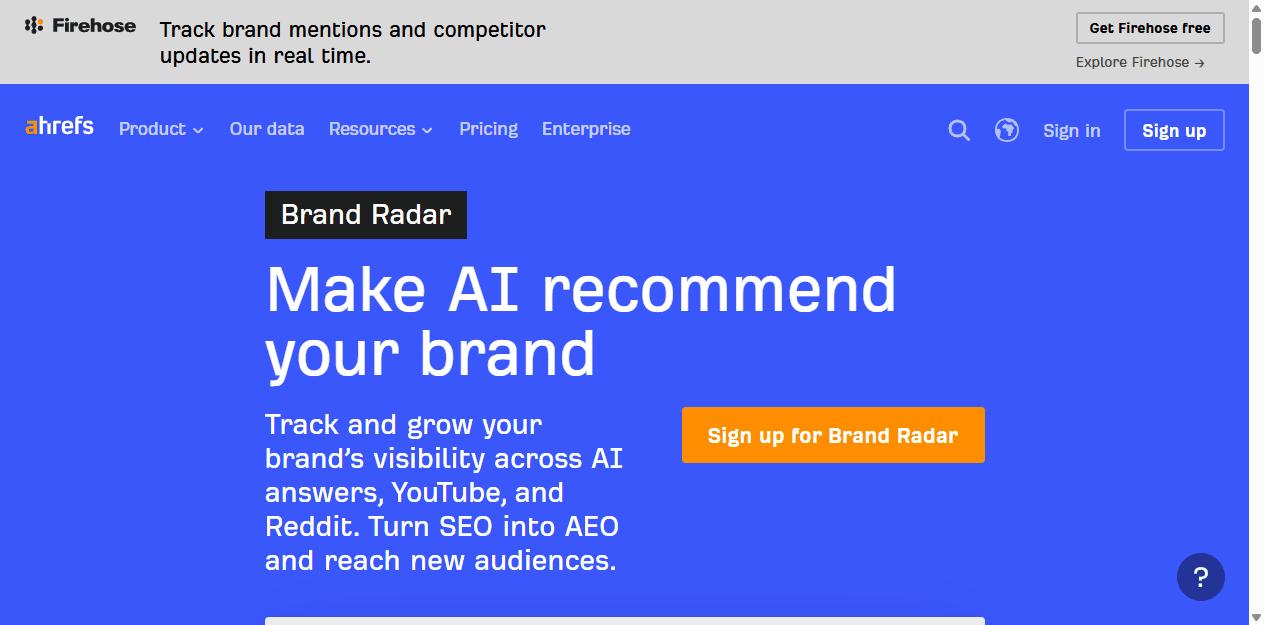
Ahrefs takes a different route. Brand Radar combines custom tracking with a large database of search-backed prompts derived from its keyword data. That helps me discover categories, questions, cited domains, and pages beyond the list my team guessed in a workshop. Broad discovery is especially useful when a brand sells into several use cases and the prompt universe is unclear.
The platform also connects AI answers with the wider source environment: organic search, Reddit, YouTube, TikTok, and web visibility. I like that because citations do not emerge from an isolated AI channel. They are often downstream of documentation, strong search pages, independent reviews, community discussion, original data, or video content that already exists on the open web.
The economics require care. A standalone single-platform index starts at $199 per month. All-platform access costs $699 per month and includes 2,500 custom prompt checks. Additional custom prompt tracking tiers start at $50 for 2,500 checks and rise with volume. Existing paid Ahrefs plans also include a small custom-prompt allowance, so current customers should inspect that before buying a standalone package.
I would use Brand Radar as a research layer: discover high-frequency source patterns, isolate a manageable prompt set, then monitor the pages and domains that matter. I would not pay $699 merely to display more logos in a report. The all-platform tier needs to reveal cross-platform source differences that change content, PR, or channel investment.
Best for
Ahrefs customers, category researchers, and larger brands that need broad prompt and source discovery.
Not for
A small team with 25 known questions and no need for a large pre-collected index.
Migration cost
Moderate because custom checks, discovery exports, source lists, and Ahrefs reporting may become intertwined.
First test
Find the top cited domains for one category, then compare them with the team's current link, PR, community, and content plan.
4. Best for an existing SEO stack
Semrush makes citation tracking easiest to defend inside a familiar reporting process.
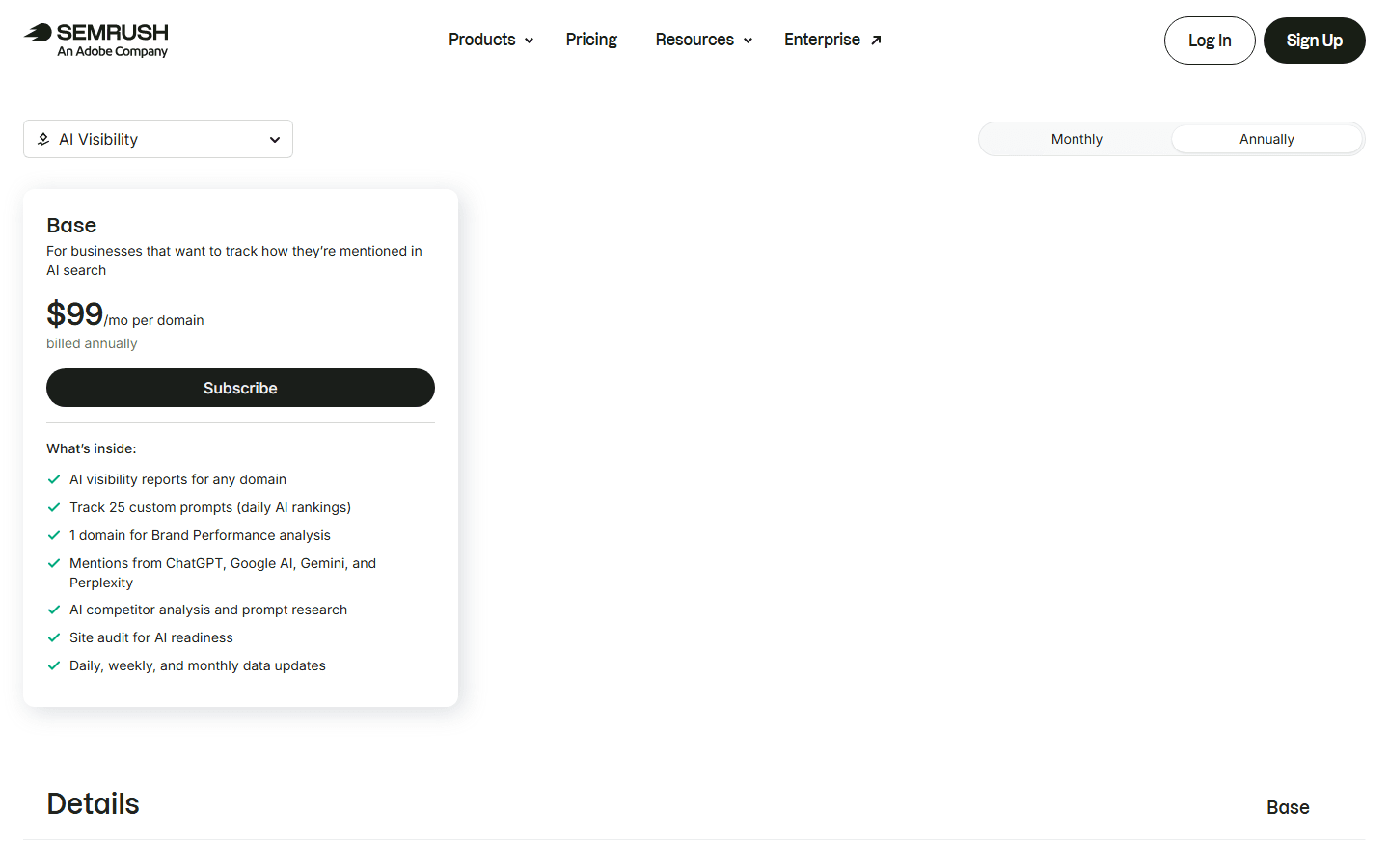
Semrush's AI Visibility Toolkit puts citations beside familiar SEO work. The overview includes mentions, cited pages, citations, AI visibility, competitor research, prompt research, and AI-readiness checks. The strategic advantage is not that every metric is unique. It is that an SEO team can connect source gaps to keyword, content, audit, analytics, and Search Console work without adding another isolated platform.
The Base plan costs $99 per month per domain when billed annually. It includes 25 custom prompts with daily tracking, one Brand Performance domain, mentions from ChatGPT, Google AI, Gemini, and Perplexity, competitor analysis, prompt research, and an AI-readiness audit. Extra domains cost another $99 monthly, while 50 additional prompts cost $60 monthly.
Twenty-five prompts is enough for a disciplined pilot and not enough for careless expansion. I would reserve them for high-intent comparisons, core use cases, objections, and category questions that appear in sales calls. Semrush's broader analysis reports can help discover the environment, while the fixed prompt set measures the change.
This is the rational choice when Semrush already owns the reporting stack. It is a weaker choice when the team buys a second large suite only for citations. In that case, LLMrefs or Geneo may answer the narrow question at a lower total cost, while Profound provides deeper citation-specific operations at a higher one.
Best for
Existing Semrush teams that need AI citations inside established SEO, audit, analytics, and reporting routines.
Not for
Several brands, products, or markets that would quickly multiply per-domain and prompt costs.
Migration cost
Low for current Semrush users; moderate when prompt tracking and reports become client-facing deliverables.
First test
Use all 25 prompts on one revenue topic and annotate every content, PR, or product change during the month.
5. Best for granular control
Rankscale is the tool I would shortlist when one blended citation number is the enemy.
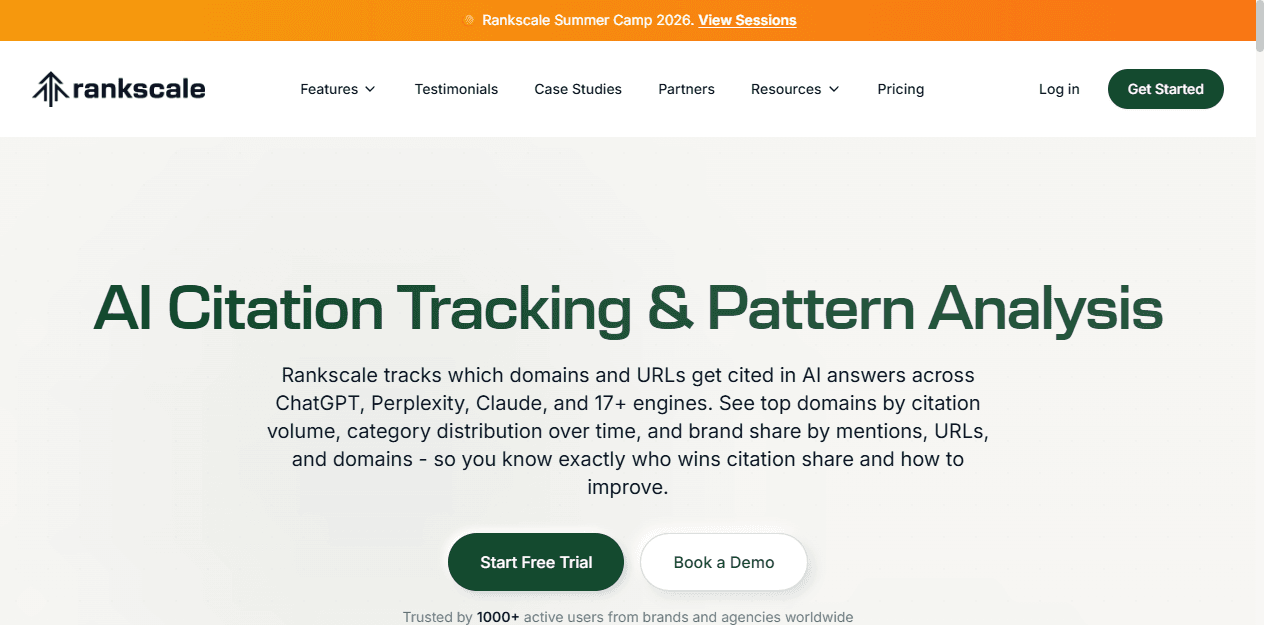
Rankscale separates domains, URLs, citation volume, category patterns, brand mentions, and citation share across more than 17 supported engines. It also exposes regions, schedules, prompt research, sentiment, technical page audits, and query-level details. That combination suits an analyst who wants to inspect the machinery instead of accepting a summary tile.
Its public plans start at EUR20 per month and use credits. Credit pricing can be fair when a team deliberately chooses engines, markets, prompts, and cadence. It can also become confusing when a buyer compares it with a simple monthly prompt allowance. I always calculate the cost of one complete run before deciding whether a credit plan is cheap.
The strongest use case is a multi-market or technical program. Citation behavior can differ by engine and region, and aggregating those surfaces may hide the exact source opportunity. Rankscale's Looker Studio connector and query-level fields are useful when reporting needs the original AI response, citation URLs, competitor ranks, and execution context rather than one unexplained chart pasted into slides.
The setup cost is discipline. Someone must define prompt groups, markets, schedules, brand rules, and reporting fields. A team that wants a one-click weekly email may find this excessive. A team debugging why one documentation domain earns citations in Germany but not the United States may finally have the controls it needs.
Best for
Technical marketers, agencies, and multi-market teams that need engines, regions, schedules, raw records, and flexible reporting.
Not for
Teams that want a fixed allowance and a very simple executive dashboard.
Migration cost
Moderate because credit assumptions, prompt groups, engine choices, and reporting fields need exact documentation.
First test
Run the same 30 prompts across two engines and two markets, then verify whether the differences lead to separate actions.
6. Best content action layer
Writesonic earns its price when the same team measures and fixes the gap.
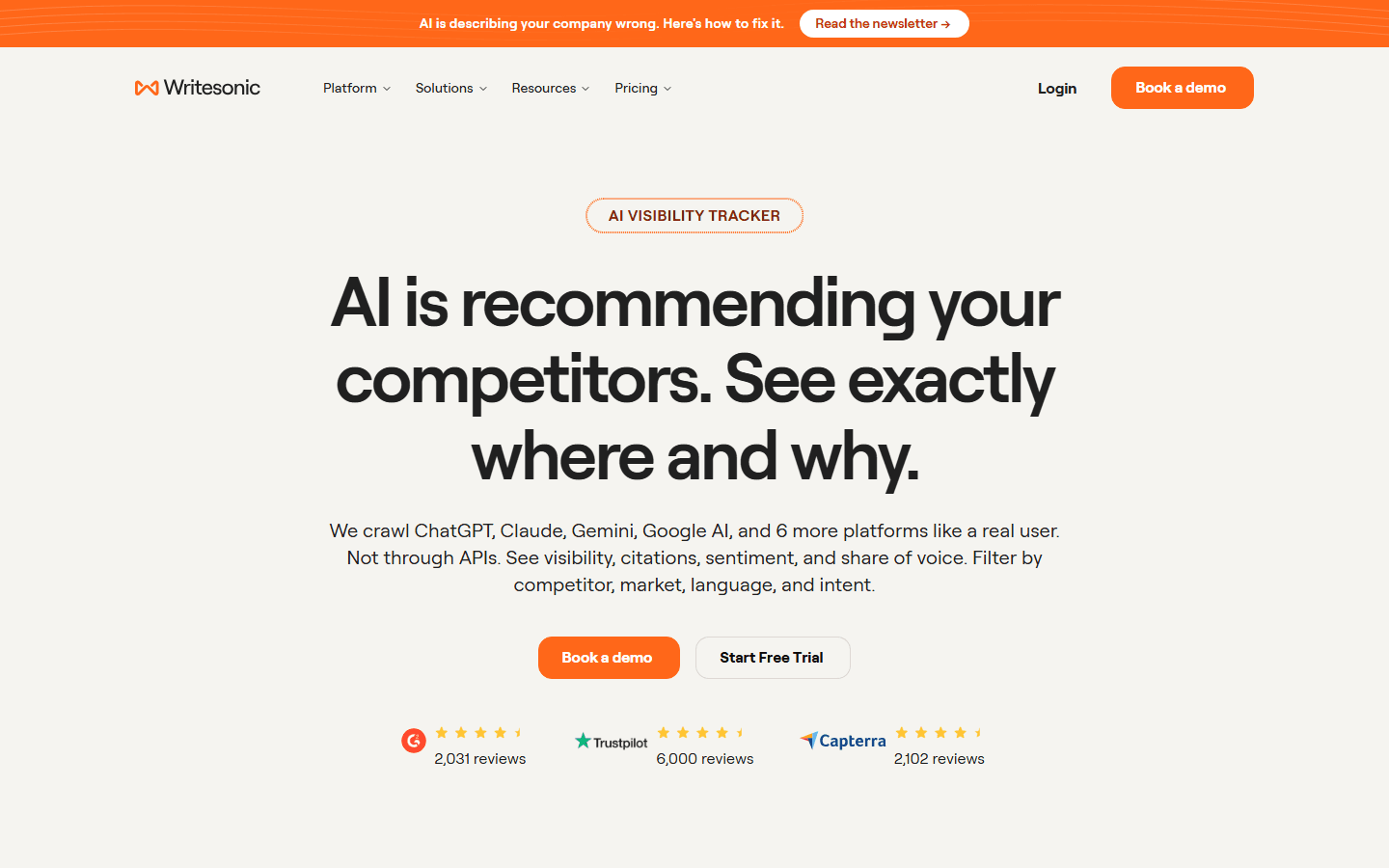
Writesonic combines AI visibility with content, audit, and optimization workflows. Its tracker covers visibility, citations, sentiment, share of voice, competitors, markets, languages, and intent. That broad action layer is useful when the content team owns the full loop from source gap to brief, draft, update, and follow-up measurement.
Basic costs $249 monthly or $199 per month on annual billing and includes 100 prompts across ChatGPT, Gemini, and Google AI Overviews alongside the wider SEO and content platform. Growth costs $499 monthly or $399 annually and raises the allowance to 200 prompts with more advanced GEO capability. Enterprise expands engine coverage further.
I would not buy Writesonic only to count citations. The entry price assumes that the team values the adjacent content and SEO workflows. If writers already use another platform and citation work belongs to a separate analyst, that bundle creates overlap. If one team owns discovery, optimization, publishing, and measurement, the workflow compression can justify the premium.
My buying test is operational: can I take a competitor-cited source, identify the missing format or claim, update one priority page, and track the same prompt group without exporting work across three systems? If the answer is yes, Writesonic is more than a tracker. If not, the bundle is an expensive place to store a line chart.
Best for
Content-led teams that want citation monitoring, audits, creation, optimization, and publishing work in one platform.
Not for
Analysts who only need source evidence or teams already committed to separate content and SEO suites.
Migration cost
High when briefs, generated content, audits, prompt history, and reporting all live inside the same workspace.
First test
Move one competitor-citation gap through research, page update, publication, and four weeks of follow-up measurement.
7. Best budget pilot
Geneo lets me test the habit before I fund the department.
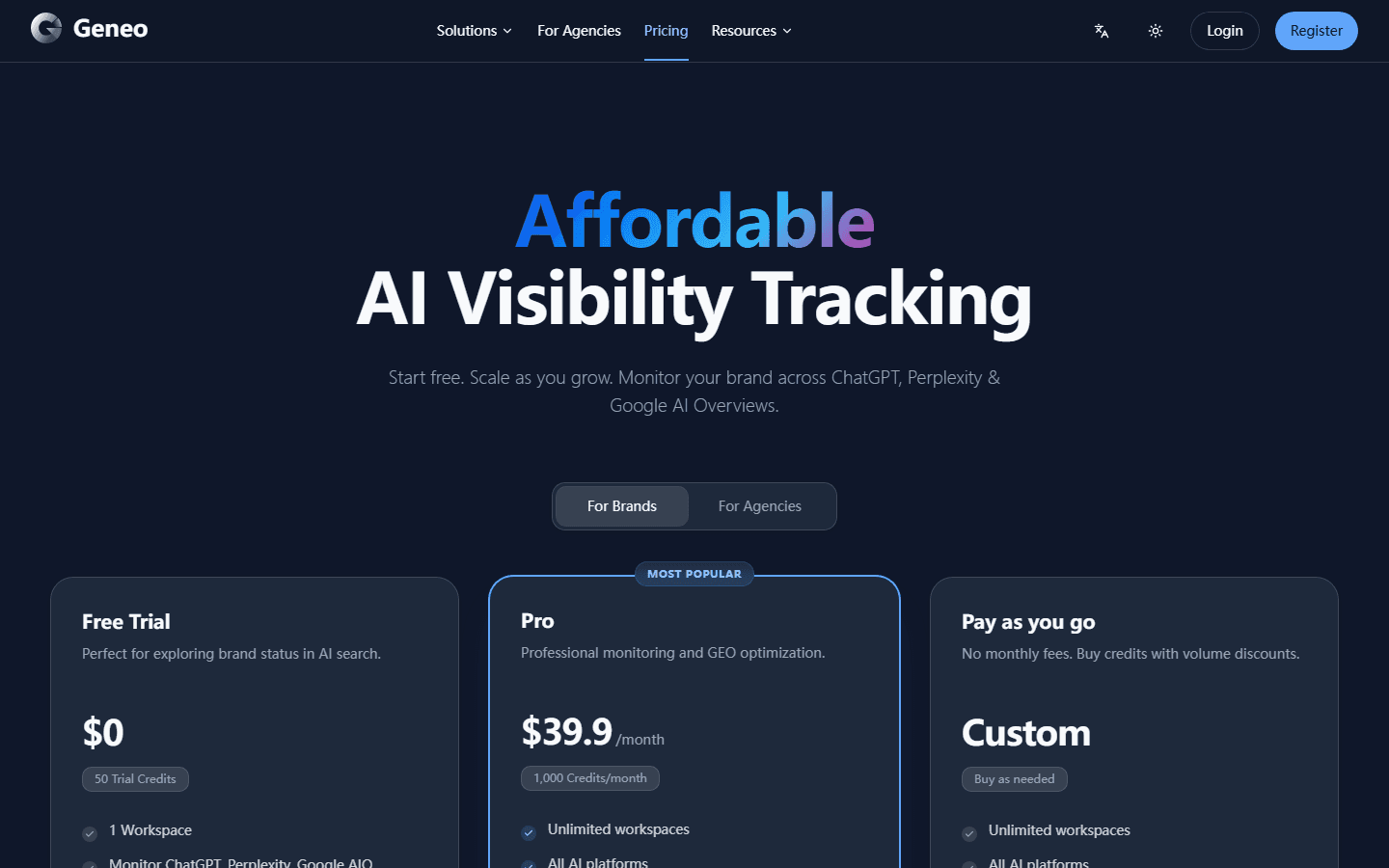
Geneo is the budget option I would use to learn whether citation monitoring changes behavior. The free trial includes 50 credits. Pro costs $39.90 per month with 1,000 credits, unlimited workspaces, competitor analysis, historical data, and monitoring across its supported AI platforms. Pay-as-you-go credits add flexibility when work arrives in audits rather than a steady daily program.
The low entry price does not remove the measurement problem. I still need a stable prompt set, raw evidence, source categories, and a comparison with analytics. What Geneo lowers is the cost of discovering whether the team will maintain that process. That is valuable because many AI visibility subscriptions fail from neglected workflows, not missing features.
Credit models demand a spreadsheet before purchase. I calculate prompts multiplied by models, markets, repetitions, brands, and reporting cycles. Then I leave room for investigation. If every unexpected finding feels too expensive to explore, the nominally cheap plan is constraining the work.
Geneo is not my choice for deep enterprise governance or the broadest source-intelligence program. It is my choice for a consultant, startup, or small marketing team that wants to replace manual copy-and-paste work, preserve history, and learn which evidence actually earns a place in monthly planning.
Best for
Startups, consultants, and small teams that need an affordable first automation layer.
Not for
Global programs requiring the broadest model set, governance, source taxonomy, or executive reporting controls.
Migration cost
Low at pilot scale, but export prompt, answer, citation, and credit-use records before leaving.
First test
Use the trial or one Pro month to complete a full report and price every useful decision per credit consumed.
Buyer fit
Buy automation when collection is the bottleneck, not when the team lacks a plan.
The strongest buyer already has recurring customer questions, a defined competitor set, content or PR capacity, and someone accountable for interpreting results. The tracker removes repetitive collection, preserves history, and exposes source patterns across more prompts and surfaces than a spreadsheet can handle.
Agencies have an additional reason to buy: repeatable evidence for client reporting. They also face the worst allowance math. Prompts multiplied by models, markets, runs, and clients can exhaust a plan surprisingly fast. I divide the real allowance by active clients before I compare any headline price.
The weakest buyer is an early brand with no category clarity, no publishing rhythm, and no one available to act on the results. A dashboard will describe the absence with impressive decimals. It will not create original data, customer proof, useful documentation, independent reviews, or earned media.
Good fit
A named owner, 25 or more high-value prompts, recurring content or PR work, and monthly reporting that needs evidence.
Poor fit
No action budget, no stable category, no source strategy, or a desire for one permanent universal citation count.
Agency fit
The plan still works after multiplying prompts by models, markets, repetitions, brands, and clients.
Success signal
A recurring source pattern changes a page, brief, documentation set, outreach target, claim, or reporting decision.
Customer research
Reddit's recurring complaint is accuracy theater.
The harshest Reddit threads call AI citation tracking snake oil. The argument is straightforward: answers vary with model version, retrieval, timing, location, account state, memory, and prompt wording, while vendors sample different questions and sometimes different product surfaces. Two tools can therefore show different results without either having access to a universal ground truth.
I also saw teams report a mismatch between monitoring dashboards and observed ChatGPT referrals. Others objected to the price, especially when a product offers a precise-looking score but cannot explain its prompt demand, collection method, or connection to revenue. Several people recommended a manual monthly baseline before paying for automation.
Those complaints are not a reason to ignore the category. They are a reason to change the standard. I do not ask whether a tool knows every answer every user saw. It cannot. I ask whether it repeats a controlled query set, separates platforms, preserves raw evidence, explains the sample, and shows a directional change after a deliberate intervention over several weeks.
The Reddit advice I trust most is to keep the action close to the evidence. Track recurring cited pages and domains, compare owned and third-party sources, update one page or pursue one publisher, then measure the same prompt group again. A citation tracker becomes useful when it shortens that loop. It becomes theater when the score is the final deliverable.
- Discussion about sampling, model variance, API output, and whether citation trends are measurable
- Discussion about conflicting tool data, manual baselines, and the difference between mentions and traffic
- Discussion about free tracking, AI referral filters, manual prompts, and paid-tool accuracy
- Discussion about starting manually and tracking repeated sources before buying software
Migration cost
The expensive asset is the baseline, not the account.
Moving prompts between tools looks easy until the first report changes. The prompt text may match while the engine surface, market, repetition count, source taxonomy, entity rules, and citation-share formula do not. A smooth-looking trend across that boundary can be completely fictional.
Before I cancel, I export complete answers and every cited URL, not only charts. I document source categories and overrides, brand aliases, competitor domains, prompt tags, market settings, collection cadence, and metric formulas. I also preserve annotations for launches, content updates, PR wins, and model changes.
I overlap the old and new tools for at least two reporting cycles. The numbers will not match exactly, and I do not force them to. I need enough evidence to explain the methodological difference, establish a new baseline, and prevent stakeholders from treating a vendor change as sudden market growth or collapse.
| Move | What to preserve | Why it matters |
|---|---|---|
| Prompt definition | Exact prompt, topic, funnel stage, persona, market, language, and cadence | Small wording or location changes can alter retrieval and citations. |
| Raw evidence | Complete answer, cited URL, title, domain, model, timestamp, and response identifier | A chart cannot be audited after the answer or model changes. |
| Source taxonomy | Owned, competitor, earned, social, institutional, PR, and custom categories | Different category rules can manufacture an apparent trend break. |
| Entity rules | Brand aliases, products, domains, competitors, exclusions, and regional names | Loose matching can miss citations or count unrelated entities. |
| Metric formulas | Citation share, visibility, position, aggregation, repeat runs, and sampling method | Two vendors can use the same metric name and report different numbers. |
| Reporting layer | Exports, dashboards, annotations, client views, integrations, and baseline dates | Rebuilding the last mile often costs more than importing prompts. |
My 30-day test
I make the tracker earn one source decision before I scale it.
- 1. Build 30 buyer questions. I use category discovery, use cases, comparisons, objections, implementation, and branded evaluation. Sales calls and support tickets beat a synthetic keyword dump.
- 2. Run a manual control. I record ten questions across the two or three surfaces customers actually use, including the full answer and every cited source.
- 3. Configure source categories. I separate owned, competitor, earned media, community, institutional, directory, and custom sources so each pattern has a different response.
- 4. Find one repeatable gap. I choose a competitor page, publisher, missing documentation format, unsupported claim, or weak owned source that appears across several answers.
- 5. Ship one intervention. I update a page, publish original evidence, improve documentation, correct a claim, or approach a recurring publisher. Monitoring without action cannot prove value.
- 6. Measure the same sample. I compare citations by platform and source category over four weeks, then check AI referrals, assisted conversions, leads, and sales feedback separately.
- 7. Price the real year. I include extra domains, prompts, engines, markets, users, exports, integrations, overages, annual commitment, and the analyst time needed to maintain the program.
If the tool produces one defensible source decision, preserves enough evidence to audit it, and saves more collection time than it creates in review work, I keep it for another quarter. If the team mainly admires the visibility score, I cancel and return to the smaller manual baseline.
FAQ
Questions I would settle before buying citation tracking software.
What is the best AI citation tracker in 2026?
Profound is my best dedicated AI citation tracker when a team needs source categorization, citation share, watched pages, earned-media targets, and a clear action layer. LLMrefs is the better value for a practical SEO team, while Ahrefs Brand Radar is stronger for broad source discovery across a very large search-backed prompt index.
What should an AI citation tracker record?
It should preserve the exact prompt, complete answer, every cited URL, page title, domain, model or surface, market, language, timestamp, brand and competitor matches, source category, and metric definitions. A citation score without the underlying evidence is difficult to trust or migrate.
Are AI citations the same as AI mentions?
No. A mention means the answer names a brand. A citation means the answer references a specific page or domain as a source. A brand can be mentioned without receiving a link, and a third-party page can shape the answer without the brand's own site being cited.
Can AI citation tracking be perfectly accurate?
No. Model versions, retrieval, prompt wording, location, timing, account state, and repeated runs can change the answer. Good tools create a controlled, repeatable sample and preserve the evidence. I use trends and source patterns, not one supposedly exact universal citation count.
Is there a free AI citation tracker?
Several vendors offer limited free audits or trial credits, but a spreadsheet is still the cleanest free baseline. Run 20 to 30 fixed buyer questions across the two or three surfaces your customers use, save citations and source categories, and repeat monthly before buying automation.
How is citation share different from AI referral traffic?
Citation share measures how often your pages or chosen source category appear in a controlled answer sample. AI referral traffic measures recorded visits that reach your analytics. A citation may produce no click, and an AI-assisted conversion may arrive without a clean referrer, so I report both separately.
Primary sources
Product details I checked for this guide.
- Profound citation tracking features
- Profound pricing and prompt limits
- LLMrefs AI search analytics and pricing
- Ahrefs Brand Radar features, indexes, and pricing
- Semrush AI Visibility pricing
- Semrush AI Visibility limits and workflow
- Rankscale citation analysis
- Rankscale plans and credits
- Writesonic plan documentation
- Geneo pricing and credits